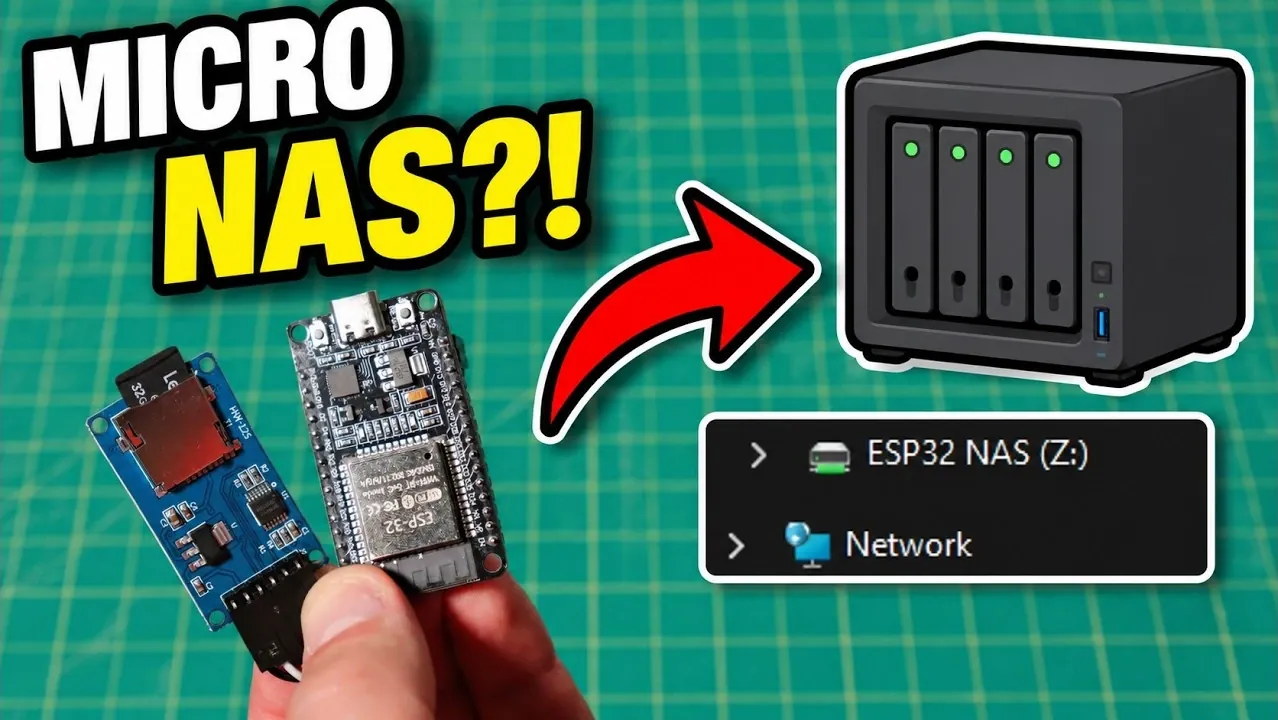
Building a micro NAS system using an ESP32 microcontroller and a micro SD card is a compact and energy-efficient way to enable basic file storage and sharing. Theory to Thing explores how this setup uses the ESP32’s built-in Wi-Fi and the WebDAV protocol to create a standalone, wireless solution for managing files. With a hardware configuration that uses the Serial Peripheral Interface (SPI) to connect the ESP32 to a micro SD card, this project supports cards up to 32GB reliably, making it accessible even for those with limited electronics experience. The result is a lightweight, portable system that operates independently of external network infrastructure.
In this explainer, you’ll gain insight into the hardware assembly process, including how the SPI interface facilitates communication between components. Discover how the WebDAV protocol enables wireless file operations like uploading and downloading directly through a web browser. Additionally, you’ll learn about the system’s practical limitations, such as slower file transfer speeds and hardware constraints, as well as its strengths in portability and low power consumption. Whether you’re interested in a DIY file-sharing solution or exploring embedded systems, this guide provides a clear breakdown of what this micro NAS can achieve.
Compact and Efficient
TL;DR Key Takeaways :
- The project uses an ESP32 microcontroller and a micro SD card to create a compact, low-power Network-Attached Storage (NAS) system for basic file storage and sharing.
- Wireless file management is enabled through the WebDAV protocol, allowing users to perform file operations via a web browser without external network infrastructure.
- The system is highly portable, with a small form factor and standalone operation, making it ideal for remote locations or temporary setups.
- Low power consumption (less than 1W during file transfers) makes it suitable for battery-powered or solar-powered applications.
- While functional, the system has limitations such as slower file transfer speeds and hardware constraints, making it less suitable for demanding tasks like streaming or handling large datasets.
Hardware Setup
The core of this project is the ESP32 microcontroller, a versatile and cost-effective device equipped with built-in Wi-Fi. Due to the ESP32’s limited onboard storage, a micro SD card serves as the primary storage medium. Theoretically, micro SD cards with capacities up to 2TB are supported, though testing has demonstrated reliable performance with cards up to 32GB.
The connection between the ESP32 and the micro SD card is established using the Serial Peripheral Interface (SPI), which requires six pins for communication. This hardware configuration is not only compact but also lightweight, making it ideal for applications where space and power are limited. The simplicity of the setup ensures that even those with basic electronics knowledge can assemble the system with ease.
Core Functionality: Wireless File Management
The system’s functionality is driven by the WebDAV protocol, a widely used standard for managing files over a network. With WebDAV, users can wirelessly perform essential file operations such as uploading, downloading, copying, moving and deleting files. The ESP32 acts as a local Wi-Fi access point, allowing direct connections from devices like smartphones, tablets and PCs without requiring external network infrastructure.
File management is conducted through a web browser, making sure compatibility with a broad range of devices and operating systems. This standalone capability is particularly advantageous in scenarios where traditional network infrastructure is unavailable, such as remote locations or temporary setups. The system’s ease of use and accessibility make it a practical solution for basic file-sharing needs.

Expand your understanding of ESP32 with additional resources from our extensive library of articles.
- $5 ESP32-S3 Super Mini Packs Wi-Fi and Bluetooth
- The $4 ESP32 S3 Super Mini Packs a 240 MHz Dual-Core Chip
- How an $8 ESP32 S3 Microcontroller Runs a 28.9M Parameter Local LLM
- 5 ESP32 Projects Worth Building in 2026: Such as an Apple HomeKit Controller
- $4 ESP32 Module Brings Wi-Fi and Bluetooth to IoT Projects
- Replacing Security Cameras with Three $10 ESP32S3 Wi-Fi Boards
- ESP32-S3 Super Mini Costs $5 and Packs Wi-Fi and Bluetooth
- ESP32-S3 Super Mini Brings 240 MHz Dual-Core Power For $4
- ESP32 S31 Devkit Hands-on: 320 MHz RISC-V Chip Adds Wi-Fi 6
- Build a DIY Open source Flipper Zero Using a ESP32-DIV
Performance: Practical but Limited
While the system is functional, its performance is inherently limited by the hardware. File transfer speeds depend on factors such as the SPI clock speed, the micro SD card’s read/write capabilities and the overhead of Wi-Fi communication. Testing has shown that increasing the SPI clock speed beyond 20 MHz yields minimal improvements, as other bottlenecks, such as Wi-Fi latency, become more prominent.
As a result, transfer speeds are slower compared to traditional NAS systems. This makes the setup more suitable for basic file storage and occasional transfers rather than demanding tasks like streaming large media files or managing extensive datasets. Users seeking high-speed performance may find this solution less suitable for their needs.
Power Efficiency: Low Consumption, High Potential
One of the most notable advantages of this micro NAS is its low power consumption. The ESP32 consumes approximately 50mA at 5V when idle and less than 1W during file transfers. This energy efficiency makes the system an excellent choice for battery-powered or solar-powered applications, where conserving power is essential.
The combination of low power usage and a compact design ensures that the device can operate in environments with limited access to electricity. This makes it a versatile solution for use in remote locations, fieldwork, or other scenarios where energy efficiency is a priority.
Portability: A Lightweight Solution
Portability is a key strength of this setup. Its small form factor and standalone operation allow it to be deployed in a variety of scenarios. The ability to create a local Wi-Fi network eliminates the need for external routers or internet connections, making it a flexible and mobile storage solution.
This portability is particularly useful for professionals working in remote locations, students needing a quick file-sharing system, or hobbyists exploring embedded systems. The lightweight design and ease of deployment make it a practical alternative to bulkier, traditional NAS systems.
Limitations: Understanding the Trade-Offs
Despite its many advantages, this project has some notable limitations. The slower file transfer speeds, while adequate for basic tasks, may not meet the expectations of users accustomed to the performance of traditional NAS systems. Additionally, the hardware constraints of the ESP32 and the SPI interface limit the potential for significant performance improvements.
These limitations make the system less suitable for demanding applications, such as streaming high-definition media or handling large volumes of data. Users should carefully consider these trade-offs when determining whether this solution aligns with their specific needs and expectations.
Exploring Practical Applications
This project demonstrates the potential of combining an ESP32 microcontroller with a micro SD card to create a simple, portable NAS solution. By using the WebDAV protocol and the ESP32’s Wi-Fi capabilities, the system provides basic file storage and sharing in a compact, energy-efficient package.
While it cannot match the speed or capacity of traditional NAS systems, its standalone operation, low power consumption, and portability make it an excellent choice for specific use cases. Whether you’re looking for a lightweight storage solution for remote locations, a hands-on project to deepen your understanding of embedded systems, or a temporary file-sharing setup, this micro NAS offers a practical and innovative approach to file management.
Media Credit: Theory to Thing
Disclosure: Some of our articles include affiliate links. If you buy something through one of these links, Geeky Gadgets may earn an affiliate commission. Learn about our Disclosure Policy.
