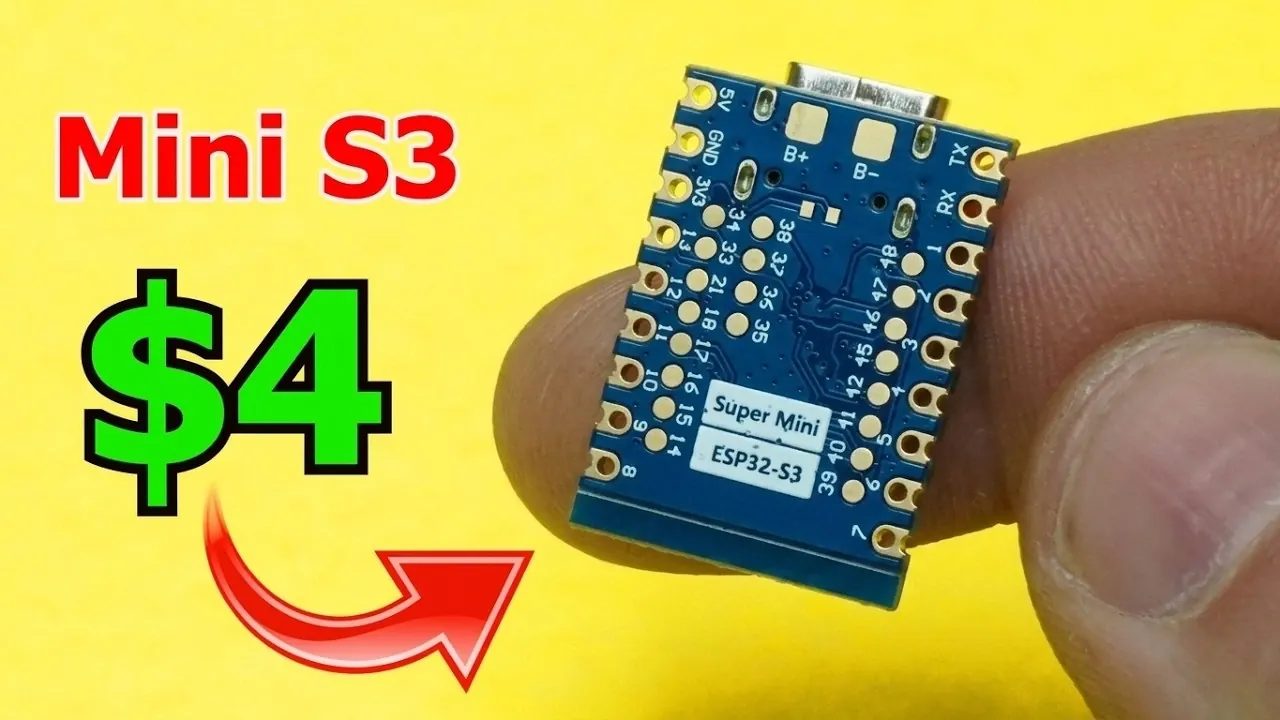
The ESP32-S3 Super Mini, highlighted by Hacktuber, is a compact yet capable development board designed for AI and IoT applications. Priced at just $4, it features a dual-core Xtensa LX7 processor running at up to 240 MHz, making it suitable for both hobbyist experiments and professional projects. With 512 KB of internal SRAM, external flash memory options up to 16 MB and PSRAM configurations reaching 8 MB, this board is equipped to handle resource-intensive tasks. Its 45 programmable GPIO pins, including 14 touch-sensitive inputs, further enhance its adaptability for integrating sensors, actuators and other components.
Explore how this board’s modular design supports custom solutions, such as adding e-paper displays for low-power output or connecting sensors for environmental monitoring. Gain insight into its standout features, including a programmable RGB LED, integrated temperature sensor and built-in lithium battery charger. This overview will also touch on practical applications like Wi-Fi-enabled clocks and IoT message boards, showcasing how the ESP32-S3 Super Mini can be tailored to meet diverse project needs.
Small Size, Big Capabilities
TL;DR Key Takeaways :
- The ESP32-S3 Super Mini is an affordable ($4) development board designed for AI and IoT applications, offering high performance and flexibility for both hobbyists and professionals.
- Powered by a dual-core Xtensa LX7 MCU running at up to 240 MHz, it includes 512 KB SRAM, external flash memory (4 MB to 16 MB), and PSRAM (2 MB to 8 MB) for handling resource-intensive tasks.
- Features include 2.4 GHz Wi-Fi, Bluetooth 5, 45 GPIO pins (14 touch-sensitive), a programmable RGB LED, an integrated temperature sensor and a lithium battery charger with USB Type-C support.
- Its modular design supports easy integration of custom components like sensors and e-paper displays, allowing applications such as weather stations, network clocks and IoT message boards.
- The compact and cost-effective design makes it ideal for prototyping and small-scale projects, catering to a wide range of AI and IoT use cases.
The ESP32-S3 Super Mini is powered by a dual-core Xtensa LX7 microcontroller unit (MCU) running at up to 240 MHz. This high-performance processor is complemented by 512 KB of internal SRAM and external flash memory options ranging from 4 MB to 16 MB, along with PSRAM capacities of 2 MB to 8 MB. These memory configurations ensure the board can handle resource-intensive applications with ease.
Connectivity is a standout feature of this board. It supports 2.4 GHz Wi-Fi and Bluetooth 5, allowing seamless communication with devices and networks. Additionally, the board includes 45 programmable GPIO pins, 14 of which are touch-sensitive inputs, allowing for integration with a wide range of sensors, actuators and other components. Other notable features include:
- Programmable RGB LED: Provides visual feedback for various applications.
- Integrated temperature sensor: Enables environmental monitoring and data collection.
- Lithium battery charger: Features a USB Type-C connector for efficient power management.
These features make the ESP32-S3 Super Mini a versatile tool for prototyping and deployment, offering a balance of power and convenience in a compact form factor.
How It Compares: ESP32-S3 vs ESP32-C3
When compared to the ESP32-C3, the ESP32-S3 Super Mini offers several enhancements that make it a more capable option for diverse applications. It provides a higher number of GPIO pins, additional touch-sensitive inputs and built-in support for lithium battery charging. The inclusion of a programmable RGB LED and an integrated temperature sensor further expands its functionality, making it suitable for more complex projects.
The ESP32-S3 Super Mini also supports larger memory configurations, which can be critical for applications requiring extensive data processing or storage. These improvements position it as a more flexible and powerful alternative to its sibling, catering to a broader range of use cases.
Check out more relevant guides from our extensive collection on ESP32-S3 that you might find useful.
- $5 ESP32-S3 Super Mini Packs Wi-Fi and Bluetooth
- $4 ESP32-S3 Super Mini Packs a 0.96-Inch IPS TFT Screen
- ESP32-S3 Automation System Packs 16 Relays for Smart Homes
- ESP32 S31 Devkit Hands-on: 320 MHz RISC-V Chip Adds Wi-Fi 6
- $4 ESP32 Module Brings Wi-Fi and Bluetooth to IoT Projects
- $5 ESP32 S3 Board Packs a 240 MHz Dual-Core Chip
- ESP32 Lineup Compared: S3 Handles AI While C6 Tackles Matter
- Build an ESP32 Live Weather Station with a DHT22 Sensor
- 10 Weekend IoT Projects to Build with ESP8266 and ESP32
- Build a DIY Open source Flipper Zero Using a ESP32-DIV
Modular Design: Build Custom Solutions
The ESP32-S3 Super Mini is designed with modularity in mind, allowing users to easily integrate custom components and sensors. Its pin headers simplify the process of connecting external modules, allowing rapid prototyping and testing. For instance, you can attach sensors like the AHT20 or BM280 to measure temperature, humidity, pressure and altitude.
The board also supports the addition of e-paper displays, which provide low-power, high-visibility output. This feature is particularly useful for applications such as:
- Weather stations: Display real-time environmental data with minimal power consumption.
- Network-connected clocks: Synchronize and display time using an e-paper or LED screen.
- Interactive message boards: Provide real-time updates with partial refresh capabilities.
This modular approach ensures that the ESP32-S3 Super Mini can be tailored to meet the specific requirements of your project, whether it’s a simple DIY endeavor or a sophisticated IoT solution.
Applications: Unlocking New Possibilities
The capabilities of the ESP32-S3 Super Mini open the door to a wide range of innovative applications. Its combination of processing power, connectivity and modularity makes it suitable for both simple and complex projects. Here are a few examples to inspire your next creation:
- Wi-Fi-enabled clock: Synchronize time from a network and display it on an e-paper or LED screen for a sleek, modern timekeeping solution.
- Wi-Fi network scanner: Monitor available networks and display metrics such as signal strength or channel usage.
- System information display: Show critical data like IP address, uptime, or battery status in real-time.
- IoT message board: Use an e-paper display to provide updates, notifications, or alerts with minimal power consumption.
These examples highlight the board’s versatility, making it an ideal choice for developers looking to explore new possibilities in AI and IoT.
Compact Design: Perfect for Prototyping
The small form factor of the ESP32-S3 Super Mini makes it an excellent choice for prototyping and small-scale projects. Despite its compact size, it offers a comprehensive set of features that cater to a variety of applications. Whether you’re working on a smart home device, a wearable gadget, or an industrial IoT solution, this board provides the tools you need to turn your ideas into reality.
Its affordability further enhances its appeal, allowing developers to experiment and iterate without significant financial investment. This combination of cost-effectiveness and functionality ensures that the ESP32-S3 Super Mini remains a go-to option for both beginners and experienced developers.
Media Credit: Hacktuber
Disclosure: Some of our articles include affiliate links. If you buy something through one of these links, Geeky Gadgets may earn an affiliate commission. Learn about our Disclosure Policy.
