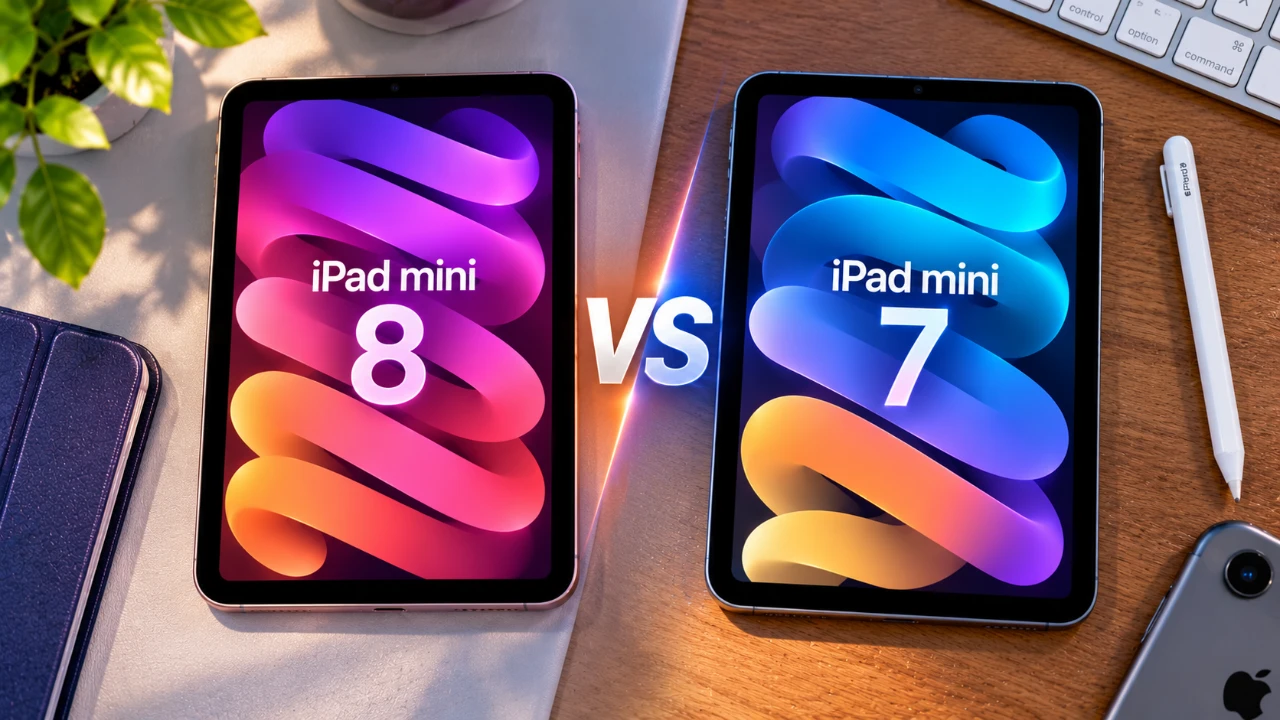
The iPad Mini 8 introduces a range of updates, including an advanced OLED display, improved performance and enhanced connectivity options. However, its higher price and the absence of ProMotion technology may leave some users questioning whether it’s worth upgrading from the iPad Mini 7. Deciding between the two models ultimately depends on your priorities, whether they lie in display quality, processing power, or connectivity features. The video below from Matt Talks Tech gives us more details on the two tablets and how they compare.

Design and Display: A Visual Leap with Some Trade-Offs
The most notable upgrade in the iPad Mini 8 is its OLED display, which delivers deeper blacks, higher contrast ratios and HDR support for a more vibrant and immersive viewing experience. With a peak brightness of 1,200 nits for HDR content and 600 nits for standard use, the display is well-suited for both indoor and outdoor environments. The screen size has also increased slightly to 8.5 inches, while maintaining the same sharp 326 PPI resolution as the Mini 7.
In terms of portability, the Mini 8 is thinner and lighter than its predecessor, measuring just 5.44 mm thick and weighing 255 grams. This makes it an excellent choice for users who prioritize mobility. However, the absence of ProMotion technology, which limits the refresh rate to 60 Hz, may be a drawback for those accustomed to smoother scrolling and animations on devices with higher refresh rates.
Performance and Hardware: Power Meets Efficiency
The iPad Mini 8 is powered by the A20 Pro chip, which offers a significant performance boost over the Mini 7. This chip features a 6-core CPU, a 16-core neural engine and advanced AI capabilities, making it ideal for multitasking, gaming and creative applications. Storage options range from 128 GB to 512 GB, with the highest-tier model unlocking the full potential of the 6-core CPU for maximum performance.
Despite a slightly smaller battery capacity (18.9 Wh compared to the Mini 7’s 19.3 Wh), Apple claims the Mini 8 still delivers up to 10 hours of Wi-Fi usage. The device supports fast charging, allowing you to reach 50% battery in just 30 minutes with a 35W USB-C adapter. However, this adapter is sold separately, adding to the overall cost.
Connectivity: Faster, Smarter and More Versatile
The iPad Mini 8 introduces the N1 wireless chip, which supports Wi-Fi 7, Bluetooth 6 and Thread. These advancements ensure faster and more reliable connectivity across modern networks and smart home devices. Cellular models are equipped with the C2 modem, offering 5G capabilities with up to 50% faster data speeds compared to the Mini 7.
Another notable improvement is the upgraded USB-C port, which now supports USB 3 data transfer speeds of up to 10 Gbps. This port also enables external 4K display support at 60 Hz, making the Mini 8 a versatile tool for both professional and personal use.
Camera and Audio: Designed for Modern Communication
The front-facing 12 MP camera has been repositioned to the landscape edge, making video calls more natural and convenient when the device is used horizontally. This adjustment is particularly beneficial for virtual meetings, online classes, or video conferencing.
The Mini 8 also features an acoustic display, which integrates speakers directly into the screen. This design delivers a more immersive audio experience without adding bulk, complementing the device’s slim and lightweight profile.
Pricing: A Premium Experience at a Premium Cost
The iPad Mini 8 starts at $699 for the 128 GB Wi-Fi model, with the 256 GB and 512 GB versions priced at $799 and $999, respectively. Cellular models come at a higher cost, starting at $849 for the base storage option and reaching $1,149 for the top-tier version. For users seeking reduced glare, a nano-texture glass option is available for an additional $100 on the 256 GB and 512 GB models.
Key Considerations: is the Upgrade Worth It?
The iPad Mini 8’s OLED display is its most compelling feature, offering a noticeable improvement in visual quality. However, the absence of ProMotion technology and the higher price point may deter some users.
- Choose the iPad Mini 8 if you value innovative display technology, faster connectivity and improved processing power for multitasking and creative tasks.
- Stick with the iPad Mini 7 if you prioritize smoother performance with ProMotion or are looking for a more budget-friendly option.
Ultimately, the decision comes down to your specific needs and whether the new features justify the added cost. By carefully evaluating the upgrades against your priorities, you can determine which model aligns best with your expectations and usage requirements.
Explore further guides and articles from our vast library that you may find relevant to your interests in iPad Mini.
- Apple iPad Mini 8 Just Fully Leaked: Here is Everything Changing
- iPad Mini 8: Major Changes Coming to Apple’s Next Compact Tablet
- Apple’s OLED iPad Mini Is Finally Happening: Here Is Everything We Know
- Apple Appears to Have Accidentally Leaked the iPad Mini 8
- iPad Mini 8 Leaks: Massive Upgrades, But Will You Pay $799 for It?
- Leaked OLED iPad Mini Details Surface, but Does It Finally Deserve the ‘Pro’ Name?
Source & Image Credit: Matt Talks Tech
Disclosure: Some of our articles include affiliate links. If you buy something through one of these links, Geeky Gadgets may earn an affiliate commission. Learn about our Disclosure Policy.
