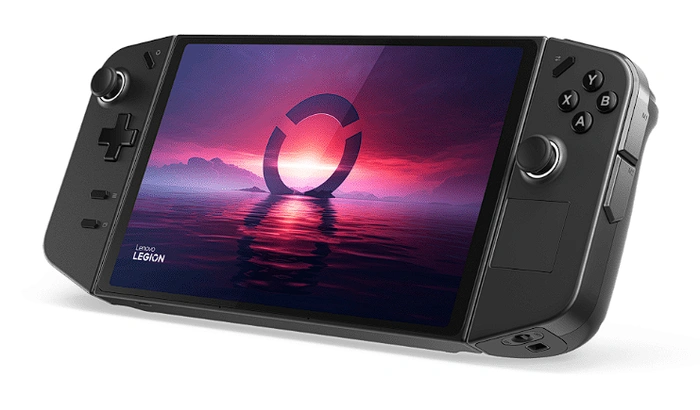
Lenovo has recently launched its latest innovation, the Lenovo Legion Go. This Windows 11 handheld gaming device boasting the ability to play first-person shooter games effectively, offering a unique gaming experience that is both portable and powerful. One of the standout features of the Lenovo Legion Go is its detachable set of controllers. This design element, reminiscent of the Nintendo Switch, offers a different mechanism for removal, providing flexibility for gamers. The controllers can be used separately or attached to the device, which also features a built-in kickstand for added convenience.
The Legion Go sports a large 8.8-inch display, ensuring a visually immersive gaming experience. The device also incorporates HALL sensors for the sticks, which use magnets to determine the stick’s position and apparently significantly reduces the likelihood of stick drift. Adding to its list of unique features, the Lenovo Legion Go also includes a touchpad.
- The new Lenovo Legion Go brings Windows PC gaming power to a handheld mobile form factor, powered by AMD Ryzen Z1 Series processors that bring games to life on its 8.8-inch Lenovo PureSight Gaming Display.
- For gamers who want to take their Lenovo Legion Go portable gaming experience to the next level, the new Lenovo Legion Glasses leverage micro-OLED technology to provide a large screen viewing experience that fits in the pocket.
Lenovo Legion Go vs ROG Ally vs Steam Deck
The 10-point touch screen enables natural and intuitive control, be it scrolling, tapping, or swiping. The Legion Go features up to 16GB LPDDR5X (7500Mhz) RAM with power management flexibility that delivers optimal gaming performance and faster loading times depending on the scenario, as well as an up to 1TB PCIe Gen4 SSD and micro-SD slot supporting up to 2TB of extra storage. If you are interested in upgrading your Steam Deck RAM will be pleased to know that you can increase it to 32GB although the upgrade procedure does require a few skills.

Featuring up to an AMD Ryzen Z1 Extreme processor with AMD RNDA Graphics and smart power management technology, the Lenovo Legion Go runs Windows 11 and delivers a potent combo of console-rivalling graphics performance that bring games to life on its massive 8.8-inch QHD+ 16:10 Lenovo PureSight gaming display, giving gamers more immersive screen real estate.
Capable of up to 500nits brightness and sporting a 97% DCI-P3 color gamut, the display is also adjustable to playstyle and situation, supporting resolutions from 1600p to 800p as well as 144Hz and 60Hz refresh rates.

ROG Ally hands on
The ROG Ally is a true Windows 11 gaming machine, featuring AMD’s brand-new Ryzen Z1 Series processors, the ROG Ally is an incredibly powerful RDNA 3 graphics powered handheld gaming machine.

Other articles you may find of interest on the subject of
- ROG Ally BIOS update released by ASUS
- How to upgrade an ASUS ROG Ally SSD
- ROG Ally teardown overview and quick look video
- ASUS ROG Ally gameplay tested
- ASUS ROG Ally dock mode transforms handheld into desktop PC
- Playing Bethesda’s Starfield on the Steam Deck – Early Access
- Syntech Steam Deck docking station $40
- How to upgrade a Steam Deck SSD for more storage
- Steam Deck transparent case shows inner workings

Valve Steam Deck
The Valve Steam Deck is a groundbreaking device that promises to revolutionize the concept of handheld gaming. With its powerful specifications, multiple control options, and unparalleled versatility, it offers a genuinely compelling alternative to both traditional gaming PCs and handheld consoles.

Specifications
At the heart of the Steam Deck is a custom AMD APU that combines a quad-core Zen 2 CPU with AMD RDNA 2 architecture for the GPU. The device comes in three storage options: 64GB eMMC, 256GB NVMe SSD, and 512GB NVMe SSD, catering to various needs and budgets. It boasts a 7-inch LCD screen with a resolution of 1280 x 800 pixels, providing a 16:10 aspect ratio.
- Processor: Custom AMD APU, Zen 2 4c/8t, 2.4-3.5GHz
- Graphics: AMD RDNA 2, 1-1.6GHz, 8 Compute Units
- RAM: 16GB LPDDR5
- Storage: 64GB eMMC / 256GB NVMe SSD / 512GB NVMe SSD
- Display: 7-inch LCD, 1280 x 800 pixels, 16:10 aspect ratio
- Battery: 40 watt-hour
- Connectivity: USB-C with DisplayPort 1.4, Bluetooth 5.0, 3.5mm headphone jack, microSD slot
- Operating System: SteamOS 3.0 (Based on Linux)
Gameplay and Controls
The Steam Deck is equipped with a plethora of control options, providing a comprehensive gaming experience. Alongside the traditional D-pad and thumbsticks, Valve has incorporated trackpads to offer precise control, particularly in games that typically require a mouse. Additionally, the device includes a 6-axis gyro for motion controls. The ergonomic design aims to provide comfort during extended gaming sessions.
One of the standout features of the Steam Deck is its versatility. It runs on SteamOS 3.0, a custom AMD Linux-based operating system, but users have the freedom to install third-party software and operating systems. This makes the device not just a gaming console but also a portable PC. Moreover, it features a USB-C port with DisplayPort 1.4 support, allowing you to connect the device to a docking station or external display for a more traditional PC gaming setup.
The Steam Deck entered a market that had long been dominated by consoles like the Nintendo Switch. However, unlike traditional handhelds that are limited to their own ecosystems, the Steam Deck offers access to a massive library of PC games via the Steam platform.
Disclosure: Some of our articles include affiliate links. If you buy something through one of these links, Geeky Gadgets may earn an affiliate commission. Learn about our Disclosure Policy.
