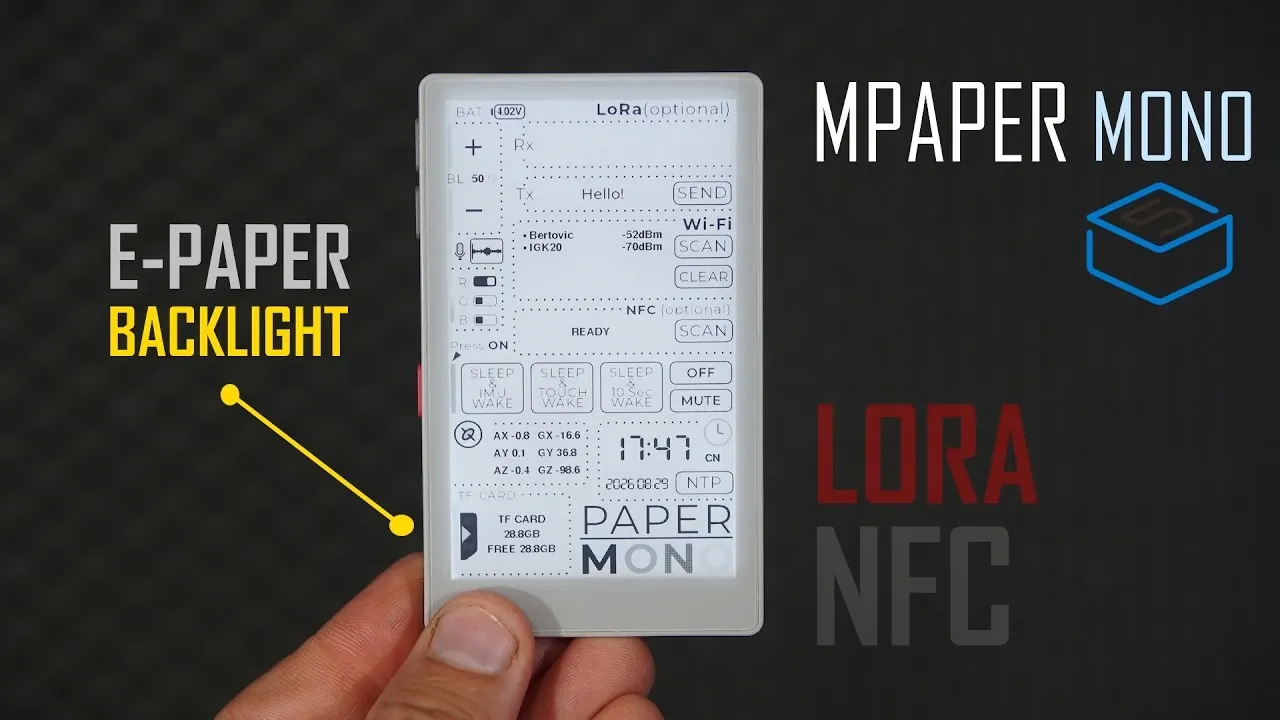
The M5Stack PaperMono, powered by the ESP32 microcontroller, is a compact device designed for versatility and portability. At the heart of its appeal is the 4.7-inch e-paper display, which offers an 800×480 resolution and supports four grayscale levels. This energy-efficient screen is highly readable in sunlight and includes a backlight for low-light conditions, making it ideal for applications like e-readers and digital dashboards. Volos Projects explores how this open source device, with features such as LoRa communication, an NFC reader and a 1,150mAh rechargeable battery, serves as a flexible platform for IoT projects and creative experimentation.
Dive into this breakdown to understand how the PaperMono’s hardware and software ecosystem can support your next project. You’ll learn about its compatibility with the Arduino IDE, preloaded firmware options and additional utilities like M5Burner for quick customization. Explore its three distinct variants, PaperMono, PaperMonoLite and PaperColor, and discover how their unique feature sets cater to different needs. Whether you’re interested in long-range communication, portable displays, or hands-on development, this guide provides a detailed look at the PaperMono’s capabilities.
Energy-Efficient E-Paper Display
TL;DR Key Takeaways :
- The M5Stack PaperMono is a compact, open source device powered by the ESP32 microcontroller, designed for developers, hobbyists and tech enthusiasts to create IoT projects and interactive tools.
- It features a 4.7-inch e-paper display with 800×480 resolution, four grayscale levels, sunlight readability and minimal power consumption, making it ideal for low-power applications like e-readers and digital dashboards.
- Equipped with robust hardware, including a touchscreen, LoRa communication, NFC reader, accelerometer, microphone, speaker and more, it supports diverse use cases such as environmental monitoring and portable devices.
- The device is highly customizable with open source software, Arduino IDE compatibility and preloaded firmware, catering to both beginners and experienced developers.
- Available in three variants, PaperMono, PaperMonoLite and PaperColor, it offers flexibility for different needs, from budget-friendly options to models with advanced features like LoRa and color displays.
One of the most notable features of the PaperMono is its 4.7-inch e-paper display, which delivers an 800×480 resolution and supports four grayscale levels. This display is highly readable in direct sunlight, making it ideal for outdoor use and it includes a backlight for improved visibility in low-light conditions. The e-paper technology ensures minimal power consumption, significantly extending the device’s battery life. These attributes make the PaperMono particularly well-suited for applications such as e-readers, digital dashboards and other low-power display solutions.
Robust Hardware for Diverse Applications
The M5Stack PaperMono is equipped with a comprehensive array of hardware components, allowing it to support a wide range of use cases. Key features include:
- A 1,150mAh rechargeable battery for extended operation.
- A responsive touchscreen interface for intuitive control.
- LoRa communication for long-range data transmission.
- An NFC reader for secure, contactless data exchange.
- RGB light for customizable visual notifications.
- Two programmable push buttons for user-defined inputs.
- An SD card slot for expandable storage options.
- A real-time clock for accurate timekeeping.
- An accelerometer for motion detection and tracking.
- A built-in microphone and speaker for audio input and output.
This robust hardware suite makes the PaperMono a versatile platform for IoT applications, portable devices and creative projects. Its combination of features ensures that it can handle everything from environmental monitoring to interactive displays.
Below are more guides on ESP32 from our extensive range of articles.
- $5 ESP32-S3 Super Mini Packs Wi-Fi and Bluetooth
- How an $8 ESP32 S3 Microcontroller Runs a 28.9M Parameter Local LLM
- $4 ESP32 Module Brings Wi-Fi and Bluetooth to IoT Projects
- ESP32-S3 Super Mini Brings 240 MHz Dual-Core Power For $4
- ESP32 S31 Devkit Hands-on: 320 MHz RISC-V Chip Adds Wi-Fi 6
- $4 ESP32-S3 Super Mini Packs a 0.96-Inch IPS TFT Screen
- Build a DIY Open-Source Flipper Zero Using a ESP32-DIV
- $9 CYD ESP32 Module Includes a 2.88-Inch LCD Screen
- ESP32-S3 Automation System Packs 16 Relays for Smart Homes
- ESP32 Minimalist AI Note Taker Features OpenAI Whisper for Text Dictation
Open source Software and Customization
The PaperMono’s open source software ecosystem is a key factor in its appeal. Fully compatible with the Arduino IDE, it allows users to program the device to meet their specific needs. For those less experienced with coding, the device comes preloaded with firmware that demonstrates its core functionalities. Additional tools, such as the Crosspoint firmware for e-reading and the M5Burner utility for accessing a variety of firmware options, further enhance its adaptability. This flexibility ensures that the PaperMono is accessible to both beginners and experienced developers, making it an excellent choice for a wide range of projects.
Compact Design for Portability
Slightly larger than a credit card, the PaperMono is designed for portability without sacrificing functionality. Its sleek and sturdy build ensures durability, while the intuitive layout enhances usability. Whether you are using it as a portable e-reader, a communication tool, or a platform for custom projects, the PaperMono’s compact design makes it an excellent choice for on-the-go applications. Its lightweight form factor and thoughtful design make it easy to carry and deploy in various environments.
Three Variants to Suit Different Needs
The M5Stack PaperMono is available in three distinct versions, allowing users to choose the model that best fits their requirements:
- PaperMono: The standard version, offering the full range of features, including LoRa and NFC capabilities.
- PaperMonoLite: A budget-friendly option that excludes LoRa and NFC functionality while retaining other core features.
- PaperColor: A variant with a color display, designed for applications requiring vibrant visuals, though it lacks LoRa support.
These options provide flexibility for users with varying needs, whether they are focused on IoT development, educational projects, or personal experimentation.
Applications and Use Cases
The versatility of the PaperMono supports a wide array of applications, making it a valuable tool for both personal and professional use. Some potential use cases include:
- Using the e-paper display for e-book reading, digital signage, or as a customizable clock.
- Using LoRa communication for long-range data transmission in IoT networks or remote monitoring systems.
- Developing creative projects such as environmental sensors, portable dashboards, or interactive educational tools.
The availability of pre-configured firmware through the M5Burner software further expands its potential, allowing users to quickly adapt the device to their specific needs without extensive programming.
Availability and Future Potential
As of October 2026, the M5Stack PaperMono has gained significant attention among developers and tech enthusiasts. While initial stock has been limited, restocking efforts are underway to meet growing demand. Its combination of advanced features, open source flexibility and compact design positions it as a valuable tool for a wide range of applications. Whether you are exploring IoT solutions, experimenting with new technologies, or seeking a portable e-paper device, the PaperMono offers a compelling and practical option.
Media Credit: Volos Projects
Disclosure: Some of our articles include affiliate links. If you buy something through one of these links, Geeky Gadgets may earn an affiliate commission. Learn about our Disclosure Policy.
