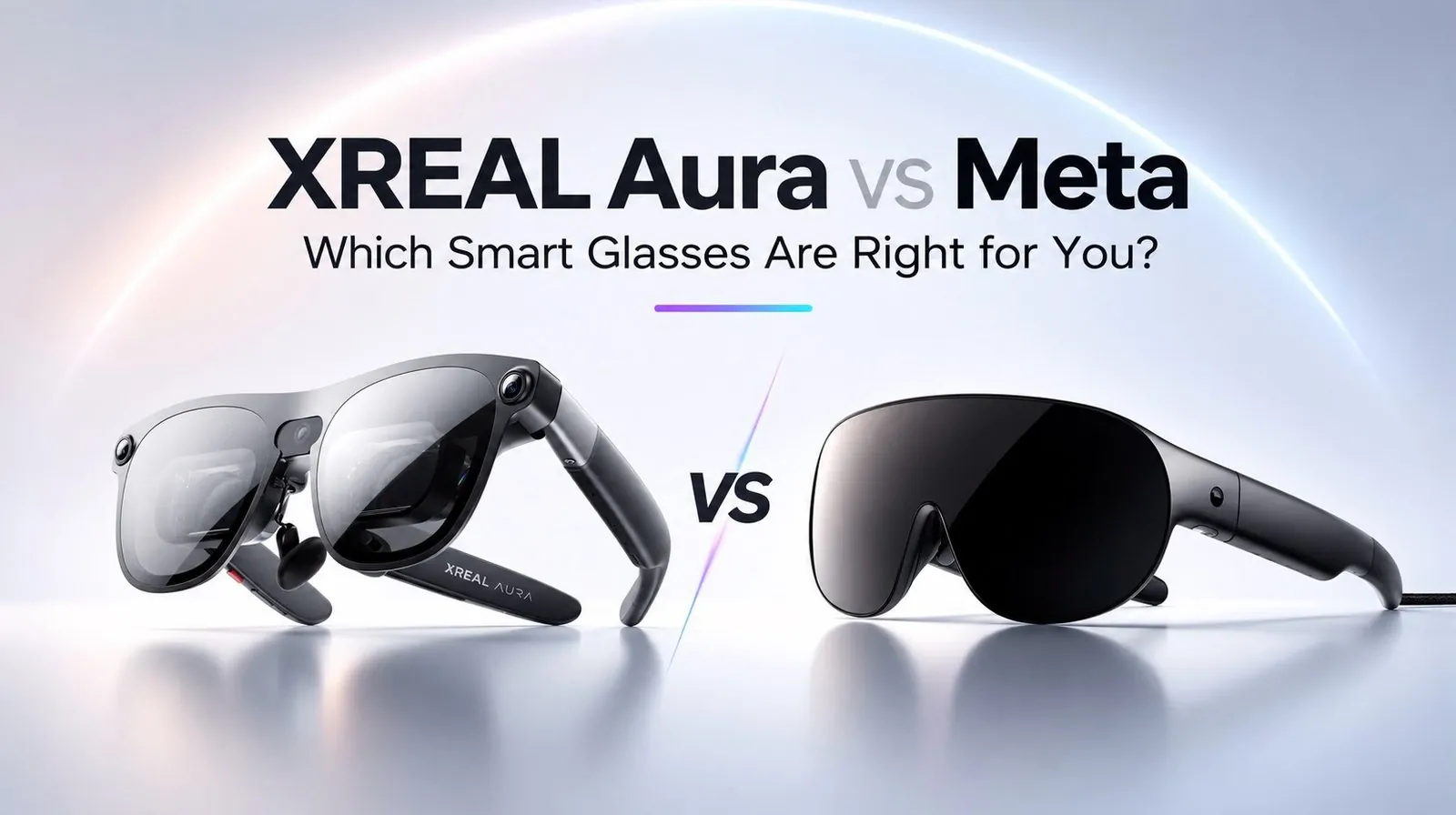
The XREAL Aura and Meta VR Glasses represent two different approaches to extended reality, with each device targeting distinct priorities. The XREAL Aura combines an optical see-through design with Android XR, Google’s Gemini AI, and access to familiar applications for productivity and entertainment. Meta’s VR Glasses, meanwhile, place greater emphasis on immersive experiences, featuring high-resolution micro-OLED displays, Dolby Vision HDR, and compatibility with the Meta Quest gaming ecosystem, as explored by Tech Depot.
Both devices use Qualcomm’s Snapdragon Reality Elite platform and lightweight glasses connected to external compute pucks. However, their display technologies, software ecosystems, gaming capabilities, and release schedules create important differences. This comparison examines pricing, availability, productivity features, entertainment, battery life, and accessories to help you determine which device best suits your requirements.
TL;DR Key Takeaways :
- The XREAL Aura launched for ordering on October 28, 2026, starting at $1,099, with discounted pricing available through December 2026. Meta VR Glasses will cost $1,299.99 when they arrive in spring 2027, giving XREAL a significant availability advantage.
- The XREAL Aura uses optical see-through lenses with adjustable electrochromic dimming, while Meta’s glasses combine full-color camera passthrough with micro-OLED displays, a 5K-class visual experience, and Dolby Vision HDR.
- XREAL focuses on spatial productivity through Android XR, Google Play, Gemini AI, and multiple virtual screens. Meta also supports productivity with virtual displays, wireless computer connectivity, and a projected keyboard and touchpad, although its everyday performance remains to be tested.
- Meta VR Glasses support the Quest ecosystem, eye tracking, and more than 75 games designed for hand gestures at launch. The XREAL Aura offers Android XR gaming and external display compatibility with supported gaming handhelds, including the Steam Deck and ROG Ally.
- The XREAL Aura glasses weigh approximately 95 g, with a 265 g compute puck, while Meta’s glasses weigh around 100 g and use a separate puck reportedly weighing approximately 300 g. XREAL specifies three to four hours of typical battery life, compared with Meta’s estimate of up to three hours of high-resolution media playback.
XREAL Aura vs Meta VR Glasses: A Detailed Comparison
The XREAL Aura and Meta VR Glasses demonstrate how extended reality technology is evolving beyond traditional bulky headsets. Both move their processing hardware and batteries into external compute pucks, allowing the glasses themselves to remain relatively lightweight.
Despite using the same Snapdragon Reality Elite platform, the devices deliver substantially different experiences. XREAL prioritizes transparent optics, Android applications, and flexible spatial computing, while Meta combines virtual reality gaming, cinematic entertainment, and productivity within its Horizon OS ecosystem.
Their differences become especially important when considering how each device interacts with the physical environment, which applications it supports, and whether its capabilities justify the cost.
Pricing and Availability
The XREAL Aura officially launched for ordering on October 28, 2026, with a limited-time starting price of $1,099 for the model featuring 12 GB of RAM and 256 GB of storage. A higher-specification configuration with 16 GB of RAM and 512 GB of storage costs $1,299.
These promotional prices remain available through December 2026. After the introductory offer ends, XREAL plans to return to its regular prices of $1,279 and $1,499, respectively. Customers who completed purchases at the original higher prices before October 28 are eligible for refunds covering the price difference. XREAL states that these refunds will be initiated within 30 days and returned to the original payment method.
Meta VR Glasses will cost $1,299.99 when they become available, placing them approximately $201 above the entry-level Aura at its promotional price. However, Meta’s standard package does not include Touch Plus motion controllers, which are required for some Quest games. These must be purchased separately, although existing compatible controllers can also be used. Optional light blockers may add another expense.
Availability is another significant consideration. XREAL opened orders in the United States, Canada, and South Korea on October 28, followed by Japan on November 2. Initial shipments are expected to begin in mid-November 2026, with orders fulfilled in batches.
Meta, meanwhile, has scheduled its VR Glasses for spring 2027, without announcing a specific release date. This gives XREAL a head start of several months, making the Aura the more immediate option for customers looking to adopt this technology before the end of 2026.

Here are more guides from our previous articles and guides related to XREAL Aura and Meta VR Glasses that you may find helpful.
- Best $1300 Smart Glasses: XREAL Aura vs Meta VR Headset
- $20 Price Gap Pits XREAL Aura Against Meta VR Glasses
- Immersive Meta VR Glasses Challenge XREAL Aura AR Vision
- Meta VR Glasses Ditch the PC with a Standalone OS
- Spring 2027 Launch Set for the $1,300 Meta VR Glasses
Display and Immersion
One of the most significant differences between these devices is how they combine digital content with the physical world. The XREAL Aura uses an optical see-through design, allowing users to view their surroundings directly through transparent lenses while displaying digital interfaces and virtual objects.
This approach makes the Aura particularly well suited to applications where maintaining awareness of the environment is important, including desk-based productivity, multitasking, and media consumption. Its five levels of electrochromic dimming allow users to adjust lens transparency according to lighting conditions and the content being displayed.
Meta VR Glasses take a different approach, using full-color passthrough cameras to capture the surrounding environment and display it through micro-OLED panels. This enables users to switch between viewing their surroundings and experiencing immersive virtual environments. The glasses also feature an open-periphery design, while optional light blockers can reduce external distractions during immersive experiences.
Display resolution is another important distinction. Meta’s glasses feature dual micro-OLED panels with a resolution of 2412 × 2288 pixels per eye and refresh rates of up to 120 Hz. Meta markets this system as its “5K Infinite Display,” offering approximately 37 pixels per degree for improved image clarity and text readability.
The glasses also support Dolby Vision HDR, Dolby Atmos spatial audio, and IMAX Enhanced content, making them particularly appealing for films, immersive sports broadcasts, and other entertainment experiences.
The XREAL Aura uses Sony micro-OLED displays with a resolution of 1920 × 1200 pixels per eye, a refresh rate of up to 120 Hz, and approximately 32 pixels per degree. Although the resolution is lower than Meta’s, the transparent optical design provides a different viewing experience that prioritizes integrating virtual content into the user’s surroundings.
Field of view also requires careful comparison. XREAL specifies a 70° diagonal field of view, while Meta quotes 70° horizontally and 66° vertically. Because the measurements use different orientations, the headline figures are not directly equivalent. Meta’s glasses provide a wider viewing area, although both devices offer a more restricted field of view than larger VR headsets such as the Meta Quest 3.
Ultimately, XREAL emphasizes the ability to combine digital content with a direct view of the physical world, while Meta provides higher-resolution displays and greater flexibility for immersive entertainment.
Work and Productivity
Productivity is a central feature of the XREAL Aura. Running Google’s Android XR operating system, the device supports applications from the Google Play Store alongside software developed specifically for extended reality. Gemini AI is integrated into the platform, allowing users to interact with applications and request contextual assistance.
Users can arrange up to five virtual screens within their surroundings, creating a flexible workspace without needing multiple physical monitors. Familiar applications such as Chrome, YouTube, and Google productivity tools can be used within the Android XR environment, subject to their supported functionality and interface compatibility.
The Aura can also connect to compatible Mac and Windows laptops through USB-C DisplayPort input, allowing the computer’s display to appear on a large virtual screen. This is distinct from the device’s native Android XR multitasking capabilities, which operate through its compute puck.
For navigation, users can rely on hand gestures, voice commands, connected Bluetooth accessories, or the touchpad built into the external compute puck. This range of input methods provides flexibility when working in different environments.
Meta’s VR Glasses also place considerable emphasis on productivity. The company has demonstrated multiple virtual displays, wireless computer connectivity, and a virtual keyboard and touchpad that can be projected onto a flat surface. These features are intended to create a portable workstation without requiring a conventional external monitor.
Meta’s higher-resolution displays could offer an advantage when reading smaller text or working with detailed interfaces. Full-color passthrough also allows users to see their physical keyboard, desk, and surrounding environment while using virtual screens.
However, important questions remain about the practicality of extended work sessions, particularly when using projected input controls. Keyboard accuracy, text readability, application compatibility, and comfort will require independent testing once the hardware becomes available.
For now, XREAL provides the earlier opportunity to explore Android XR productivity, while Meta’s announced capabilities suggest it could become a strong alternative for portable virtual workspaces.
Gaming Capabilities
Gaming highlights another important difference between the two devices. Meta VR Glasses run Horizon OS, the same operating system used by Meta Quest devices, providing access to the existing Quest software ecosystem.
Meta has announced more than 75 games designed to work entirely through hand gestures at launch, allowing users to interact without conventional controllers. Eye tracking also enables features such as gaze-based selection and foveated rendering, which concentrates rendering resources on the areas where users are looking.
For games designed around conventional VR controllers, Meta VR Glasses support Quest Touch Plus controllers, available separately. This compatibility expands the range of accessible titles beyond those developed primarily for hand tracking.
The glasses are also expected to support Xbox Cloud Gaming, offering access to compatible streamed games alongside native VR experiences. However, the quality of gaming performance, controller compatibility, and individual game support will need to be assessed after release.
The XREAL Aura approaches gaming from a different perspective. Alongside games developed for Android XR, its glasses can function as an external display for compatible handheld gaming devices.
Supported devices include the Steam Deck and ROG Ally, enabling users to play conventional games on a large virtual screen. XREAL also documents support for Nintendo Switch connectivity, although compatible adapters or powered docks may be required depending on the console and connection method. Specific Nintendo Switch 2 compatibility should be verified before purchase.
Users can pair Bluetooth controllers, including compatible Xbox and PlayStation gamepads. XREAL also offers a dedicated GameSir-developed controller featuring a shortcut for Gemini, but this accessory is sold separately or included in selected gaming bundles rather than the standard Aura package.
For gamers who already own handheld PCs and want a portable virtual display, XREAL provides an appealing option. Meta, meanwhile, offers more extensive support for immersive VR gaming through its established Quest ecosystem.
The distinction is not absolute, however. Meta’s glasses can also support compatible external display sources, while XREAL offers spatial games through Android XR. The most important consideration is whether users primarily want conventional games on a virtual screen or games designed for interaction within a virtual environment.
Weight and Comfort
Both devices use lightweight glasses connected to external compute pucks, reducing the amount of hardware worn directly on the head. The XREAL Aura weighs approximately 95 g, compared with around 100 g for Meta VR Glasses.
XREAL’s compute puck adds 265 g, bringing the combined weight to approximately 360 g, excluding cables and accessories. Meta’s external puck reportedly weighs around 300 g, producing an estimated combined system weight of 400 g.
Although XREAL is slightly lighter overall based on these figures, the difference may be less significant in practice because the compute pucks are designed to be carried in a pocket or attached to clothing rather than worn on the head.
Comfort will also depend on factors beyond weight, including frame design, fit, heat management, nose pressure, and how the connecting cable behaves during movement. These considerations are particularly important for users planning extended productivity or entertainment sessions.
Battery performance is another area worth examining. XREAL specifies approximately three to four hours of typical use from the Aura’s compute puck, with support for charging during operation.
Meta rates its VR Glasses at up to three hours of continuous high-resolution media playback and supports 45W fast charging. However, these figures reflect different usage conditions and should not be treated as equivalent battery benchmarks.
Actual battery life will vary according to screen brightness, application demands, wireless connectivity, and other settings. Independent testing will be needed to establish which device offers better endurance under comparable workloads.
AI Integration
Artificial intelligence plays a significant role in both devices, although the companies have adopted different software ecosystems.
The XREAL Aura integrates Google’s Gemini AI through Android XR, allowing users to issue voice commands, request assistance, and interact with supported applications. Gemini can also use contextual information from the user’s surroundings and digital workspace to provide relevant responses.
This integration is particularly useful for users already working within Google’s ecosystem, where compatible applications and services can be accessed through the same spatial computing environment.
Meta VR Glasses similarly integrate Meta AI directly into Horizon OS. The company has demonstrated interactions combining voice commands, eye tracking, and hand gestures, allowing users to launch applications, control media, navigate interfaces, and search for information without conventional controllers.
Both approaches aim to make interacting with digital environments more natural and reduce reliance on physical input devices. However, their effectiveness will depend on factors such as response accuracy, supported applications, contextual understanding, and the reliability of voice and gesture recognition.
While both companies have outlined their AI capabilities, real-world comparisons will be necessary to determine which delivers the more practical and consistent experience.
Who Should Buy Which?
The XREAL Aura and Meta VR Glasses are designed for overlapping but distinct audiences, making the right choice dependent on how the devices will be used.
The XREAL Aura is particularly attractive for users interested in spatial productivity, Android applications, and gaming on a portable virtual display. Its optical see-through design allows digital content to remain visible alongside the physical environment, while Gemini AI and Google Play support provide access to a broad software ecosystem.
Its earlier availability and introductory price of $1,099 also make it the more accessible option for customers wanting to explore extended reality technology before the end of 2026.
However, buyers should consider the additional cost of accessories, compatibility requirements for external devices, and whether Android XR applications provide the functionality they need.
Meta VR Glasses are likely to appeal more strongly to users prioritizing immersive entertainment, high-resolution visuals, and access to the Quest gaming ecosystem. Their micro-OLED displays, Dolby Vision HDR support, spatial audio, and eye-tracking technology create a promising foundation for films, gaming, and virtual workspaces.
The main limitations are their higher price, spring 2027 release window, and the potential additional expense of accessories such as motion controllers and light blockers.
Neither device should be considered a definitive winner for productivity or comfort until both have undergone independent testing. XREAL’s transparent optics and Meta’s video passthrough displays present different advantages, and the preferred experience will depend heavily on individual requirements.
Ultimately, the XREAL Aura offers a compelling combination of Android XR, spatial multitasking, handheld gaming compatibility, and earlier availability. Meta VR Glasses promise a more immersive experience with sharper displays and closer integration with the Quest ecosystem, but buyers will need to wait until 2027 to assess their real-world performance.
Media Credit: Tech Depot
Disclosure: Some of our articles include affiliate links. If you buy something through one of these links, Geeky Gadgets may earn an affiliate commission. Learn about our Disclosure Policy.
