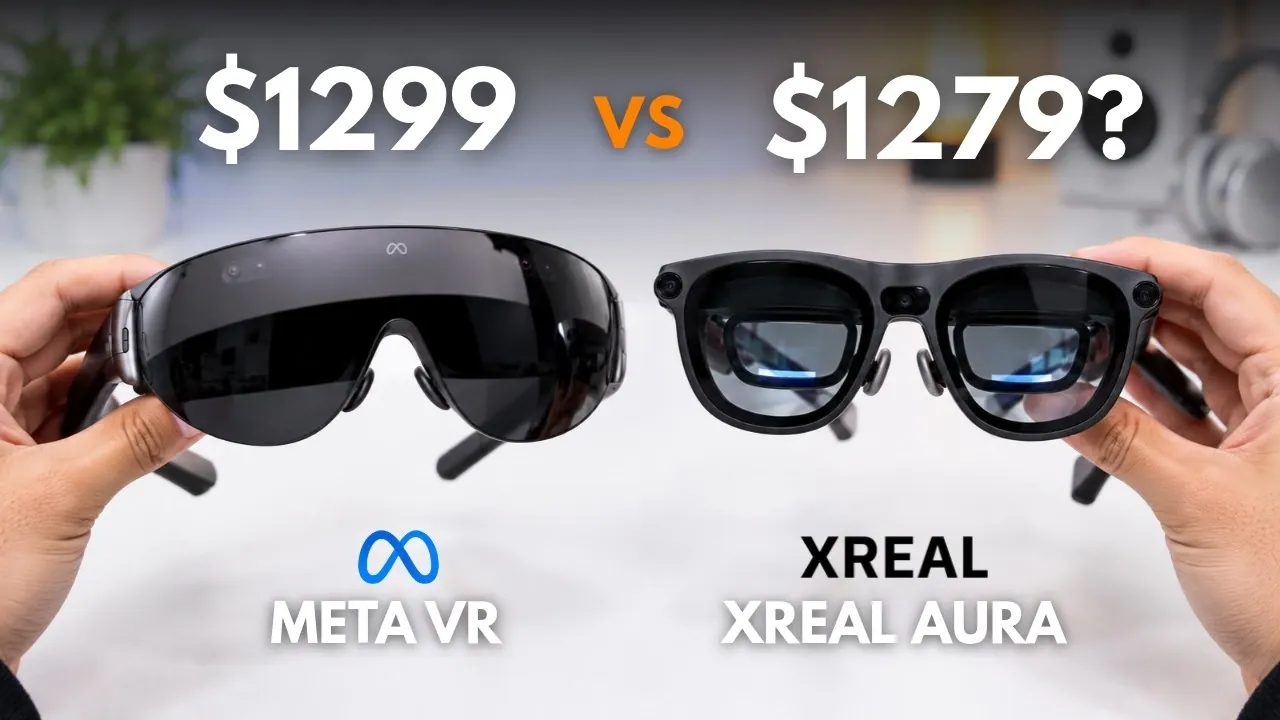
The XREAL Aura has introduced a compelling alternative to Meta’s VR glasses, offering a distinct focus on augmented reality (AR) rather than full virtual immersion. As Tech Court explains, the Aura employs optical see-through technology paired with electrochromic dimming, allowing users to seamlessly blend digital overlays with their physical environment. This approach contrasts sharply with Meta’s reliance on video pass-through technology, which creates entirely immersive virtual spaces. With only a $20 price difference between the two devices, the choice ultimately comes down to whether you value real-world integration or fully immersive digital experiences.
Explore how these differences translate into practical use cases, from the Aura’s lightweight portability and Android XR platform to Meta’s hand-tracking and robust productivity ecosystem. Gain insight into the strengths and trade-offs of each device, including their respective approaches to tracking, app compatibility and ecosystem maturity. By the end of this explainer, you’ll have a clearer understanding of which device aligns better with your specific needs and how their unique features cater to different priorities.
XREAL Aura vs Meta VR
TL;DR Key Takeaways :
- The XREAL Aura focuses on augmented reality (AR) with optical see-through technology and electrochromic dimming, offering seamless integration with the real world, while Meta VR glasses prioritize virtual reality (VR) with video pass-through technology for fully immersive experiences.
- Meta VR glasses have a more mature and robust software ecosystem, supporting productivity tasks and offering advanced hand-tracking and controller support, whereas the XREAL Aura’s ecosystem is still developing but emphasizes spatial computing and portability.
- The XREAL Aura is designed for lightweight, adaptable AR applications, while Meta VR glasses cater to gaming, virtual meetings and immersive entertainment, making them ideal for different user needs.
- The XREAL Aura is set to launch before the holiday season, giving it an early market advantage, while Meta VR glasses are expected to release in the spring, using Meta’s established ecosystem and resources for long-term competitiveness.
- With only a $20 price difference, the decision between the two devices hinges on features and use cases: XREAL Aura excels in AR and real-world integration, while Meta VR glasses dominate in VR immersion and ecosystem maturity.
How the Technology Stacks Up
The XREAL Aura and Meta VR glasses are built on fundamentally different technological principles, each designed to deliver a unique user experience.
- XREAL Aura: The Aura employs optical see-through technology, allowing digital overlays to seamlessly integrate with your physical surroundings. This feature is enhanced by electrochromic dimming, which allows users to adjust the visibility of the real world as needed. Powered by the Android XR platform, the Aura relies on a separate compute puck for processing, making sure portability and flexibility. This makes it particularly appealing for users who value lightweight, adaptable devices for augmented reality applications.
- Meta VR Glasses: Meta’s glasses, on the other hand, focus on video pass-through technology, creating fully immersive virtual environments. This approach is ideal for activities like gaming, virtual meetings and other scenarios where complete immersion is key. Meta’s device benefits from a mature ecosystem, offering a wide array of apps, games and AI-driven features. Additionally, its hand-tracking technology and controller support are highly refined, providing precise and intuitive input options.
These differences underscore the contrasting priorities of the two devices: the Aura emphasizes real-world integration, while Meta’s glasses are tailored for immersive virtual experiences.
Productivity and Ecosystem: A Tale of Two Platforms
When evaluating productivity and ecosystem capabilities, the Meta VR glasses currently hold a distinct edge over the XREAL Aura.
- Meta VR Glasses: Meta’s platform is backed by a robust software ecosystem that supports a variety of productivity tasks, including document editing, virtual collaboration and multitasking. Its seamless integration with the broader Meta ecosystem ensures compatibility with existing apps and services, making it a strong choice for professionals seeking a versatile and feature-rich device.
- XREAL Aura: While the Aura’s ecosystem is still in its early stages, it shows promise. Built on the Android XR platform, it has the potential for future app development and innovation. However, its current focus on spatial computing and augmented reality may limit its appeal for users who require a comprehensive suite of productivity tools. That said, the Aura’s emphasis on real-world integration could attract users who prioritize augmented reality over virtual immersion.
Your choice will depend on whether you need a device optimized for productivity or one that excels in delivering augmented reality experiences.

Discover other guides from our vast content that could be of interest on XREAL Aura.
- XREAL Aura Secures 10,000 Deposits for Fall 2026 Launch
- How XREAL Aura $1,500 Spatial Computing Glasses Could Challenge Apple Vision
- Immersive Meta VR Glasses Challenge XREAL Aura AR Vision
- XREAL Aura Brings Android XR and Gemini AI to Smart Glasses
- URXR One vs XREAL Aura: AR Glasses Specs and Features Compared
- Fall 2026 Launch Likely Prices XREAL AURA Glasses At $1,500
- VITURE Pro 2 Beats XREAL XBX in New $299 XR Glasses Test
- XREAL vs URXR vs VITURE Compared as Best AR Monitor Replacements
- XREAL Aura Hybrid AR and VR Glasses: Hands on Guide
- The New XREAL Aura AR Glasses Likely Cost Under $1,500: Fall 2026 Launch
Timing and Market Dynamics
The timing of product launches plays a significant role in shaping the competitive landscape between the XREAL Aura and Meta VR glasses.
- XREAL Aura: Scheduled for release before the holiday season, the Aura has a strategic advantage in capturing the attention of early adopters and holiday shoppers. This early launch could help it establish a foothold in the market and build momentum.
- Meta VR Glasses: Meta’s glasses are expected to debut in the spring, giving the Aura a head start. However, Meta’s extensive resources, established ecosystem and loyal user base could allow it to dominate the market once its product becomes available. The delayed launch may also give Meta time to refine its offering and address any potential shortcomings.
While the Aura’s early launch positions it as a frontrunner in the short term, Meta’s scale and polished user experience could make it a formidable competitor in the long run.
What to Consider Before Buying
Choosing between the XREAL Aura and Meta VR glasses requires careful consideration of your specific needs and preferences. Here are the key factors to evaluate:
- Software Ecosystem: Meta offers a more mature and expansive ecosystem with a wide range of apps and features, while the Aura’s platform is still in its developmental stages.
- Comfort and Usability: Assess the comfort of each device for extended use and the ease of navigating their respective interfaces.
- Tracking Capabilities: Both devices feature advanced tracking technologies, but Meta’s hand-tracking and controller support are more refined and precise.
- Primary Use Cases: The Aura is ideal for augmented reality applications and real-world integration, while Meta’s glasses excel in delivering immersive virtual environments.
By weighing these factors, you can determine which device aligns better with your expectations and intended use cases.
Features, Not Price, Drive the Decision
With only a $20 difference in price, the competition between the XREAL Aura and Meta VR glasses is less about affordability and more about the features, ecosystem and user experience each device offers.
- XREAL Aura: Best suited for users who value augmented reality, spatial computing, and seamless integration with the real world. Its lightweight design and focus on portability make it an attractive option for those prioritizing real-world applications.
- Meta VR Glasses: Ideal for users seeking immersive virtual environments, a mature software ecosystem, and advanced input options. Its comprehensive suite of features makes it a strong contender for gaming, virtual collaboration and entertainment.
As the market evolves, your decision will ultimately depend on how you plan to use these devices. Whether you prioritize productivity, entertainment, or social interactions, the XREAL Aura’s early launch gives it an initial advantage. However, Meta’s established ecosystem and resources position it as a potential long-term leader. Carefully consider your personal preferences and priorities to make the best choice for your needs.
Media Credit: Tech Court
Disclosure: Some of our articles include affiliate links. If you buy something through one of these links, Geeky Gadgets may earn an affiliate commission. Learn about our Disclosure Policy.
