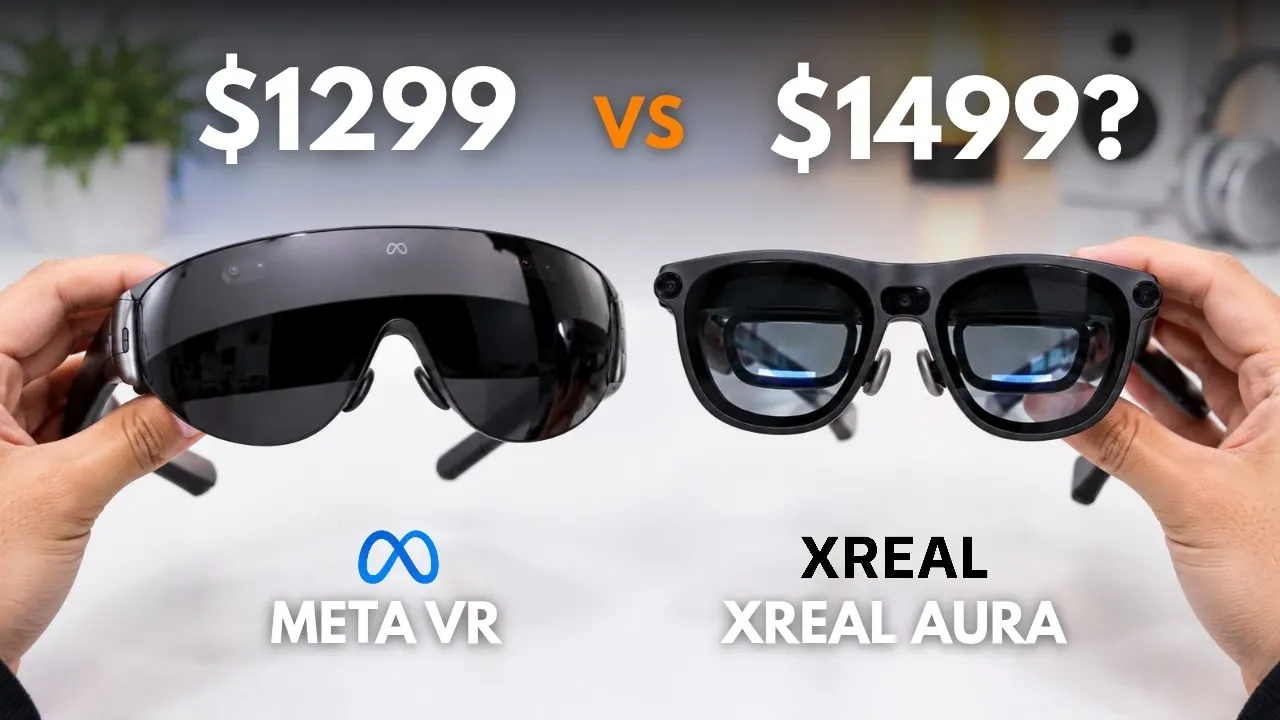
Meta’s latest VR glasses introduce a lightweight design paired with an external compute puck, a setup that directly challenges the XREAL Aura in the growing spatial computing market. By separating the processing hardware from the glasses themselves, Meta has created a more balanced and comfortable experience without compromising performance. Tech Court highlights how this approach mirrors XREAL Aura’s design philosophy, yet the two devices diverge significantly in their focus. While Meta emphasizes immersive VR with features like full-color passthrough and optional light blockers, XREAL Aura leans toward augmented reality, prioritizing digital overlays in real-world environments.
Dive into this breakdown to explore how Meta’s advanced hardware, including dual micro OLED displays and Qualcomm Snapdragon Reality Elite processing, compares to XREAL Aura’s AR-centric capabilities. Gain insight into the trade-offs between immersive VR and lightweight AR, the productivity and entertainment features each device offers and the pricing strategies shaping their appeal. Whether you’re drawn to virtual collaboration or real-world digital enhancements, this guide will help you understand the evolving dynamics of spatial computing.
Balancing Comfort and Performance
TL;DR Key Takeaways :
- Meta’s latest VR glasses emphasize lightweight design and comfort by separating hardware into glasses and an external compute puck, directly competing with XREAL Aura in the spatial computing market.
- Meta VR glasses focus on immersive VR experiences with features like full-color passthrough, dual micro OLED displays and advanced entertainment options, while XREAL Aura prioritizes lightweight AR functionality and digital overlays.
- Key features of Meta VR glasses include eye and hand tracking, Meta AI integration, virtual multi-monitor setups and access to the MetaQuest gaming catalog, making them ideal for productivity and entertainment.
- Pricing and availability: Meta VR glasses are set to launch in spring 2027 for $1,299.99, while XREAL Aura is expected in fall 2026 with a price under $1,500, catering to different user priorities.
- Both devices highlight trade-offs: Meta’s tethered design and limited battery life versus XREAL’s AR-focused functionality, reflecting distinct visions for the future of spatial computing.
Meta VR glasses weigh a mere 100 grams, offering a lightweight and ergonomic design that ensures comfort during extended use. The compute puck, which houses the processing power, battery and storage, reduces the weight on your face, allowing a more balanced and user-friendly experience. Powered by the Qualcomm Snapdragon Reality Elite platform, the glasses deliver robust performance, a feature that is also central to the XREAL Aura.
The glasses feature dual micro OLED displays with a resolution of 2412×2288 pixels per eye, a 120Hz refresh rate and 37 pixels per degree, making sure sharp visuals and smooth performance. The field of view spans 70° horizontally and 66° vertically, creating an immersive virtual experience. XREAL Aura, while employing a similar compute puck design, leans more toward augmented reality, focusing on projecting digital overlays onto the real world. This distinction highlights the differing priorities of the two devices, with Meta emphasizing immersive VR and XREAL Aura targeting AR applications.
Key Differences: Immersive VR vs Augmented Reality
Meta VR glasses are designed to deliver full-color passthrough VR, allowing you to seamlessly transition between immersive virtual environments and the real world. An optional light blocker enhances the VR experience by minimizing external distractions. In contrast, XREAL Aura focuses on optical see-through AR, allowing users to interact with digital overlays that are integrated into their physical surroundings.
While both devices aim to provide lightweight and portable solutions for spatial computing, their execution diverges significantly. Meta’s glasses cater to users seeking immersive VR experiences, making them ideal for gaming, virtual collaboration and entertainment. On the other hand, XREAL Aura appeals to users who prioritize augmented reality applications, such as productivity tools and real-world digital enhancements.

Here are additional guides from our expansive article library that you may find useful on Meta VR glasses.
- New Meta VR Glasses Pack an IMAX-certified Cinema and Weigh Just 100g
- Spring 2027 Launch Set for the $1,300 Meta VR Glasses
- Meta’s 100-Gram VR Glasses Replace Bulky Headset Designs
- Meta Connect 2026: Ray-Ban Meta Audio, Ray-Ban Meta Gen 3 and Compact VR Glasses
- $1299 Meta VR Glasses Offer a Portable Laptop Alternative: Hand Tracking, Lightweight
- MetaQuest Emulator Brings Batman VR to Non-Meta Headsets
- XREAL’s $434 AR Glasses Launch, Meta Pushes Phoenix to 2027
Features and Capabilities: Enhancing Productivity and Entertainment
Meta VR glasses are equipped with a range of advanced features designed to enhance both productivity and entertainment. These include:
- Eye and hand tracking: Enables intuitive interaction with virtual environments.
- Meta AI integration: Supports voice, eye and gesture control for seamless navigation.
- Virtual multi-monitor setups: Ideal for productivity tasks, offering a flexible workspace.
- Connectivity: Wireless and USB-C options for integration with PCs and other devices.
- Entertainment options: Includes Dolby Vision, Dolby Atmos, IMAX certification, 3D movies and immersive live sports.
- Gaming capabilities: Access to the MetaQuest gaming catalog, Xbox Cloud Gaming and hand tracking for an engaging gaming experience.
XREAL Aura, by contrast, uses the Android XR and Gemini platforms to deliver optical AR experiences. Its compute puck supports DisplayPort input, making sure compatibility with PCs and gaming devices. While it lacks some of the immersive VR features offered by Meta, XREAL Aura excels in lightweight AR functionality, making it a compelling choice for users seeking portable and practical augmented reality solutions.
Pricing and Availability
Meta VR glasses are scheduled for release in spring 2027, with a price of $1,299.99. XREAL Aura is expected to launch in fall 2026, with pricing anticipated to be under $1,500. With similar price points, the choice between the two devices ultimately depends on your specific needs. If you value immersive VR experiences and advanced entertainment features, Meta’s offering may be the better fit. Conversely, if lightweight AR functionality and real-world digital integration are your priorities, XREAL Aura could be the ideal choice.
Challenges and Trade-offs
Both devices come with trade-offs that may influence your decision:
- Meta VR Glasses: While innovative, the tethering to a compute puck via an optical cable may restrict mobility. Battery life is another limitation, offering approximately three hours of high-resolution media playback. Additionally, the field of view, though immersive, is smaller compared to traditional VR headsets.
- XREAL Aura: Justifying its price point could be challenging, especially when compared to Meta’s feature-rich offering. Its focus on AR functionality limits its appeal to users seeking fully immersive VR experiences.
Industry Implications: Shaping the Future of Spatial Computing
The introduction of Meta VR glasses and XREAL Aura represents a significant moment in the evolution of spatial computing. Both devices prioritize reducing the weight on your face while maintaining robust functionality, setting a new benchmark for comfort and usability. Meta’s focus on immersive VR contrasts sharply with XREAL’s emphasis on lightweight AR, illustrating two distinct visions for the future of this technology.
As competition in the spatial computing market intensifies, more companies are likely to adopt similar designs, driving further innovation and expanding the range of available options. For consumers, this means greater flexibility to choose devices that align with their specific needs, whether they prioritize immersive entertainment, enhanced productivity, or seamless integration of digital and physical environments. The coming years promise to be fantastic for spatial computing, with Meta and XREAL leading the charge into this exciting new era.
Media Credit: Tech Court
Disclosure: Some of our articles include affiliate links. If you buy something through one of these links, Geeky Gadgets may earn an affiliate commission. Learn about our Disclosure Policy.
