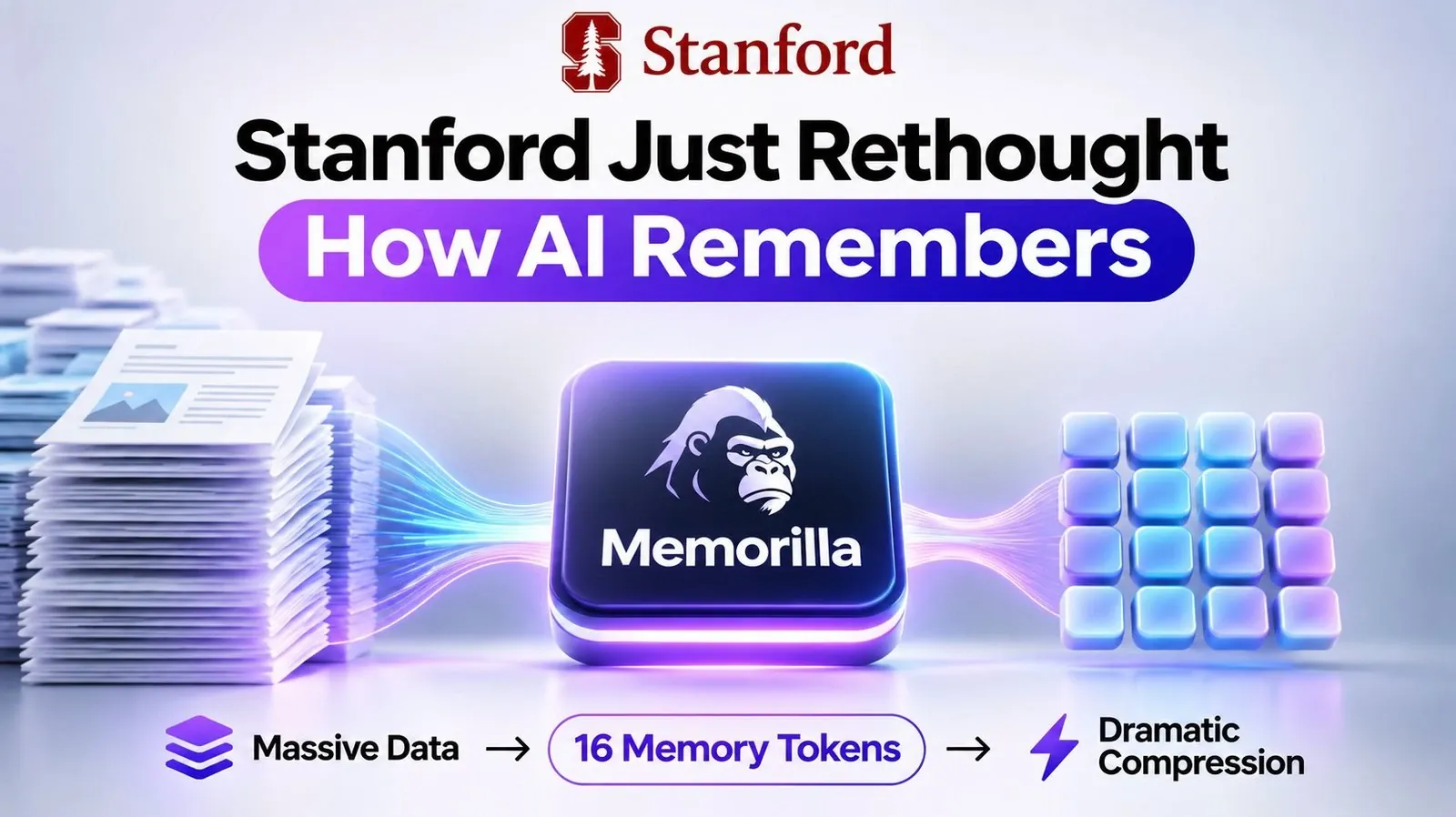
Stanford’s Memorilla project introduces a compact memory module designed to compress vast datasets into just 16 memory tokens, offering a novel approach to AI memory management. By using a fixed memory size regardless of dataset length, it aims to improve processing speed and efficiency. For example, Memorilla reduced response times for 128,000 tokens of text from over 19 seconds to approximately 3 seconds. However, its limitations in accuracy and detail retention suggest it is still far from production-ready, as noted by Better Stack.
Explore how Memorilla’s two-stage process scores and refines data relevance, its integration with the Qwen 3 language model, and its performance benchmarks. Gain insight into its speed advantages over traditional methods, the challenges it faces with hallucination and precision, and its potential for customization through retraining. This breakdown examines where Memorilla excels and where it falls short in addressing AI memory challenges.
Stanford’s Memorilla: A New Approach to AI Memory
TL;DR Key Takeaways :
- Stanford’s Memorilla compresses large datasets into just 16 memory tokens using a compact memory module with approximately 200 million parameters, aiming to improve speed and efficiency in AI memory processing.
- Memorilla, gathers information from an entire document collection into a fixed number of query-dependent memory tokens for a frozen LLM.
- Memorilla demonstrated significant speed advantages, reducing response times from over 19 seconds to approximately 3 seconds when compressing 128,000 tokens of text, and maintaining consistent answering times of around 0.12 seconds for up to 512 documents.
- Accuracy remains a major limitation, with Memorilla struggling to retain precise details, fabricating information, and failing to retrieve specific facts in tests, such as answering only one out of eight plot questions correctly for “The Hound of the Baskervilles.”
- Memorilla reportedly achieved the highest average score across benchmarks compared to other memory systems, and its results were reproduced almost word for word on rented GPUs, but small-scale tests revealed frequent forgetting and hallucination issues.
- Memorilla is not yet production-ready due to its struggles with accuracy and hallucination, though its retraining tools offer potential for customization and future development; established methods like RAG are recommended for reliable outputs in the meantime.
Stanford’s Memorilla project introduces a method for managing large datasets in AI systems by compressing entire conversations or datasets into just 16 memory tokens. This approach aims to address challenges in speed and efficiency for AI memory processing. While it shows promise in compression and speed, its current limitations in accuracy and detail retention suggest it is not ready for production use.
How Memorilla Works
Memorilla uses a compact memory module with approximately 200 million parameters to compress documents into 16 memory tokens. It first converts documents into vectors using an embedding model. The memory module then processes these vectors in two stages: scoring their relevance to a query and refining the selection. The resulting 16 tokens are passed to Qwen 3, an unmodified language model, which generates responses based on the compressed data.
Unlike traditional methods that rely on full context windows or retrieval-augmented generation (RAG) systems, Memorilla maintains a fixed memory size regardless of the dataset’s length. This design ensures the system processes only 16 tokens, even when handling hundreds of documents or entire books.
During training, only the memory module is updated, while the embedding model and Qwen 3 remain unchanged. This separation allows the system to focus on improving memory compression without altering the underlying language model.

Uncover more insights about AI memory in previous articles we have written.
- DeepSeek Solves AI Memory Problem with Compression
- Google Memory Bank Released : Long-Term AI Memory for Your Agents
- Why AI Memory Systems Are the Future of Large Language Models
- Why Google’s TurboQuant Algorithm is Disrupting the AI Memory Chip Market
- How Obsidian’s “Memory Vaults” Are Changing the Way We Code with AI
Performance and Speed
Memorilla demonstrated significant speed advantages in testing. Compressing 128,000 tokens of Sherlock Holmes novels into 16 memory tokens reduced response times from over 19 seconds to approximately 3 seconds. Its answering time remained consistent at around 0.12 seconds when processing up to 512 documents, maintaining stable performance regardless of dataset size.
Even with larger datasets, Memorilla’s speed held steady. In one test involving 128,000 tokens of text, its answering time stayed flat, highlighting its efficiency. Compared to traditional methods, it significantly reduced the time required to process large document sets.
However, converting documents into vectors adds some overhead. Including this step, Memorilla processed 512 documents in approximately 3.2 seconds, making it about six times faster than the full context method. While this falls short of the 27-fold speed improvement suggested in the research paper, it remains a notable advantage.
Accuracy and Limitations
Despite its speed, Memorilla struggles with accuracy. In one example from the project’s readme, it inferred a family history of type 2 diabetes from a single chat about diabetes risk. While this contextual link was interesting, it may have been coincidental.
Custom tests revealed more significant issues. In a “buried clue” test, Memorilla failed to retrieve specific details, such as a user’s sister’s name and birthday, and fabricated information, including a non-existent allergy. None of the four methods tested in this experiment successfully identified a single buried clue. For comparison, RAG correctly answered the easy control question, while the full context method largely ignored the chats and stated it lacked access to personal information.
When tested with “The Hound of the Baskervilles,” Memorilla answered only one out of eight plot questions correctly and hallucinated details from a different Sherlock Holmes story. These findings suggest it struggles to retain precise details as datasets grow. For instance, when given a single chat about a user’s sister, it correctly identified her name as Priya but gave the wrong birthday. As more chats were added, it reverted to an incorrect name, Emily.
Training and Benchmarks
Memorilla’s training involved three stages: reconstructing Wikipedia passages, training on QA and summarization datasets, and benchmarks. This multi-stage process aimed to improve its ability to compress and retrieve relevant information from large datasets.
Despite its limitations, Memorilla reportedly achieved the highest average score across all benchmarks compared to other memory systems like MEMS Zero and MemoRAG. On one fact-checking benchmark, it was said to outperform providing a model with every single document. The host reproduced Memorilla’s results almost word for word on rented GPUs, supporting the reported findings.
However, these results should be interpreted cautiously. Small-scale tests showed that Memorilla frequently forgot specific facts and filled gaps with fabricated information. These issues, along with its inability to handle datasets outside its training scope effectively, highlight its current shortcomings.
Not Yet Production-Ready
Memorilla remains a research checkpoint rather than a finished product. Its ability to compress large datasets into 16 tokens and maintain consistent speed makes it promising for certain applications. However, its struggles with accuracy, hallucination, and detail retention make it unsuitable for production use in its current state.
The host suggests that Memorilla might perform better when retrained on user-specific data. The project’s GitHub repository includes tools for retraining the memory module, allowing users to customize it for their needs. While this retraining capability was not tested in the host’s experiments, it offers potential for future development.
Better Stack highlights that Memorilla’s fixed memory size and consistent speed address key challenges in processing large datasets, but its struggles with accuracy and hallucination limit its current utility. While it achieved strong benchmark results and offers retraining options for customization, Better Stack advises that it is not yet suitable for production use. For now, they recommend established methods like RAG for reliable outputs, noting that Memorilla remains a research checkpoint with room for improvement.
Media Credit: Better Stack
Disclosure: Some of our articles include affiliate links. If you buy something through one of these links, Geeky Gadgets may earn an affiliate commission. Learn about our Disclosure Policy.
