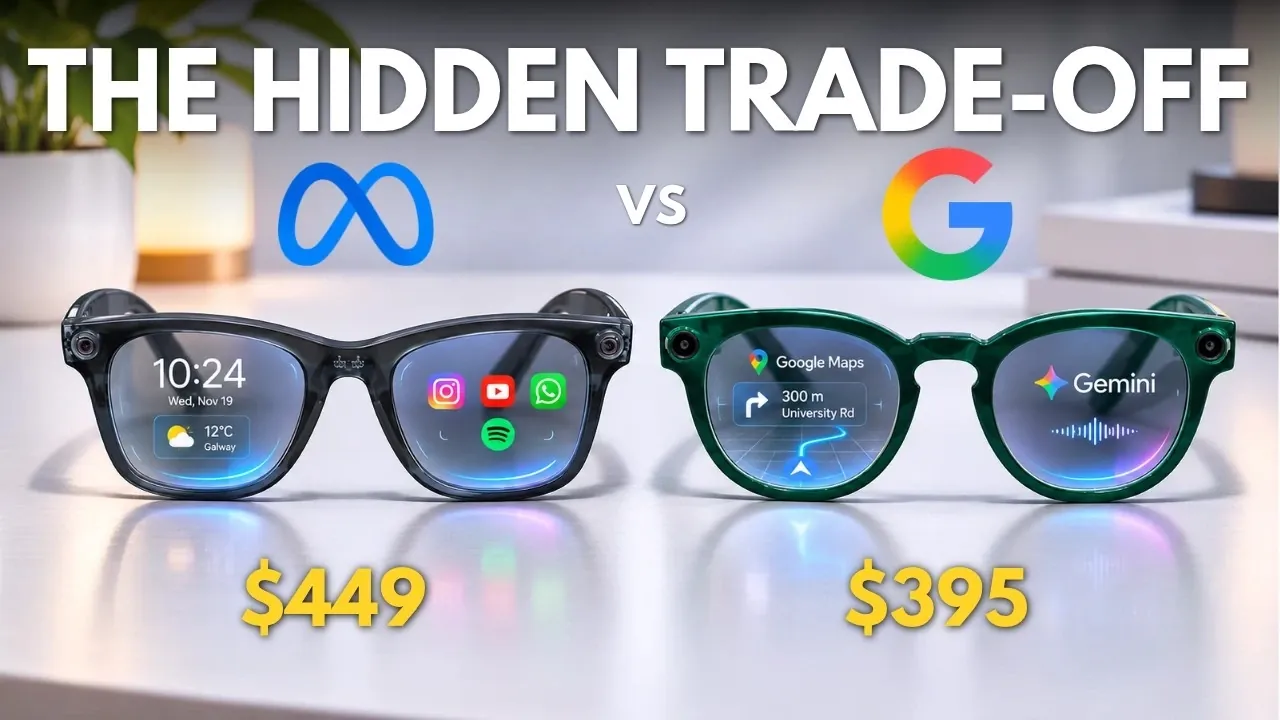
Smart glasses are evolving quickly, and the latest entries from Google and Ray-Ban Meta offer distinct approaches to wearable tech. Google’s glasses, developed with Samsung and designed by Warby Parker and Gentle Monster, start at $395 and integrate deeply with the Google ecosystem, including apps like Gmail and Maps. In contrast, Ray-Ban Meta’s Gen 3 glasses, priced at $449, emphasize broader compatibility and features like live streaming and offline translation, as explored by Tech Court.
Dive into this explainer to understand how these models compare in key areas like battery life, camera performance, and software integration. You’ll gain insight into Google’s ecosystem-focused design, including its Android-exclusive features, and Meta’s global availability and social media integration. Whether you’re prioritizing compatibility, functionality, or price, this breakdown will help clarify which smart glasses align best with your needs.
Smart Glasses Showdown: Google vs Ray-Ban Meta
TL;DR Key Takeaways :
- Google’s new smart glasses, priced at $395, are lighter and offer double the storage (64 GB) compared to the $449 Ray-Ban Meta Gen 3, but Meta’s glasses include six microphones for better noise reduction and a charging case with up to 50 extra hours of battery life.
- Google’s glasses integrate with its ecosystem, featuring the Gemini assistant for tasks like navigation, translation in over 70 languages, and visual input, though some features are Android-only at launch and testing revealed occasional inaccuracies.
- Meta’s glasses support a wider range of devices, including iPhones and Android phones, and are available globally, while Google’s glasses are limited to Pixel 7 or newer and select Galaxy phones, launching only in the US and South Korea on December 10, 2026.
- Privacy concerns differ: Google’s glasses blur faces and include a physical switch to disable smart functions, but the recording light does not activate during visual input. Meta’s glasses disable recording if the light is blocked but may use shared photos to improve its AI.
- Meta offers more options, including the $379 Gen 2 for a budget-friendly choice, the $449 Gen 3 with incremental upgrades, and a $799 display model, while Google’s display glasses remain in testing with no release date.
Ray-Ban’s smart glasses have been a popular choice for wearable tech that resembles traditional eyewear. This week, Google entered the market with its own smart glasses, developed with Samsung and designed by Warby Parker and Gentle Monster. Priced at $395, Google’s glasses are less expensive than the $449 Ray-Ban Meta Gen 3. While both models share core features, they differ in compatibility, regional availability, and functionality.
Key Features and Specifications
Both models feature a 12-megapixel camera, open-ear speakers for calls and music, and an IPX4 rating, making them resistant to sweat and light rain but unsuitable for swimming. Neither includes a display, requiring users to rely on their phones for visual content. Battery life is rated at nine hours for both, though Meta’s glasses reportedly drain faster with heavy camera use.
Video recording capabilities show slight differences. Meta Gen 3 records in 3K resolution, while Google’s glasses also list 3K but have produced shorter 2K clips in some tests. Google’s glasses are lighter at 41 g, compared to Meta Gen 3’s 52 g, which may be noticeable during extended wear. Storage also differs: Google offers 64 GB, double Meta’s 32 GB.
However, Meta includes six microphones that claim to reduce over 90% of background noise during calls, compared to Google’s four microphones. Meta’s charging case provides up to 50 extra hours of battery life, while Google’s case supports seven full charges but is heavier, weighing 167 g for Warby Parker frames and 194 g for Gentle Monster frames.

Become an expert in Google and Meta smart glasses with the help of our in-depth articles and helpful guides.
- Samsung vs Google AI Glasses: Official Prices and Features
- $395 Samsung and Google Smart Glasses Undercut Ray-Ban Meta Gen 3
- Skip the $449 Ray-Ban Meta Gen 3 If You Own the Gen 2 Glasses
- Upcoming Samsung Smart Glasses Ditch Displays for Google Gemini
- Are You Ready? Samsung’s Gemini-Powered Galaxy Glasses Land This November
Software and Ecosystem Integration
Google’s glasses integrate closely with its ecosystem. The Gemini assistant supports Google Calendar, Gmail, and Maps, allowing users to manage schedules, respond to messages, and navigate without their phones. Gemini also offers visual input features like identifying bus schedules or posters and supports translation in over 70 languages via the Translate app. However, some features, such as Guided Vision for blind and low-vision users, are Android-only at launch.
In testing, Gemini occasionally required explicit prompts to use the camera and once provided incorrect information about a bird until corrected. Another reviewer noted that Gemini could rejoin a conversation if its response was repeated aloud. The gesture to summon Gemini, a double pinch from the wrist, works with a Pixel Watch but not with an Apple Watch.
Meta’s glasses excel in compatibility and availability. They support iPhones running iOS 17 or newer and Android devices on Android 10 or later, and they are available globally. Live translation works offline once a language pack is downloaded, and sharing to Instagram, WhatsApp, and Messenger is built-in. Meta’s glasses also support live streaming, a feature blocked by app store rules on Google’s glasses. Additionally, Meta includes a new action button for quick access to Meta AI.
Privacy and Security
Privacy features vary between the two models. Google’s glasses include a white light to indicate recording, blur faces before processing images, and have a physical switch to disable smart functions. However, the recording light remains off when Gemini uses the camera for visual input, raising concerns. Google states that images are not saved or used for training or ads, though text chats with Gemini are stored in the user’s history.
Meta’s glasses disable recording if the light is blocked, but the company has acknowledged that photos shared with its AI may be used to improve the system. This, combined with Meta’s association with a social media company, could make some users uncomfortable in public or private settings. Samsung has stated that recording on its glasses stops when they are removed.
Compatibility and Regional Availability
Google’s glasses are designed primarily for its ecosystem, supporting Pixel 7 and newer devices, as well as recent Galaxy phones running One UI 9. They do not support Motorola, OnePlus, Xiaomi, or Samsung’s A series phones at launch. iPhone compatibility is unclear, with conflicting reports on whether the cutoff is the iPhone 13 Pro or newer, or the iPhone 13 with 6 GB of RAM.
Additionally, Google’s glasses are launching only in the US and South Korea, with shipments beginning on December 10, 2026. Users must have an adult Google account registered in one of these regions to activate the glasses.
In contrast, Meta’s glasses are already available globally and support a broader range of devices. With three generations of development, they offer a more refined product compared to Google’s first-generation release.
Price and Value
Meta’s Gen 3 glasses are the most expensive in this category at $449, $70 more than the Gen 2, which costs $379. The Gen 3 adds an extra hour of battery life, a slimmer frame, an action button, and improved microphones but retains the same camera as the Gen 2.
For users uninterested in photo or video capabilities, Meta offers the Ray-Ban Meta Audio glasses at $349, which include open-ear speakers and the assistant. Meta’s higher-end display model starts at $799 and offers around six hours of use.
Google’s Warby Parker frames start at $395, placing them between Meta’s Gen 2 and Gen 3 in price. Gentle Monster frames for Google’s glasses range from $449 to $489. Both brands offer prescription lens options, which can significantly increase costs.
Warby Parker supports prescriptions from minus 8 to plus 5, while Gentle Monster accommodates up to minus 9 on some frames, though these orders are final sale. Adding prescription or light-responsive lenses to Google’s glasses can push the total well above $395.
Who Should Buy Which?
Choosing between Google and Ray-Ban Meta smart glasses depends on your phone, location, and priorities. Google’s glasses are ideal for users with a Pixel 7 or newer, or a Galaxy running One UI 9, who live in the US or South Korea and rely heavily on Google apps. However, their limited compatibility, regional restrictions, and lack of independent reviews make them a riskier investment.
Meta’s glasses are better suited for users with other phones, those outside the US or South Korea, or anyone seeking a proven product available now. The Gen 2 at $379 offers a more affordable option, while the Gen 3 provides incremental upgrades for those willing to spend more. For users seeking a display in the lens, Meta’s higher-end model starts at $799, while Google’s display glasses remain in testing with no release date.
Tech Court concludes that the choice between Google and Ray-Ban Meta smart glasses hinges on your phone, location, and priorities. Google’s glasses are a better fit for Pixel 7 or Galaxy users in the US or South Korea who rely on Google apps, but their limited compatibility and lack of independent reviews make them a cautious buy. Meta’s glasses, with broader compatibility and global availability, are the safer option for most users today. For iPhone owners, waiting for real buyer feedback is advisable.
Media Credit: Tech Court
Disclosure: Some of our articles include affiliate links. If you buy something through one of these links, Geeky Gadgets may earn an affiliate commission. Learn about our Disclosure Policy.
