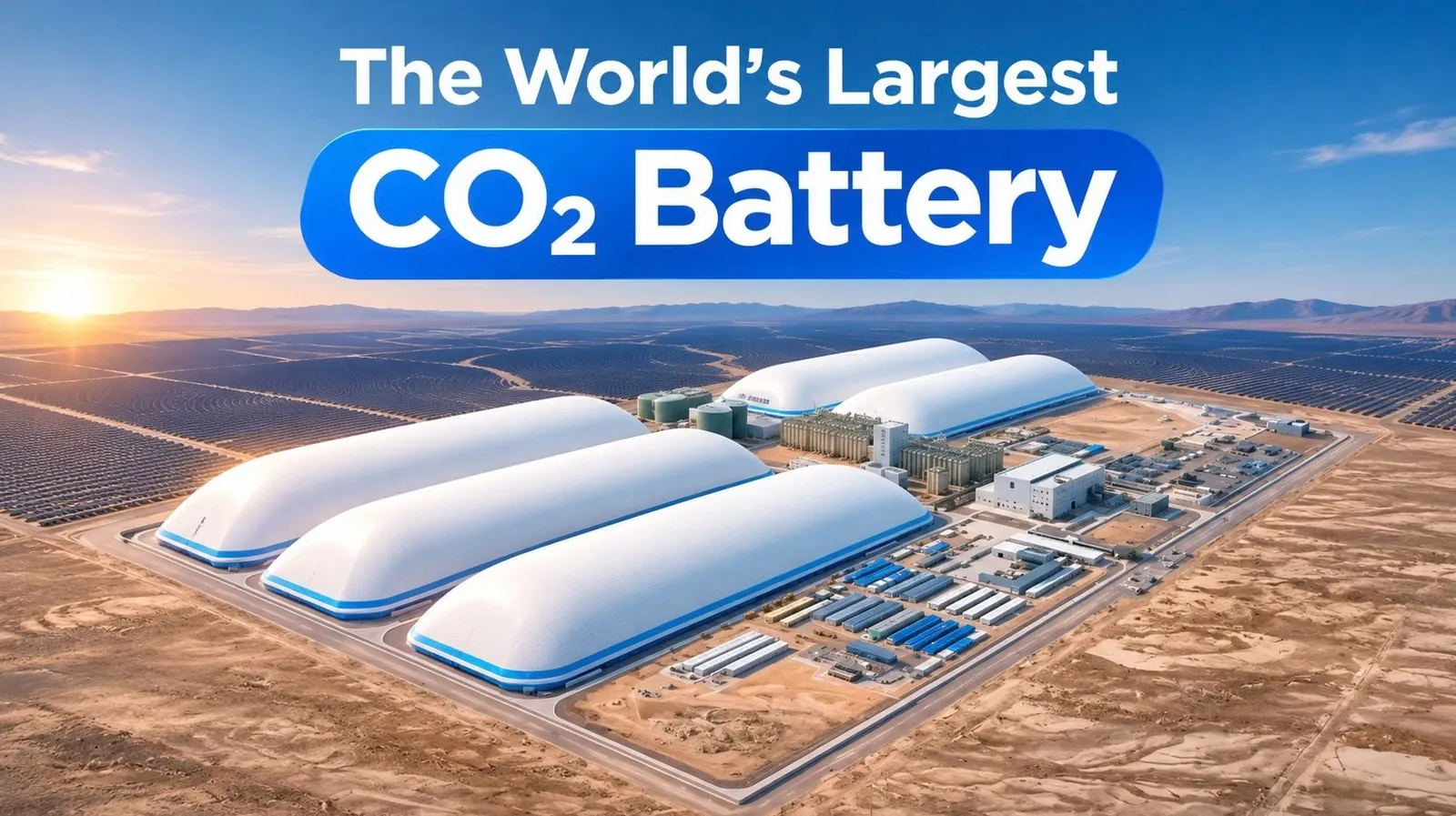
China’s Mulei County is now home to the world’s largest CO2 battery, a facility capable of storing energy from 600 megawatts of wind and 400 megawatts of solar power. With the ability to deliver electricity for up to 10 hours, it highlights progress in long-duration energy storage. However, its overall efficiency remains uncertain, as independent performance data has not yet been released, according to Two Bit da Vinci.
Discover how CO2 batteries use carbon dioxide’s properties under moderate conditions to store and release energy. Learn about their potential cost benefits and scalability for extended storage durations, alongside challenges like low energy density and significant land use. This analysis also compares CO2 batteries to alternatives such as lithium-ion and sodium-ion systems, providing a detailed look at their role in future energy solutions.
The World’s Largest CO2 Battery: A Bold Step with Challenges
TL;DR Key Takeaways :
- China has connected the world’s largest CO2 battery in Mulei County, Xinjiang, designed to store energy from 600 MW of wind and 400 MW of solar power, with a claimed storage duration of up to 10 hours, though overall system efficiency remains unverified.
- CO2 batteries use carbon dioxide’s unique properties to store and release energy, with Energy Dome reporting “70 plus percent” efficiency, lower than the roughly 90% efficiency of lithium-ion batteries, according to MIT Technology Review.
- CO2 batteries are marketed as cost-effective for long-duration storage, with estimated costs of $50–$60 per megawatt-hour and a lifespan of over 30 years, but their low energy density and large land requirements are significant drawbacks.
- Challenges include unverified performance claims, as seen with Energy Dome’s Sardinia plant, which reportedly delivered less power than projected and faced delays, and the inability to reduce atmospheric CO2 due to reliance on pure CO2 from suppliers.
- CO2 batteries may find a niche in applications exceeding eight hours, particularly at fossil fuel sites with existing infrastructure, but their role in the energy storage landscape depends on further validation and long-term studies.
China has connected the world’s largest CO2 battery to the grid in Mulei County, Xinjiang. This facility, five times larger than the previous record holder, represents a significant advancement in energy storage technology. Designed to store energy from 600 megawatts of wind and 400 megawatts of solar power, the plant can deliver stored energy for up to 10 hours.
While the CO2 turbines are reportedly designed to achieve more than 92% efficiency, the overall system efficiency remains unverified, as China Huadyang has not disclosed independently confirmed figures.
How CO2 Batteries Work
CO2 batteries rely on a unique property of carbon dioxide: it condenses into a liquid at around 55 bars of pressure and near ambient temperature, avoiding the cryogenic temperatures required for air-based systems. CO2’s critical temperature is approximately 31° C, just above a warm room, compared to nitrogen’s critical temperature of about -47° C and oxygen’s at about -19° C.
The process involves compressing CO2, storing the heat generated during compression, and condensing the gas into a liquid. During discharge, the liquid CO2 is evaporated, reheated using stored thermal energy, and expanded through a turbine to generate electricity. This system uses eight key components: a compressor, thermal storage medium, condenser, pressure vessel, evaporator, turbine, generator, and an inflatable dome.
Energy Dome, an Italian company developing a similar system, highlights the advantages of this approach, such as avoiding the high costs of compressed air storage. However, CO2 batteries have lower round-trip efficiency compared to lithium-ion batteries. Energy Dome reports “70 plus percent” efficiency, while lithium-ion systems achieve roughly 90%, according to MIT Technology Review.

Advance your skills in energy by reading more of our detailed content.
- $20/kWh Compressed Air Energy Storage Undercuts Lithium-Ion
- Old EV Batteries Keep Up to 80% of Capacity for Local Grids
- MIT Says Energy-Storing Concrete Improves 10-fold by Switching to Organic Electrolyte
- Why Traditional Home Batteries Are Losing Ground to Plug-in Alternatives
- How NASA’s Mars Oxygen Tech Sparked a 100-Hour Battery Breakthrough
Cost and Scalability
CO2 batteries are positioned as a cost-effective solution for long-duration energy storage. Energy Dome’s CEO estimates costs at $50 to $60 per megawatt-hour, while lithium-ion batteries for storage durations exceeding four hours are already within $5 to $15 of that range. The CO2 battery’s longer lifespan, advertised at over 30 years compared to around 12 years for lithium-ion, could improve its economic appeal over time.
Scalability is another potential advantage. A CO2 battery system can expand by adding more domes and CO2, keeping hardware costs relatively stable. In contrast, doubling the storage capacity of lithium-ion systems requires doubling the number of cells, increasing costs proportionally. Mulei County’s CO2 battery employs similar technology developed by a team at Xiang Jaoong University.
At approximately 17° C and atmospheric pressure, 2,000 tons of CO2 occupy about 1.1 million cubic meters, equivalent to a cube slightly over 100 meters on each side when the battery is empty.
Challenges of CO2 Batteries
Despite their promise, CO2 batteries face notable challenges. One major limitation is their low energy density. Mulei County’s CO2 battery stores about a fifth of a watt-hour per liter, approximately 2,000 times less than a lithium-ion cell. This low density results in a larger physical footprint; the Mulei County plant spans around 5 hectares, roughly twice the land area of a comparable lithium-ion battery.
Efficiency and performance claims for CO2 batteries also require further validation. For instance, Energy Dome’s Sardinia plant, completed in July 2025, fell short of its initial power delivery expectations. While it was projected to power 35,000 Italian homes for 10 hours, MIT Technology Review reports the actual figure is closer to 18,000 homes. The Sardinia plant also experienced a year-and-a-half delay, though such timelines are common for emerging technologies.
Notably, CO2 batteries do not involve carbon capture, as impurities introduced during the process complicate the system. Instead, Energy Dome and similar projects purchase pure CO2 from qualified suppliers. While this simplifies operations, it does not contribute to reducing atmospheric CO2 levels.
Comparisons with Other Technologies
The CO2 battery’s niche lies in storage durations of eight hours and beyond, where it is marketed as more cost-effective than lithium-ion systems. However, for shorter durations under four hours, lithium-ion batteries remain the more efficient and economical choice. Sodium-ion batteries are also emerging as a potential competitor, with costs projected to drop to around $42 per kilowatt-hour after 2028, though they are not yet competitive on a full system basis.
Another advantage of CO2 batteries is their ability to use existing infrastructure at fossil fuel sites. Many planned CO2 battery projects, including those in Arizona, India, Wisconsin, and Australia, are located at or near fuel-burning power plants. These sites already have grid interconnections, reducing deployment time and costs. For example:
- Salt River Project, a public utility in Arizona, has announced a 20-year agreement for a CO2 battery pilot plant at its Colorado coal plant.
- NTPC is building a CO2 battery at its Kuji thermal power station in India.
- Alliant Energy plans one near the Columbia Coal Plant in Wisconsin.
- Victoria State Electricity Commission is developing one beside the closed Hazlewood Coal Station.
However, the argument that CO2 batteries benefit from the physical inertia of large generators may weaken over time. Grid-forming inverters, which emulate inertia in software, are becoming increasingly capable. Tests by NEC, which sets North America’s grid reliability standards, show that grid-forming inverters can respond as quickly as physical inertia in the first moments after a grid disturbance.
The Future of CO2 Batteries
The CO2 battery represents a bold step toward long-duration energy storage, offering potential advantages in cost and scalability for applications exceeding eight hours. However, its lower energy density, larger land requirements, and unverified efficiency claims present significant hurdles. While it is unlikely to replace lithium-ion batteries for shorter storage durations, it could find a niche in specific scenarios, particularly at fossil fuel sites with existing infrastructure.
Two Bit da Vinci highlights that the CO2 battery’s primary appeal is in long-duration storage, particularly for applications exceeding eight hours, where it may offer cost and scalability benefits compared to lithium-ion systems. However, its significantly lower energy density, larger land requirements, and unverified efficiency claims remain critical challenges. While its use at fossil fuel sites with existing grid infrastructure could reduce deployment barriers, further validation and longer-term studies will be necessary to determine whether it can reliably fulfill its intended role in the energy storage landscape.
Media Credit: Two Bit da Vinci
Disclosure: Some of our articles include affiliate links. If you buy something through one of these links, Geeky Gadgets may earn an affiliate commission. Learn about our Disclosure Policy.
