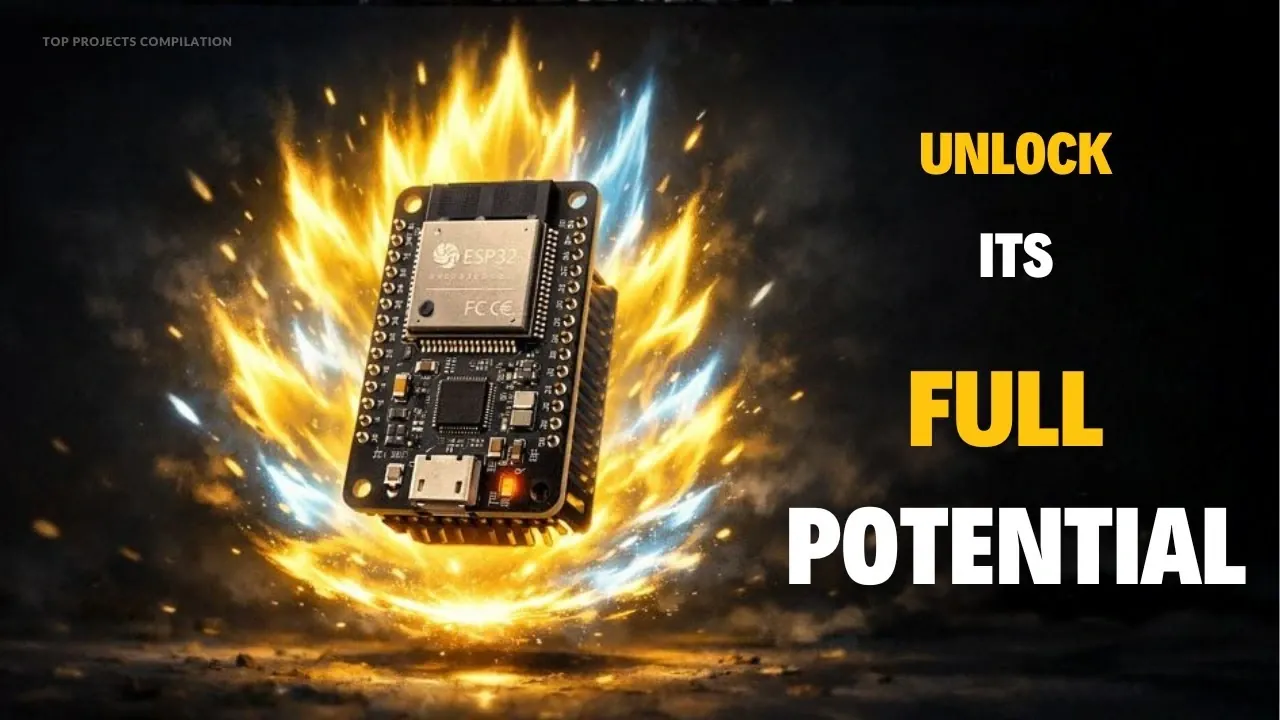
The ESP32 microcontroller has become a go-to choice for developers working on IoT and embedded system projects, offering a combination of versatility and performance. One standout feature is its dual-core architecture, which allows simultaneous execution of tasks across two cores. This setup is particularly beneficial for complex applications, such as managing Wi-Fi communication on one core while processing sensor data on the other. In a recent explainer by ToP Projects Compilation, the ESP32’s capabilities are explored in depth, highlighting how its design supports efficient multitasking and real-time responsiveness.
Dive into this breakdown to discover how features like ESP-NOW for direct device-to-device communication, Over-the-Air (OTA) updates, and integrated FreeRTOS can elevate your projects. You’ll also gain insight into the ESP32’s power-saving modes, which are ideal for battery-dependent systems and its built-in DAC for generating precise analog signals. Whether you’re designing a smart home dashboard or an industrial automation system, this guide provides practical takeaways to help you maximize the potential of the ESP32 in your next project.
Dual-Core Architecture for Multitasking
TL;DR Key Takeaways :
- The ESP32 features a dual-core architecture and integrated FreeRTOS, allowing efficient multitasking and real-time task management for complex applications.
- ESP-NOW protocol allows direct device-to-device communication without Wi-Fi, ideal for low-power and decentralized IoT systems.
- Over-the-Air (OTA) updates and deep sleep mode enhance device maintenance, power efficiency and longevity, making it suitable for remote and battery-powered projects.
- Built-in DAC, Wi-Fi and Bluetooth coexistence and asynchronous web server capabilities support versatile applications, including audio systems, smart home dashboards and cloud-connected devices.
- Enhanced security with TLS and Direct Memory Access (DMA) ensures secure communication and high-speed data handling for demanding IoT and embedded system projects.
The ESP32’s dual-core architecture is designed to handle multitasking with ease, allowing simultaneous execution of tasks on two separate cores. This capability is particularly useful for complex projects where different functions need to operate independently. For instance:
- One core can manage Wi-Fi communication and networking tasks.
- The other core can handle sensor data processing or control operations.
By assigning specific tasks to each core, you can achieve smoother performance and ensure real-time responsiveness, even in demanding applications.
Integrated FreeRTOS for Task Management
The ESP32 includes FreeRTOS, a real-time operating system that simplifies task management. FreeRTOS allows you to prioritize critical operations, making sure that time-sensitive tasks are executed without delays. Even on a single core, it enables efficient handling of concurrent processes. This feature is particularly beneficial for applications such as:
- Robotics, where precise timing is crucial.
- Smart systems requiring simultaneous control of multiple devices.
With FreeRTOS, you can build systems that are both reliable and responsive.

Explore further guides and articles from our vast library that you may find relevant to your interests in ESP32.
- $5 ESP32-S3 Super Mini Packs Wi-Fi and Bluetooth
- How an $8 ESP32 S3 Microcontroller Runs a 28.9M Parameter Local LLM
- $4 ESP32 Module Brings Wi-Fi and Bluetooth to IoT Projects
- ESP32 S31 Devkit Hands-on: 320 MHz RISC-V Chip Adds Wi-Fi 6
- $4 ESP32-S3 Super Mini Packs a 0.96-Inch IPS TFT Screen
- Build a DIY Open source Flipper Zero Using a ESP32-DIV
- $9 CYD ESP32 Module Includes a 2.88-Inch LCD Screen
- ESP32-S3 Automation System Packs 16 Relays for Smart Homes
- $5 ESP32 S3 Board Packs a 240 MHz Dual-Core Chip
- Optimize ESP32 Battery Life Using 10 Lesser-Known Features
ESP-NOW: Direct Device-to-Device Communication
ESP-NOW is a unique communication protocol that allows ESP32 devices to exchange data directly without relying on a Wi-Fi network or router. This feature is ideal for scenarios where low power consumption and fast communication are critical. Key applications include:
- Remote monitoring systems, such as agricultural sensors.
- Low-power IoT networks that need to operate independently of external infrastructure.
By allowing instant and energy-efficient communication, ESP-NOW expands the possibilities for decentralized IoT systems.
Asynchronous Web Server with Websockets
The ESP32 supports an asynchronous web server, allowing it to handle web requests in the background without interrupting the main program. When combined with Websockets, it facilitates real-time updates on web interfaces without requiring page reloads. This capability is particularly advantageous for:
- Smart home dashboards that display live data.
- Remote device monitoring systems with instant feedback.
This feature enhances user experience by providing seamless and interactive web-based control.
Over-the-Air (OTA) Updates
With Over-the-Air (OTA) updates, you can wirelessly upload new firmware to your ESP32 devices, eliminating the need for physical connections. This is especially valuable for devices deployed in remote or hard-to-access locations. OTA updates allow you to:
- Fix software bugs or introduce new features without manual intervention.
- Ensure your devices remain up-to-date and secure over time.
This feature simplifies maintenance and extends the lifecycle of your IoT projects.
Power Management and Deep Sleep Mode
The ESP32 is engineered for power efficiency, making it an excellent choice for battery-powered applications. Its deep sleep mode drastically reduces power consumption, allowing devices to operate for extended periods. Additionally, the Ultra-Low Power (ULP) co-processor can handle simple tasks, such as reading sensor data, while the main processor remains in deep sleep. This functionality is ideal for:
- Environmental monitoring systems that require long battery life.
- Wearable devices designed for extended operation.
By optimizing power usage, the ESP32 supports sustainable and long-lasting designs.
Built-in DAC for Analog Output
The ESP32 features a built-in Digital-to-Analog Converter (DAC), allowing you to generate true analog signals without the need for external components. This simplifies the design of projects requiring precise analog output. Applications include:
- Audio systems, such as sound synthesis or playback devices.
- Control of analog devices like motors, actuators, or lighting systems.
The DAC provides flexibility for projects that demand high-quality analog signal generation.
Wi-Fi and Bluetooth Coexistence
The ESP32 supports simultaneous operation of Wi-Fi and Bluetooth, including both Classic Bluetooth and Bluetooth Low Energy (BLE). This dual connectivity is invaluable for projects that require:
- Cloud-based data transmission via Wi-Fi.
- Local communication with nearby devices through Bluetooth.
For example, you can design a smart device that streams data to the cloud while interacting with a smartphone app, offering both remote and local control.
Enhanced Security with TLS
Security is a critical consideration in IoT projects and the ESP32 addresses this with built-in support for Transport Layer Security (TLS). TLS encrypts data and verifies certificates, making sure secure communication between devices. This feature is essential for applications involving sensitive information, such as:
- Financial transactions or payment systems.
- Protection of personal data in smart home devices.
By integrating TLS, the ESP32 helps safeguard your projects against unauthorized access and data breaches.
Direct Memory Access (DMA) for High-Speed Data Handling
The ESP32’s Direct Memory Access (DMA) feature enables data to move between memory and peripherals without involving the CPU. This reduces processing overhead and ensures smooth operation for tasks requiring high-speed data handling. Examples include:
- Rendering animations or graphics in real-time.
- Processing audio streams or acquiring high-frequency sensor data.
DMA is particularly beneficial for applications where minimal latency and efficient data transfer are critical.
Unlocking the Potential of the ESP32
The ESP32’s advanced features make it a versatile and powerful platform for IoT, automation and embedded system projects. From its dual-core architecture and real-time task management to its low-power operation and secure communication, the ESP32 equips you with the tools to build efficient, reliable and scalable solutions. Whether you’re developing a smart home device, a wearable gadget, or an industrial automation system, the ESP32 enables you to bring your ideas to life with precision and performance.
Media Credit: ToP Projects Compilation
Disclosure: Some of our articles include affiliate links. If you buy something through one of these links, Geeky Gadgets may earn an affiliate commission. Learn about our Disclosure Policy.
