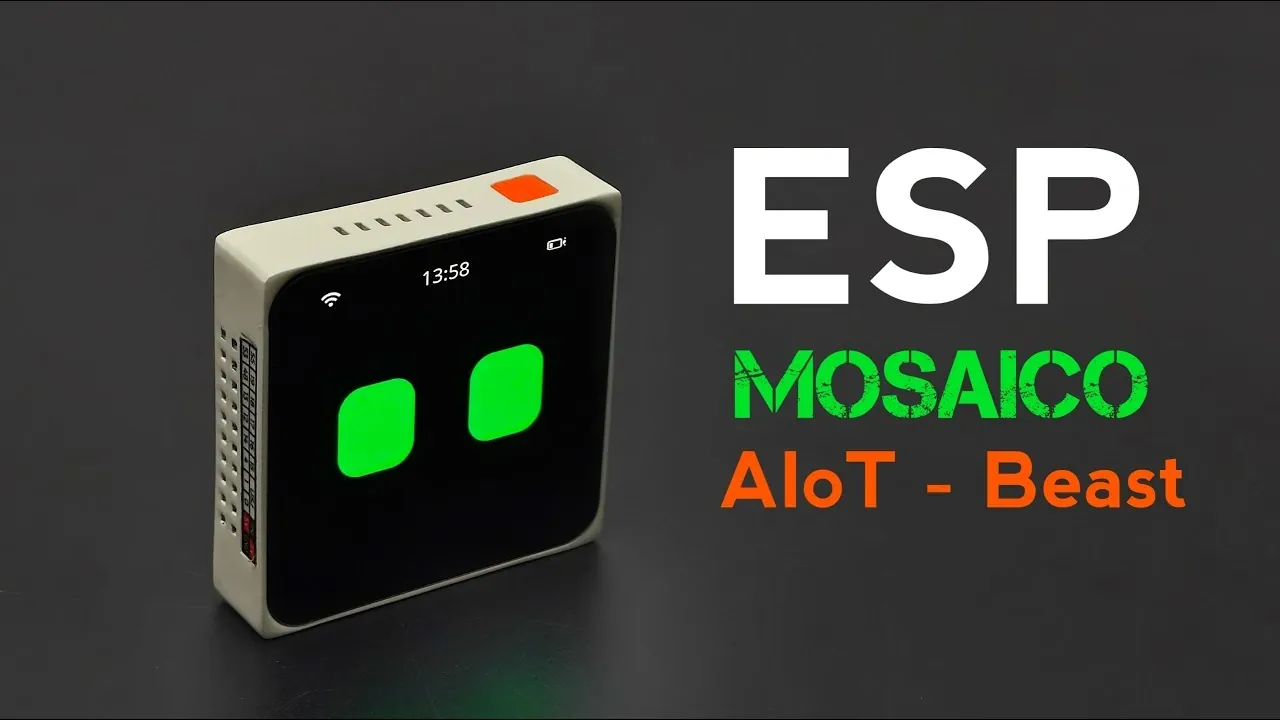
Compact yet feature-packed, the ESP M5Stack Go development board offers a robust platform for IoT, AI and multimedia projects. At its core is the ESP32-S3 chip, a dual-core processor running at 320 MHz, which ensures smooth performance for demanding applications. The board includes standout features like a 2.16-inch AMOLED touchscreen, a 3W speaker, and a BMI270 6-axis sensor for motion tracking, making it suitable for interactive and sensor-driven projects. However, as noted by EDISON SCIENCE CORNER, its 65 mAh battery limits runtime to just 30 minutes, making it better suited for stationary setups or projects with intermittent power.
Dive into this explainer to explore how the ESP M5Stack Go can elevate your development process. You’ll gain insight into its wireless connectivity options for IoT integration, learn about its expansion capabilities like the SCC301 IoT camera module and discover its compatibility with frameworks such as ESP-IDF and block coding for streamlined programming. Whether you’re designing a smart home controller, a multimedia interface, or a motion-sensitive device, this guide will help you unlock the board’s potential for your next project.
ESP M5Stack Go
TL;DR Key Takeaways :
- The ESP M5Stack Go is a compact development board featuring the powerful ESP32-S3 chip, a 2.16-inch AMOLED touchscreen and robust wireless connectivity, ideal for IoT, AI and multimedia projects.
- Key hardware includes a 3W speaker, onboard microphone, 16 MB PSRAM, 128 MB SPI NAND flash, BMI270 6-axis sensor and a USB Type-C port for charging and data transfer.
- Its 65 mAh battery provides only 30 minutes of runtime, making it more suitable for stationary or intermittently powered applications rather than portable or long-duration use.
- The board supports ESP-IDF and ESP block coding for flexible programming, with pre-built firmware available for projects like wireless Spotify controllers, PC status displays and AI assistants.
- Expansion options, such as the SCC301 IoT DVP camera module, enable applications in surveillance, computer vision and real-time video processing, enhancing its versatility for developers and hobbyists.
At the core of the ESP M5Stack Go is the ESP32-S3 chip, equipped with a 320 MHz 32-bit dual-core processor. This ensures smooth and efficient performance, even for computationally demanding tasks. The board also features a 2.16-inch AMOLED touchscreen with a 480×480 resolution, offering vibrant visuals and a responsive interface that enhances user interaction.
Additional hardware highlights include:
- A 3W speaker powered by the NS4150B amplifier, delivering clear audio for playback and voice-based applications.
- An onboard microphone, allowing voice recognition and audio input for interactive projects.
- 16 MB of PSRAM and 16 MB of flash storage, complemented by 128 MB of SPI NAND flash for storing larger multimedia files.
- A BMI270 6-axis sensor, combining an accelerometer, gyroscope and geomagnetic sensor for precise motion tracking and orientation detection.
- A USB Type-C port for fast charging, data transfer and firmware updates.
Despite its impressive hardware, the board’s 65 mAh battery provides only about 30 minutes of runtime, which limits its portability and suitability for long-term standalone use.
Connectivity and Expansion Options
The ESP M5Stack Go excels in wireless connectivity, making it an ideal choice for IoT projects. Whether you are developing a smart home device, a wearable gadget, or a remote monitoring system, the board ensures reliable communication with other devices through its advanced wireless capabilities.
For hardware expansion, the board includes 2.54 mm pitch header pins, allowing seamless integration with additional modules or sensors. One particularly notable expansion option is the rotatable SCC301 IoT DVP camera module, which supports image capture and video streaming. This feature makes the board suitable for applications such as surveillance systems, computer vision projects, or real-time video processing.

Take a look at other insightful guides from our broad collection that might capture your interest in ESP32.
- $5 ESP32-S3 Super Mini Packs Wi-Fi and Bluetooth
- The $4 ESP32 S3 Super Mini Packs a 240 MHz Dual-Core Chip
- How an $8 ESP32 S3 Microcontroller Runs a 28.9M Parameter Local LLM
- 5 ESP32 Projects Worth Building in 2026: Such as an Apple HomeKit Controller
- $4 ESP32 Module Brings Wi-Fi and Bluetooth to IoT Projects
- Replacing Security Cameras with Three $10 ESP32S3 Wi-Fi Boards
- ESP32-S3 Super Mini Costs $5 and Packs Wi-Fi and Bluetooth
- ESP32-S3 Super Mini Brings 240 MHz Dual-Core Power For $4
- ESP32 S31 Devkit Hands-on: 320 MHz RISC-V Chip Adds Wi-Fi 6
- Build a DIY Open-Source Flipper Zero Using a ESP32-DIV
Programming and Development
The ESP M5Stack Go supports ESP-IDF, the official development framework for ESP32 chips, offering a robust and flexible platform for programming and debugging. For developers who prefer a more visual approach, the board also supports ESP block coding, which simplifies the development process, especially for beginners. However, certain advanced features, such as AI model integration, may require a subscription to unlock their full potential.
The board’s versatility is evident in its wide range of potential applications. For example, it can be used as:
- A wireless Spotify controller, allowing seamless music playback and control.
- A PC status display, providing real-time system information on its AMOLED screen.
- A personal AI assistant, powered by Xiaoqi AI, capable of voice interactions and intelligent responses.
Developers can access pre-built firmware for these projects on GitHub, making it easy to get started and customize the board for specific use cases.
Limitations to Consider
While the ESP M5Stack Go offers an impressive array of features, its limited battery life is a significant drawback. The 65 mAh battery provides only about 30 minutes of operation, which restricts its use in portable or long-duration applications. This limitation makes the board better suited for stationary projects or those that can rely on intermittent power sources.
Additionally, while the board supports a variety of programming frameworks, some advanced functionalities may require additional subscriptions or expertise, which could be a barrier for some users.
Practical Applications
The compact design and extensive functionality of the ESP M5Stack Go make it suitable for a diverse range of applications. Its onboard sensors, wireless capabilities, and multimedia features allow it to adapt to both creative and technical projects. Some potential applications include:
- A secondary computer display, using its AMOLED touchscreen for sharp and vibrant visuals.
- A personal AI assistant, capable of voice interactions, real-time responses and integration with smart home systems.
- Interactive IoT devices, such as smart home controllers, wearable gadgets, or environmental monitoring systems.
The board’s ability to integrate with additional modules, such as the SCC301 camera, further expands its potential for surveillance, computer vision, and multimedia applications.
Final Thoughts
The ESP M5Stack Go stands out as a versatile and compact development board that combines advanced hardware with robust connectivity and flexible programming options. Its AMOLED touchscreen, multimedia capabilities, and onboard sensors provide a solid foundation for a wide variety of IoT, AI and multimedia projects. While its limited battery life may pose challenges for portable or long-duration use, the board’s adaptability and potential for diverse applications make it a valuable tool for both developers and hobbyists. Whether you are building a smart home device, an AI-powered assistant, or an interactive multimedia project, the ESP M5Stack Go offers the tools and flexibility to bring your ideas to life.
Media Credit: EDISON SCIENCE CORNER
Disclosure: Some of our articles include affiliate links. If you buy something through one of these links, Geeky Gadgets may earn an affiliate commission. Learn about our Disclosure Policy.
