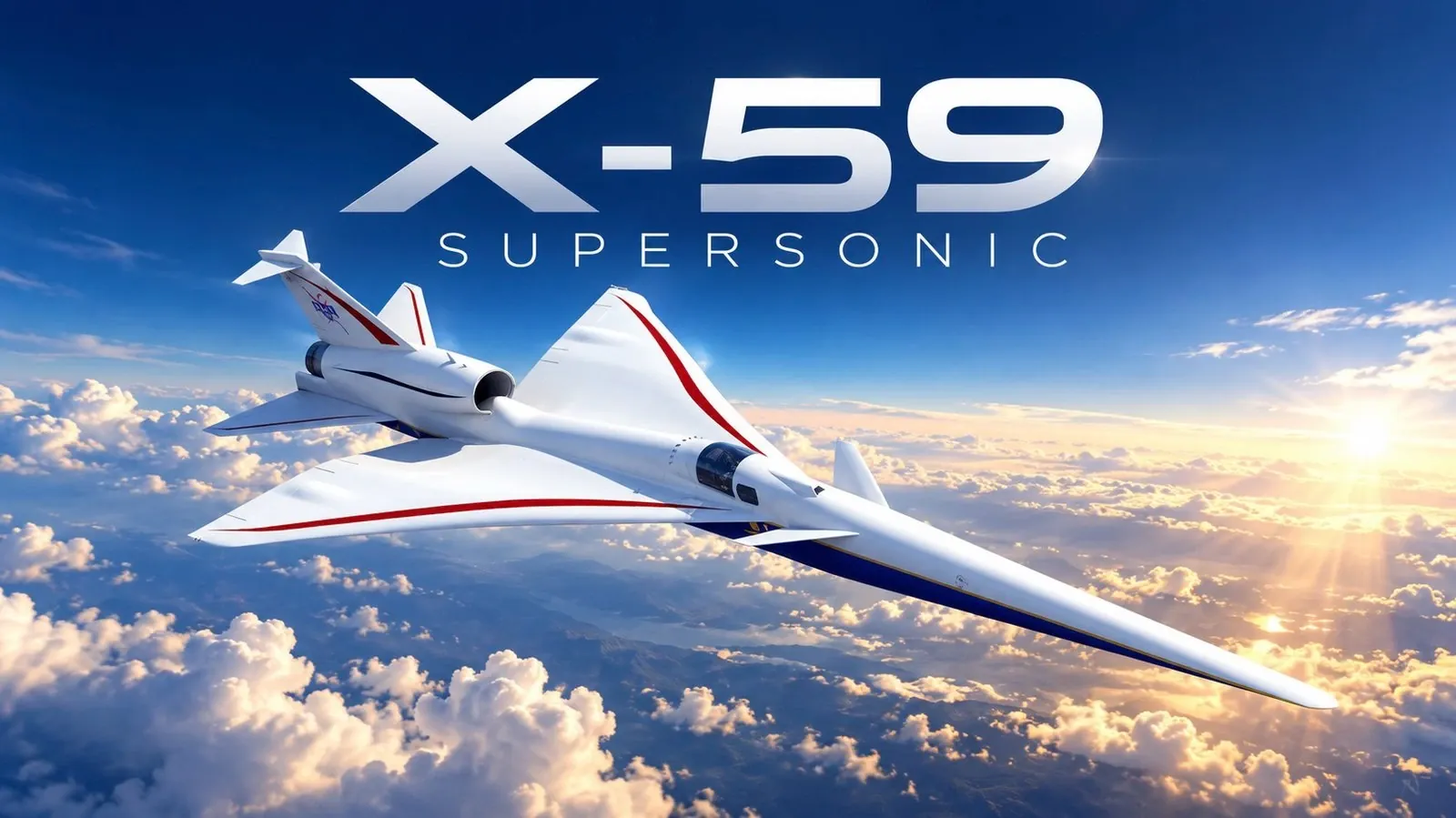
The X-59 is a supersonic aircraft developed by NASA in partnership with Lockheed Martin’s Skunk Works, designed to address the long-standing issue of sonic booms. Unlike earlier supersonic planes, it produces a quieter “sonic thump,” roughly equivalent to the sound of a door closing at 75 decibels. This is achieved through specific design elements, such as its elongated nose, which reduces shock wave intensity and its External Vision System, which replaces traditional cockpit windows with high-resolution cameras. As Real Engineering explains, these features are intended to meet both technical and regulatory requirements, potentially paving the way for supersonic flight over land.
Dive into how the X-59’s engineering addresses key challenges, including the reduction of shock wave formation and aerodynamic drag. Learn about the application of the Whitcomb Area Rule in shaping the aircraft for optimal performance and gain insight into how community response testing informs regulatory decisions. This overview provides a detailed look at the technical and procedural steps shaping the future of supersonic travel.
What Makes the X-59 Unique?
TL;DR Key Takeaways :
- The X-59, developed by NASA and Lockheed Martin, is designed to produce a quieter “sonic thump” instead of a disruptive sonic boom, addressing noise restrictions for supersonic flights over land.
- Key design innovations include a long, slender nose, delta wings, an External Vision System (XVS), and advanced aerodynamic features to reduce noise and improve efficiency.
- The aircraft aims to lower sonic boom noise to around 75 decibels, comparable to a door slam, potentially allowing faster and quieter global travel.
- Extensive testing, including community response flights, will assess public acceptance and provide data to support regulatory changes for supersonic aviation.
- The X-59 builds on lessons from past supersonic aircraft like the Concorde, addressing challenges such as noise, fuel efficiency and economic viability with modern engineering advancements.
The X-59’s primary mission is to reduce the intensity of sonic booms to a level that is acceptable for flights over populated areas. Historically, supersonic aircraft like the Concorde faced strict operational restrictions due to their loud sonic booms, which disrupted communities and led to regulatory bans on overland supersonic travel. The X-59 seeks to lower this noise to approximately 75 decibels, comparable to the sound of a door slam or a passing truck. This breakthrough could enable faster, quieter global transportation, fundamentally altering the way you travel long distances.
The aircraft’s design prioritizes noise reduction without compromising performance. By addressing the core issue of sonic boom intensity, the X-59 has the potential to unlock new opportunities for supersonic aviation, making it a viable option for both commercial and private air travel.
Key Innovations in Design
The X-59 incorporates a range of new features that enable its low-boom performance. These design elements work in harmony to achieve the aircraft’s ambitious objectives:
- Long, Slender Nose: The elongated nose smooths airflow and reduces the intensity of shock waves, significantly minimizing noise during supersonic flight.
- Delta Wings and Canards: These aerodynamic features enhance stability and efficiency, making sure optimal performance at high speeds.
- External Vision System (XVS): To compensate for the obstructed forward visibility caused by the elongated nose, the X-59 replaces traditional cockpit windows with advanced cameras and displays, providing pilots with a clear view.
- Divertless Supersonic Inlet: This innovative system manages airflow into the engine, reducing drag and improving overall efficiency.
- Whitcomb Area Rule: By optimizing the aircraft’s shape, this principle minimizes drag and enhances aerodynamic performance.
These features collectively address the technical challenges of supersonic flight, setting the X-59 apart from earlier supersonic aircraft. The integration of these innovations demonstrates how modern engineering can overcome longstanding obstacles in aviation.

Discover other guides from our vast content that could be of interest on energy.
- Proxima Fusion Plans the Alpha Stellarator for the Early 2030S
- How the Super Soaker Inventor Built a Heat Engine Without Moving Parts
- MIT Says Energy-Storing Concrete Improves 10-fold by Switching to Organic Electrolyte
- Sun-Ways Installs 18 kW Removable Solar Panels on Train Tracks
- Apple Silicon AI Performance: Local Al on Apple Silicon Uses 7X Less RAM
- Apple Watch Ultra 4 Leak Reveals Redesign and Health Features
- Google DeepMind CEO Says AGI Could Arrive in 3 to 5 Years
- iPhone Ultra Fold Leaks Reveal Apple’s First Foldable Phone
- Recent iPhone 18 Leaks Detail the Release Date and $899 Price
- Bloom Energy Server – Bloom Box Fuel Cell Gets Official
Overcoming Engineering Challenges
Designing an aircraft capable of quiet supersonic flight presents significant technical hurdles. Two primary challenges, shock wave formation and aerodynamic drag, directly impact both noise levels and fuel efficiency. The X-59 addresses these issues by distributing lift sources along its fuselage and wings, preventing shock waves from merging into a disruptive boom. This approach ensures that the aircraft can achieve supersonic speeds without generating excessive noise.
To manage costs and streamline development, the X-59 incorporates components from existing military aircraft. This strategy uses proven technologies while maintaining economic viability. Additionally, extensive wind tunnel testing and advanced computer simulations have been conducted to refine the design and predict its real-world performance. These efforts underscore the meticulous planning and engineering required to bring the X-59 to life.
Testing the X-59
The development and testing of the X-59 follow a rigorous, data-driven process. Wind tunnel experiments and computer simulations have played a crucial role in validating the aircraft’s design. Initial flight tests began in 2025, with the X-59 achieving supersonic speeds in 2026. These tests are essential for assessing the aircraft’s performance and verifying its ability to produce quieter sonic booms.
A critical phase of the project involves community response testing. During this phase, the X-59 will conduct flights over various U.S. cities to evaluate public reactions to its sonic thump. This data will be instrumental for regulatory agencies, providing the evidence needed to shape future policies on supersonic travel. By engaging with communities and gathering feedback, the project aims to build public trust and support for the next generation of supersonic aviation.
Learning from the Past
The X-59 builds on the lessons learned from earlier supersonic aircraft, such as the Concorde and the Soviet Tu-144. While these aircraft were new in their time, they faced significant limitations, including loud sonic booms, high operating costs and environmental concerns. The Concorde, for example, was restricted to overwater routes due to its disruptive noise levels and its high fuel consumption made it economically unsustainable.
The X-59 addresses these challenges with modern advancements in noise reduction, fuel efficiency and aerodynamic design. By incorporating state-of-the-art technologies and innovative engineering principles, the X-59 demonstrates how far supersonic aviation has progressed. These improvements not only make supersonic travel more practical but also align with contemporary priorities, such as sustainability and community impact.
Future Prospects and Challenges
The X-59 has the potential to transform air travel, but its success depends on overcoming several critical hurdles. Regulatory changes will be essential, as current restrictions prohibit supersonic flights over land. Economic challenges, such as high fuel costs and limited passenger capacity, must also be addressed to ensure the commercial viability of supersonic travel.
One promising avenue for addressing these challenges is the development of hybrid engines, which could improve fuel efficiency and extend the range of supersonic aircraft. Additionally, the competitive landscape is evolving, with companies like Boom Supersonic exploring alternative approaches to supersonic travel. This competition could accelerate innovation and drive the adoption of new technologies, further advancing the field.
The X-59’s success will also depend on public acceptance. Community response testing and transparent communication will play a vital role in building trust and demonstrating the benefits of quieter supersonic flight. By addressing these challenges head-on, the X-59 could usher in a new era of sustainable, accessible supersonic aviation, reshaping the way you experience global travel.
Media Credit: Real Engineering
Disclosure: Some of our articles include affiliate links. If you buy something through one of these links, Geeky Gadgets may earn an affiliate commission. Learn about our Disclosure Policy.
