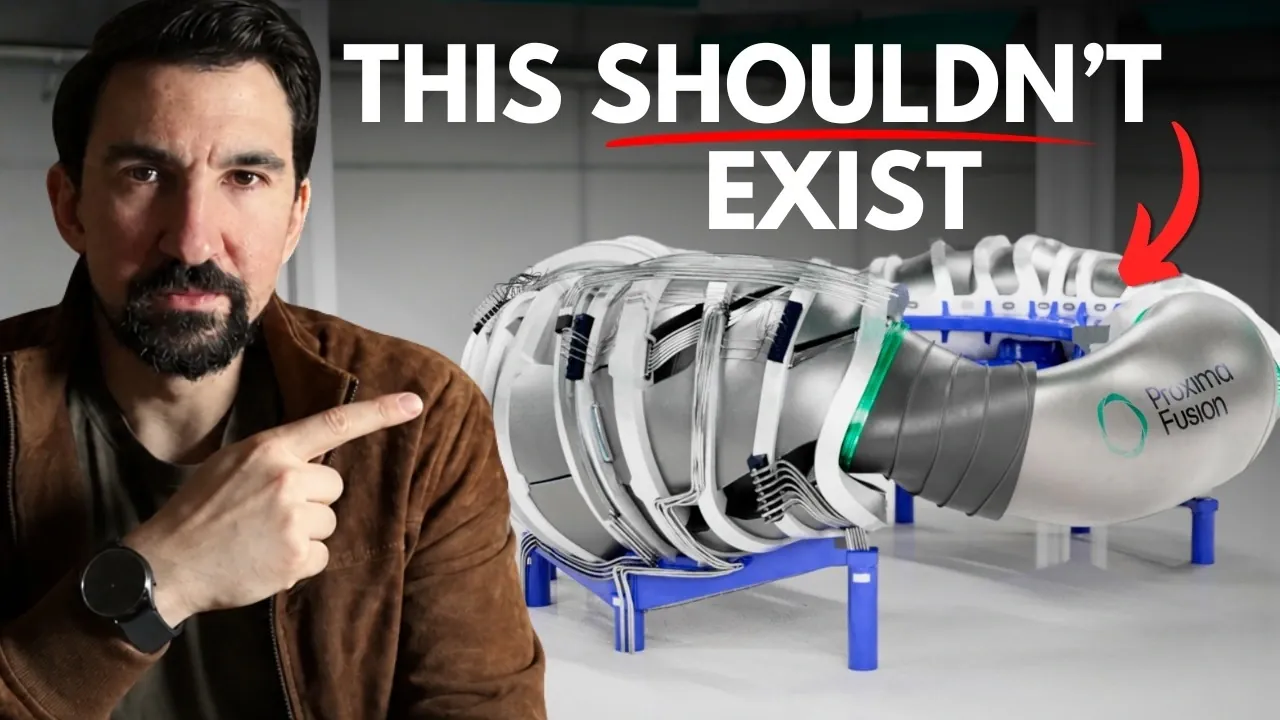
Europe’s efforts to develop a commercial nuclear fusion reactor are gaining momentum, with Proxima Fusion leading the charge. Founded in 2023, this company is advancing the stellarator, a complex reactor design that uses a helical magnetic field to confine plasma for sustained fusion reactions. Unlike the more common tokamak, which operates in pulses, the stellarator offers continuous operation and enhanced stability, though it demands precise magnetic field configurations to function effectively. Dr Ben Miles explores how breakthroughs in computational modeling and advanced superconducting materials are helping Proxima Fusion overcome these challenges, bringing the promise of net-energy-gain fusion closer to reality.
Dive into this breakdown to understand how Proxima Fusion is addressing the intricate demands of stellarator technology. You’ll gain insight into the role of rare-earth superconductors in creating compact, high-performance magnets, the importance of quasi-isodynamic optimization for reducing energy loss and the ambitious milestones set for the 2030s. These elements provide a clear view of how Europe is positioning itself at the forefront of fusion energy innovation, with implications that could reshape global energy systems.
What Makes the Stellarator Unique?
TL;DR Key Takeaways :
- Proxima Fusion, founded in 2023, is spearheading the development of a commercial stellarator-based nuclear fusion reactor, aiming for net-energy-gain by the 2030s to address the global energy crisis and reduce carbon emissions.
- The stellarator’s unique donut-shaped design with a helical magnetic field offers continuous operation and greater stability compared to tokamaks, overcoming past challenges through advancements in computational modeling and magnetic field optimization.
- Key technological breakthroughs include advanced superconductors (ReBCO tapes), precision-engineered magnetic coils and quasi-isodynamic optimization, significantly improving reactor efficiency and plasma confinement.
- Proxima Fusion’s roadmap includes testing a full-scale model coil by 2027, building a demonstration reactor (“Alpha”) in the early 2030s and deploying the first commercial power plant (“Stellaris”) by the late 2030s, with plans for 50 plants worldwide by 2050.
- Fusion energy promises fantastic benefits, including clean, carbon-free power, reduced industrial emissions, advancements in medical isotopes for healthcare and economic growth through innovation in advanced materials and engineering.
The stellarator stands out as a distinctive approach to nuclear fusion. Its donut-shaped design utilizes a helical magnetic field to confine plasma, the superheated state of matter where fusion reactions occur. Unlike the more widely known tokamak reactor, which operates in pulses and relies on symmetrical magnetic fields, the stellarator offers continuous operation and greater inherent stability. However, its intricate design requires highly precise magnetic field configurations to prevent plasma drift and energy loss. Recent advancements in computational modeling have enabled engineers to optimize these magnetic fields, overcoming challenges that previously limited the stellarator’s potential. These innovations are pivotal in achieving sustained fusion reactions and moving closer to practical fusion energy.
The Challenges of Fusion Energy
Nuclear fusion is often referred to as the “holy grail” of energy due to its potential to provide virtually limitless, clean power. However, achieving fusion is an extraordinary scientific and engineering challenge. The process requires meeting the “triple product” criteria: extremely high plasma temperatures exceeding 100 million degrees Celsius, sufficient plasma density and prolonged confinement time. Plasma confinement is particularly difficult, as high-energy particles tend to escape magnetic fields. To address this, Proxima Fusion is developing advanced superconducting magnets capable of generating stronger and more stable magnetic fields. These innovations are critical for maintaining the conditions necessary for fusion and achieving the elusive goal of net energy gain.

Browse through more resources below from our in-depth content covering more areas on energy.
- How the Super Soaker Inventor Built a Heat Engine Without Moving Parts
- Best Phone Battery Life 2025: OnePlus 15, vivo X300 Pro, & iPhone 17 Pro Max
- The Battery BATTLE ROYALE – iPhone, Pixel, Galaxy, Xiaomi – Who Wins the Drain Test
- Apple Home vs Google Home: How iOS 27 Changes the Ecosystem
- Every Major Apple Announcement Leaked Ahead of WWDC 2026
- Apple Silicon AI Performance: Local Al on Apple Silicon Uses 7X Less RAM
- Apple Watch Ultra 4 Leak Reveals Redesign and Health Features
- The Biggest Hidden Features Inside Apple’s iOS 27 Update
- The MacBook Ultra Leak Just Revealed Apple’s Next Big Move
- What Makes the Seawater Battery a Breakthrough for Sustainability
Technological Breakthroughs Driving Progress
Proxima Fusion’s approach to advancing stellarator technology is rooted in several new innovations:
- Advanced Superconductors: The use of rare-earth barium copper oxide (ReBCO) superconducting tapes allows for the creation of magnets that can sustain higher magnetic fields at cryogenic temperatures. These materials are more efficient and compact than traditional superconductors, allowing smaller and more powerful reactor designs.
- Precision Engineering: Advances in computational modeling enable engineers to design magnetic coils with unprecedented accuracy, making sure optimal plasma confinement and minimizing energy losses.
- Quasi-Isodynamic Optimization: This technique reduces plasma leakage by optimizing the magnetic field configuration, significantly improving reactor efficiency and stability.
These technological advancements are transforming the feasibility of stellarators, positioning them as a serious contender in the race to achieve practical fusion energy.
From Early Setbacks to Renewed Interest
The stellarator was one of the earliest fusion reactor designs, developed during the mid-20th century. However, early models faced significant challenges, including excessive plasma leakage and complex engineering requirements. These issues led researchers to favor tokamaks, which initially demonstrated better performance and simpler designs. Recent breakthroughs in materials science, computational modeling and magnetic field optimization have reignited interest in stellarators. Proxima Fusion is building on this renewed momentum, aiming to establish the stellarator as a cornerstone of future energy systems. By addressing the limitations of earlier designs, the company is paving the way for a new era in fusion technology.
Proxima Fusion’s Roadmap to Success
Proxima Fusion has outlined an ambitious roadmap to bring its vision of commercial fusion energy to reality:
- 2027: Develop and test a full-scale stellarator model coil to validate the feasibility of its design and magnetic field configurations.
- Early 2030s: Construct “Alpha,” a demonstration reactor designed to achieve net energy gain and prove the viability of stellarator-based fusion.
- Late 2030s: Build “Stellaris,” the first commercial stellarator power plant, capable of delivering clean, sustainable energy to the grid.
- By 2050: Deploy 50 fusion power plants worldwide, providing a scalable and reliable solution to the global energy crisis.
This timeline reflects Proxima Fusion’s commitment to advancing fusion technology and addressing the world’s growing energy demands with a long-term, sustainable strategy.
The Fantastic Potential of Fusion Energy
If successful, stellarator-based fusion reactors could transform multiple industries and contribute to global sustainability in profound ways:
- Clean Energy: Fusion is inherently carbon-free and produces no long-lived radioactive waste, eliminating many of the environmental and safety concerns associated with traditional nuclear power.
- Industrial Applications: Fusion reactors could provide high-temperature heat for industrial processes such as steel smelting and chemical production, significantly reducing carbon emissions in these energy-intensive sectors.
- Medical Advancements: The neutrons produced by fusion reactions are essential for generating medical isotopes used in cancer treatments and diagnostic imaging, potentially improving healthcare outcomes worldwide.
- Economic Growth: The development and deployment of fusion technology could stimulate innovation and create new industries, particularly in advanced superconducting materials, cryogenics and precision engineering.
These benefits underscore the immense potential of fusion energy, not only as a clean and sustainable power source but also as a fantastic option for technological and economic progress.
Europe’s Leadership in Fusion Energy
Proxima Fusion’s pursuit of a commercial stellarator represents a bold step forward in Europe’s leadership in nuclear fusion research. By combining advanced materials, precision engineering and state-of-the-art computational modeling, the company is addressing the challenges that have long hindered the realization of fusion energy. If successful, this initiative could redefine global energy production, reduce carbon emissions and unlock new possibilities in medical and industrial applications. As Europe leads the charge in this ambitious endeavor, the dream of harnessing the power of the stars is closer than ever to becoming a reality.
Media Credit: Dr Ben Miles
Disclosure: Some of our articles include affiliate links. If you buy something through one of these links, Geeky Gadgets may earn an affiliate commission. Learn about our Disclosure Policy.
