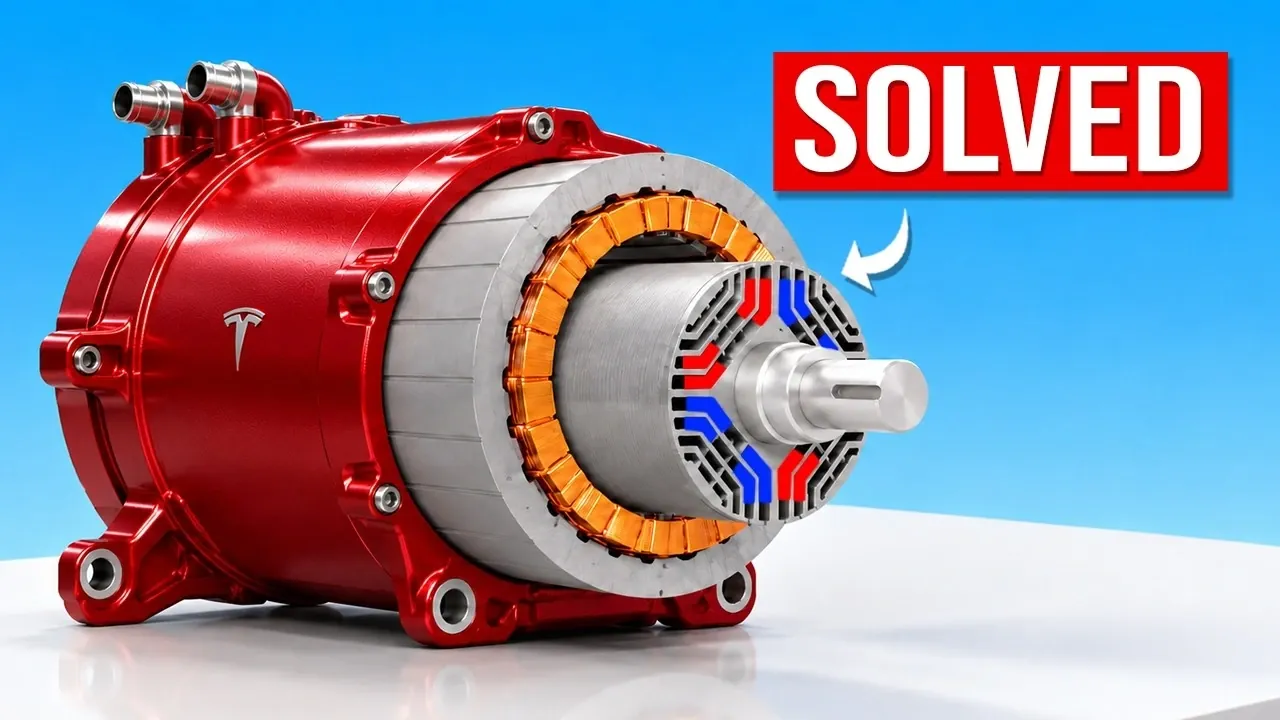
Tesla’s latest electric motor for the Cyber Cab represents a notable shift in EV design by eliminating rare earth materials. The motor is 18% smaller and 25% lighter than similar models, relying on ferrite magnets instead of rare earth options like neodymium. While ferrite magnets are typically less effective, Tesla has addressed this through a hybrid system that combines permanent magnet torque with reluctance torque. As Ziroth explains, this approach reduces environmental and supply chain challenges while maintaining Tesla’s performance benchmarks.
Explore how specific features, such as the dual-layer magnet configuration and non-magnetic rotor filler, improve efficiency and power delivery. Learn how the motor’s compact design supports streamlined manufacturing and enhances vehicle functionality. This guide also considers the broader impact of Tesla’s material choices on the sustainability of electric vehicle production.
Rare Earth-Free Electric Motor
TL;DR Key Takeaways :
- Tesla has introduced a rare earth-free electric motor for its Cyber Cab, which is 18% smaller, 25% lighter and environmentally sustainable, addressing critical supply chain and ecological challenges.
- The motor uses ferrite magnets instead of rare earth materials, maintaining high performance through advanced engineering techniques like hybrid permanent magnet and reluctance torque strategies.
- Innovative design features, such as a dual-layer magnet configuration and non-magnetic rotor filler, enhance efficiency, power output and speed, compensating for the limitations of ferrite magnets.
- The compact and lightweight motor design improves vehicle efficiency, reduces production costs and aligns with Tesla’s sustainability goals, making it ideal for smaller EVs like the Cyber Cab.
- This breakthrough sets a new standard for the EV industry, encouraging sustainable innovation and reducing dependency on rare earth materials, with implications for scalability and affordability in electric vehicle production.
The Importance of Rare Earth-Free Technology
Rare earth materials, such as neodymium, are widely used in electric motors due to their strong magnetic properties. However, their extraction and processing come with significant drawbacks:
- Geopolitical Risks: Over 90% of rare earth materials are sourced from China, creating supply chain vulnerabilities and potential trade disruptions.
- Environmental Impact: Mining and refining rare earth elements generate considerable waste and pollution, harming ecosystems and communities.
- Cost and Scarcity: The limited availability of these materials drives up costs, posing challenges for large-scale EV adoption.
Tesla’s decision to eliminate rare earth materials is a bold move toward addressing these issues. By using ferrite magnets, which are abundant, affordable and environmentally friendly, Tesla has demonstrated that sustainability and performance can coexist. While ferrite magnets are less powerful, Tesla’s engineering innovations ensure that the motor’s capabilities remain uncompromised.
Engineering Solutions to Maintain Performance
To compensate for the weaker magnetic properties of ferrite magnets, Tesla has implemented a hybrid engineering approach that combines permanent magnet technology with reluctance torque. This dual strategy ensures optimal motor performance:
- Permanent Magnet Torque: Delivers consistent magnetic force, making sure smooth and efficient operation.
- Reluctance Torque: Utilizes the natural magnetic resistance within the motor to enhance power density and efficiency.
This combination allows Tesla to achieve high performance without relying on rare earth materials. By using these techniques, the motor delivers the power and efficiency required for modern EVs while adhering to sustainability principles.
Innovative Design Features
Tesla’s rare earth-free motor incorporates several new design features that enhance its performance and efficiency:
- Dual-Layer Magnet Design: This configuration maximizes reluctance torque, improving overall motor output.
- Non-Magnetic Rotor Filler: Replacing traditional steel with non-magnetic materials prevents magnetic flux shortcuts, boosting efficiency.
- Higher Speed Capability: The motor operates at speeds 13% higher than those of the Model 3, compensating for the lower torque of ferrite magnets.
These innovations reflect Tesla’s commitment to system-level optimization, making sure that the motor delivers a balance of power, efficiency and sustainability. By focusing on holistic engineering, Tesla has created a motor that aligns with both environmental goals and performance expectations.

Enhance your knowledge on electric motors by exploring a selection of articles and guides on the subject.
- Helix SPX177 Packs 950 Horsepower Into a 28-Kilogram Frame
- Yamaha Motodroid Self Riding Motorcycle Concept
- Curtiss Hades electric motorcycle “the ultimate expression of two-wheeled minimalism”
- BMW Husqvarna Electric Motorcycle Unveiled For the First Time
- MotoCzysz E1pc -The Worlds Fastest Electric Motorcycle
- Inside BMW-Backed Deep Drive’s Two-Rotor EV Motor : 20% Real-World Efficiency Gain
- The Real Reason Superconducting Motors Are Rewriting the Rules
- The Genius of the World’s Most Efficient Electric Motor
Compact Design and Its Advantages
The motor’s compact and lightweight design is another standout feature, offering several key benefits:
- Improved Efficiency: The reduced size and weight enhance vehicle efficiency, particularly for smaller EVs like the Cyber Cab.
- Streamlined Manufacturing: A smaller motor requires fewer materials and simplifies production processes, reducing costs and resource consumption.
- Sustainability Alignment: The design supports Tesla’s sustainability goals by minimizing material usage and environmental impact.
By creating a motor that is 18% smaller and 25% lighter, Tesla has optimized it for both performance and practicality, making it an ideal choice for compact EVs.
Tailored for the Cyber Cab
The Cyber Cab, Tesla’s lightweight, two-seater electric vehicle, is the perfect platform for this motor. With moderate torque requirements, the Cyber Cab benefits from the motor’s high-speed capabilities and compact design. This pairing highlights Tesla’s ability to customize its technology for specific vehicle applications, making sure that each component is optimized for its intended use. The Cyber Cab serves as a showcase for how Tesla’s engineering innovations can be applied to create efficient, sustainable and high-performing vehicles.
Implications for the EV Industry
Tesla’s rare earth-free motor has far-reaching implications for the EV industry. By reducing reliance on rare earth materials, Tesla addresses critical environmental and geopolitical challenges, paving the way for a more sustainable and resilient EV market. This innovation could encourage other manufacturers to explore alternative materials and designs, fostering industry-wide advancements in sustainability.
Additionally, Tesla’s emphasis on system optimization and production efficiency sets a new benchmark for the industry. By demonstrating that high performance can be achieved without rare earth materials, Tesla challenges traditional assumptions about EV design and manufacturing. This approach not only benefits the environment but also enhances the scalability and affordability of electric vehicles, making them more accessible to a broader audience.
Exploring Material Alternatives
In its pursuit of a rare earth-free motor, Tesla evaluated several alternative magnet materials, including manganese bismuth and iron nitride. However, these options were deemed impractical due to challenges such as limited supply chains and complex production requirements. By selecting ferrite magnets, Tesla prioritized scalability and practicality, making sure that the motor design could be implemented on a large scale without compromising performance or sustainability.
A New Standard for EV Technology
Tesla’s rare earth-free motor represents a significant milestone in the evolution of electric vehicle technology. By eliminating rare earth materials and using advanced engineering solutions, Tesla has created a motor that is not only environmentally friendly but also cost-effective and highly efficient. This achievement underscores Tesla’s leadership in the EV industry and sets a precedent for sustainable innovation.
As the industry continues to evolve, Tesla’s rare earth-free motor could serve as a blueprint for future advancements in EV design and manufacturing. By addressing environmental and supply chain challenges while maintaining high performance, Tesla has demonstrated that sustainability and innovation can go hand in hand, shaping the future of electric mobility.
Media Credit: Ziroth
Disclosure: Some of our articles include affiliate links. If you buy something through one of these links, Geeky Gadgets may earn an affiliate commission. Learn about our Disclosure Policy.
