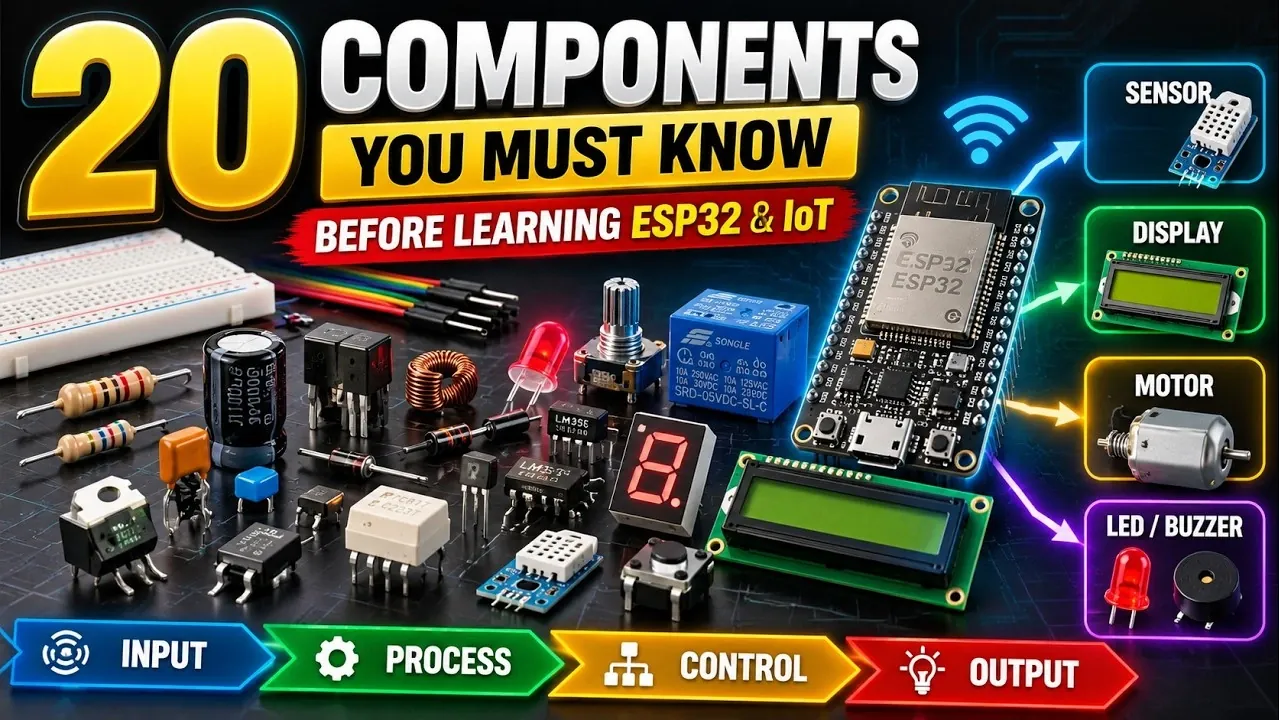
Understanding the foundational components of electronics is crucial for anyone working in IoT, robotics, or embedded systems. Before exploring the capabilities of the ESP32, Technifyi highlights the importance of familiarizing yourself with 20 essential components that form the backbone of circuit design. For instance, the breadboard, a key prototyping platform, enables you to assemble and test circuits without soldering, streamlining the process of refining your designs. Gaining a clear understanding of how components like resistors, capacitors and diodes function within a circuit lays the groundwork for tackling more advanced projects effectively.
Dive into this guide to explore the distinct roles and applications of these components in practical scenarios. Learn about the differences between NPN and PNP transistors, understand how ferrite beads help reduce high-frequency noise and discover how logic level converters assist communication between devices with varying voltage requirements. This knowledge will help you approach ESP32 projects with a solid grasp of the electronics involved.
TL;DR Key Takeaways :
- Understanding fundamental electronic components is essential for IoT, embedded systems and robotics projects, especially when working with microcontrollers like the ESP32.
- Breadboards are critical tools for prototyping and testing circuits, allowing efficient design iteration without soldering.
- Key components such as resistors, capacitors, diodes, transistors and MOSFETs play vital roles in circuit functionality, including current control, voltage regulation and signal amplification.
- Power and signal management components like voltage regulators and logic level converters ensure stable performance and compatibility between devices.
- Familiarity with analog and display components, such as operational amplifiers and LCD displays, enhances the ability to process signals and provide user feedback in projects.
Importance of Breadboards in Circuit Prototyping
Breadboards are essential tools for prototyping and testing electronic circuits. They allow you to assemble temporary circuits without the need for soldering, making them ideal for experimentation and iterative design. The breadboard’s internal structure consists of interconnected rows and columns, with dedicated power rails running along the edges for easy access to voltage and ground. By using jumper wires, you can connect components and create pathways for current flow. Mastering the use of a breadboard is a critical skill when working with the ESP32 or any other microcontroller, as it enables you to test and refine your designs efficiently.
Key Electronic Components You Should Know
To design functional and reliable circuits, it is essential to understand the roles of the following components:
- LED (Light Emitting Diode): Converts electrical energy into light. Always pair it with a current-limiting resistor to prevent damage from excessive current.
- Resistor: Controls current flow and adjusts voltage levels in a circuit. Resistors are identified by color codes or numerical markings.
- Potentiometer: A variable resistor that allows you to fine-tune voltage or resistance, commonly used for calibration or adjusting signal levels.
- Capacitor: Temporarily stores and releases electrical energy. Ceramic capacitors are ideal for high-frequency applications, while electrolytic capacitors stabilize power supplies.
- Inductor: Stores energy in a magnetic field and is often used in filtering and power regulation circuits.
- Ferrite Bead: Reduces high-frequency noise, making sure signal integrity in sensitive circuits.
- Diode: Allows current to flow in one direction, protecting circuits from reverse polarity and allowing rectification.
- Schottky Diode: Known for its low forward voltage drop, making it suitable for high-speed switching and power applications.
- Zener Diode: Regulates voltage by operating in reverse breakdown mode, protecting circuits from overvoltage conditions.
- TVS and ESD Protection Devices: Safeguard circuits against voltage spikes and electrostatic discharge, making sure long-term reliability.

Discover other guides from our vast content that could be of interest on ESP32.
- $5 ESP32-S3 Super Mini Packs Wi-Fi and Bluetooth
- The $4 ESP32 S3 Super Mini Packs a 240 MHz Dual-Core Chip
- How an $8 ESP32 S3 Microcontroller Runs a 28.9M Parameter Local LLM
- 5 ESP32 Projects Worth Building in 2026: Such as an Apple HomeKit Controller
- $4 ESP32 Module Brings Wi-Fi and Bluetooth to IoT Projects
- Replacing Security Cameras with Three $10 ESP32S3 Wi-Fi Boards
- ESP32-S3 Super Mini Costs $5 and Packs Wi-Fi and Bluetooth
- Gemini 4 Argon Writes ESP Mosaico Firmware to Control RGB LEDs
- ESP32-S3 Super Mini Brings 240 MHz Dual-Core Power For $4
- ESP32 S31 Devkit Hands-on: 320 MHz RISC-V Chip Adds Wi-Fi 6
Switching and Amplification Components
Switching and amplification are critical for controlling and enhancing signals in electronic circuits. The following components play a significant role in these processes:
- NPN Transistor: A current-controlled device used for low-side switching and signal amplification in circuits.
- PNP Transistor: Complements the NPN transistor and is used for high-side switching applications.
- N-Channel MOSFET: A voltage-controlled switch that is highly efficient for low-side load control.
- P-Channel MOSFET: Used for high-side switching, operating with opposite polarity to N-channel MOSFETs.
- Optocoupler: Provides electrical isolation between different sections of a circuit, enhancing safety and reliability in sensitive designs.
Power and Signal Management Components
Stable power delivery and effective signal management are essential for making sure reliable circuit performance. These components are indispensable in achieving those goals:
- Linear Voltage Regulator and LDO: Provide a stable output voltage by dissipating excess energy as heat, making sure consistent performance for your circuits.
- Logic Level Converter: Translates digital signals between different voltage levels, allowing compatibility between components operating at varying voltages.
Analog and Display Components
Analog signal processing and visual feedback are integral to many electronic applications. The following components are particularly useful for these purposes:
- Operational Amplifier (Op-Amp): Amplifies, buffers and conditions analog signals, allowing precise signal processing in circuits.
- Seven-Segment Display: Displays numerical information using individual LED segments, commonly used in counters, timers and basic user interfaces.
- LCD Display: Displays text, characters and graphics, communicating with microcontrollers via protocols like I2C or SPI for versatile applications.
Building a Strong Foundation for ESP32 Projects
Familiarizing yourself with these 20 essential electronic components will provide the knowledge needed to design, build and troubleshoot circuits with confidence. Whether you’re working on IoT devices, embedded systems, or robotics, these components are the building blocks that enable you to transform the ESP32 from a simple development board into the core of a functional system. By understanding their roles and practical applications, you can create innovative, reliable and efficient projects that meet your design goals.
Media Credit: Technifyi
Disclosure: Some of our articles include affiliate links. If you buy something through one of these links, Geeky Gadgets may earn an affiliate commission. Learn about our Disclosure Policy.
