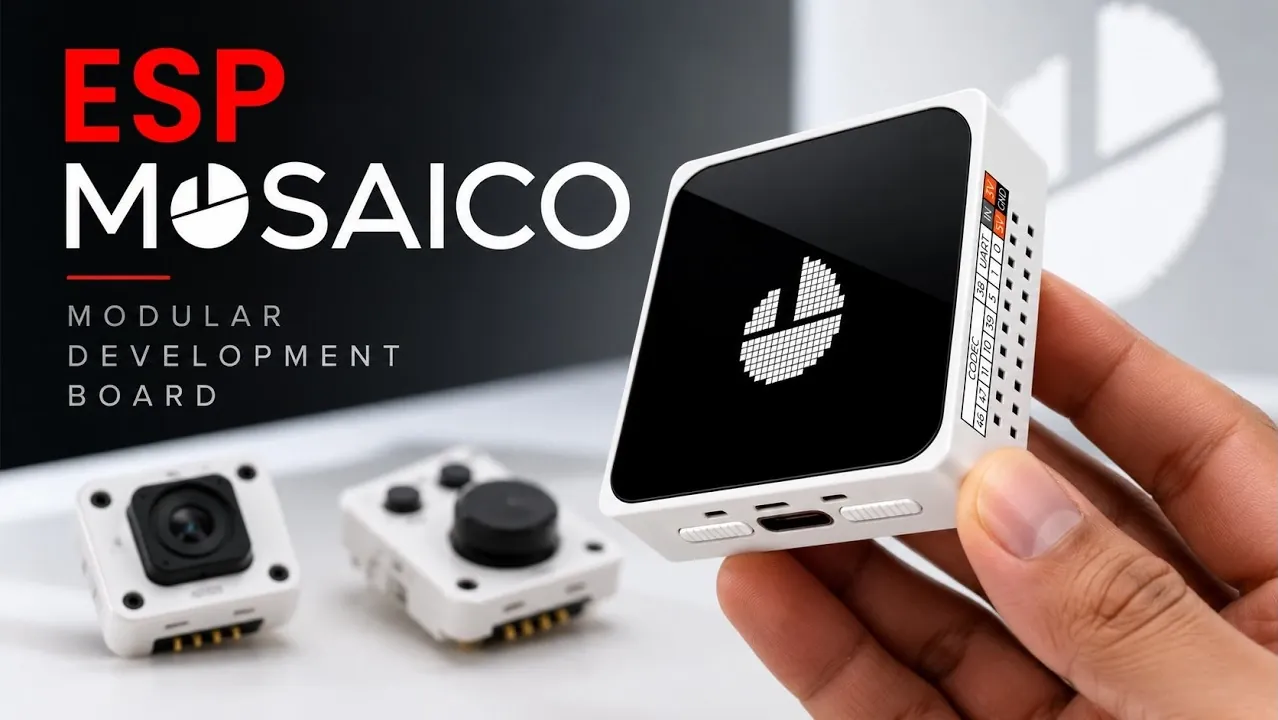
The ESP-Mosaico, built around the ESP32-S3 microcontroller, offers a modular platform for app creation and hardware prototyping, combining accessibility with advanced functionality. In a hands-on review by Tech Talkies, the board’s standout features, such as magnetic connectivity and preloaded applications, are explored in depth. With its ability to simplify hardware experimentation and reduce setup complexity, the ESP-Mosaico caters to both beginners and experienced developers. For example, its camera module and interaction module enable users to prototype visual and interactive projects without requiring extensive technical expertise.
Dive into this breakdown to understand how the ESP-Mosaico supports a range of use cases, from AI-powered app creation via ESP Cloud to custom hardware integration. Learn how preloaded apps like the digital level and music player provide immediate functionality, while modular components such as LED matrices and GPIO pins open doors to advanced customization. Whether you’re interested in rapid prototyping or building IoT devices, this review offers practical insights into using the ESP-Mosaico for your next project.
Core Hardware Features
TL;DR Key Takeaways :
- The ESP-Mosaico is a modular development board powered by the ESP32-S3 microcontroller, featuring dual-core processing and AI acceleration for versatile hardware prototyping and firmware development.
- Its innovative magnetic connectivity allows for easy attachment and detachment of components, simplifying experimentation and reducing the need for soldering or complex wiring.
- Preloaded applications, such as a digital level, gallery app and music player, provide immediate functionality and are ideal for beginners to explore the board’s capabilities.
- Integration with the ESP Cloud enables AI-powered app creation through text or voice commands, lowering the barrier to entry for users with limited coding experience.
- Advanced customization options, including support for custom expansion modules, sensors and firmware development, make the ESP-Mosaico suitable for both beginners and experienced developers in diverse applications like IoT, education and prototyping.
At the heart of the ESP-Mosaico lies the ESP32-S3 microcontroller, renowned for its dual-core processing capabilities and integrated AI acceleration. The board’s modular design is a standout feature, allowing users to attach and detach components effortlessly using magnetic connectors. This design simplifies hardware experimentation and reduces the need for soldering or complex wiring. Key hardware features include:
- A camera module capable of capturing images and videos for visual projects.
- An interaction module that supports user input and output interfaces.
- Compatibility with LED matrices, OLED displays, GPIO pins and a variety of sensors.
This modularity makes the ESP-Mosaico an ideal choice for prototyping. By allowing quick swapping of components, it allows users to test different configurations efficiently, saving both time and effort during the development process.
Preloaded Applications for Immediate Use
The ESP-Mosaico comes preloaded with several applications, providing users with immediate functionality and a hands-on introduction to its capabilities. These apps are designed to showcase the board’s potential while offering practical tools for various tasks. Some of the included applications are:
- A digital level app for measuring angles and making sure alignment in projects.
- A gallery app for viewing images captured by the camera module.
- A music player app for audio playback and sound-based experiments.
These preloaded apps are particularly beneficial for beginners, as they allow users to explore the board’s features without requiring extensive programming knowledge. For advanced users, these apps serve as a foundation for building more complex and customized projects.

Gain further expertise in ESP32 by checking out these recommendations.
- $5 ESP32-S3 Super Mini Packs Wi-Fi and Bluetooth
- The $4 ESP32 S3 Super Mini Packs a 240 MHz Dual-Core Chip
- How an $8 ESP32 S3 Microcontroller Runs a 28.9M Parameter Local LLM
- 5 ESP32 Projects Worth Building in 2026: Such as an Apple HomeKit Controller
- $4 ESP32 Module Brings Wi-Fi and Bluetooth to IoT Projects
- Replacing Security Cameras with Three $10 ESP32S3 Wi-Fi Boards
- ESP32-S3 Super Mini Costs $5 and Packs Wi-Fi and Bluetooth
- ESP32-S3 Super Mini Brings 240 MHz Dual-Core Power For $4
- ESP32 S31 Devkit Hands-on: 320 MHz RISC-V Chip Adds Wi-Fi 6
- Build a DIY Open-Source Flipper Zero Using a ESP32-DIV
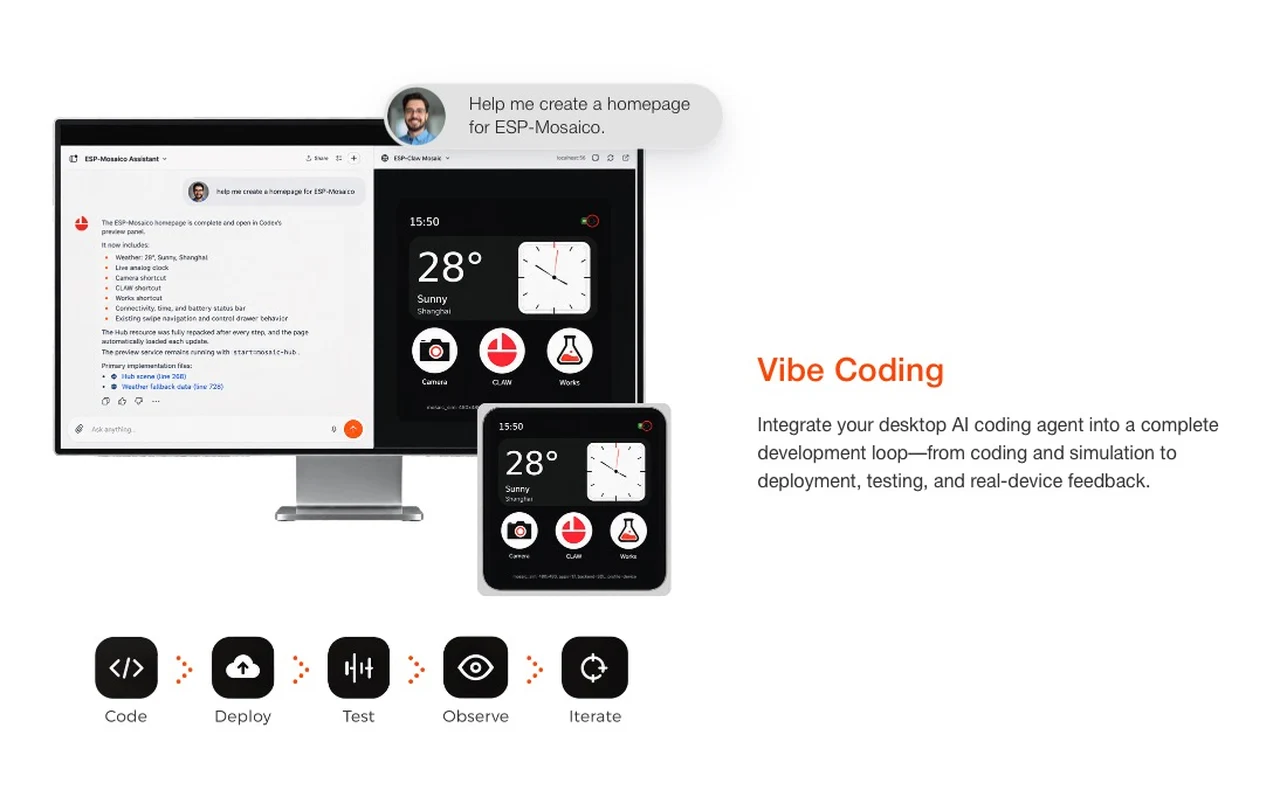
AI-Powered App Creation with ESP Cloud
One of the most compelling features of the ESP-Mosaico is its integration with the ESP Cloud, which uses AI to simplify the app creation process. By describing the desired functionality through text or voice commands, users can generate functional applications tailored to their needs. This feature is especially valuable for individuals with limited coding experience, as it lowers the barrier to entry for app development.
To use the voice chat feature, an API key from an AI service, such as the Gemini API, is required. While this adds a layer of setup complexity, it also opens the door to advanced customization and integration with other platforms. This AI-driven approach enables users to focus on their creative ideas rather than the technical intricacies of coding.
Advanced Customization for Experienced Makers
For developers and makers seeking greater control, the ESP-Mosaico offers extensive customization options. Its modular design supports the creation of custom expansion modules, allowing users to extend the board’s functionality to suit specific project requirements. Supported components include:
- LED matrices for dynamic visual displays and animations.
- OLED screens for compact, high-resolution output in various applications.
- GPIO pins for connecting external devices and peripherals.
- Sensors for monitoring environmental and physical parameters, such as temperature, humidity, or motion.
Additionally, the ESP-Mosaico allows users to develop and upload custom firmware, providing complete control over the board’s behavior. This level of flexibility makes it an invaluable tool for prototyping, testing and integrating new hardware components into larger systems.
Applications and Versatility
The ESP-Mosaico’s adaptability makes it suitable for a wide range of applications, catering to both beginners and advanced users. For those new to electronics, the AI-powered app creation feature simplifies the process of designing functional applications, such as simple games or interactive tools. Meanwhile, experienced developers can use the board as a robust platform for hardware testing and prototyping. Its modular design encourages experimentation with various configurations, allowing users to refine their projects efficiently.
Potential Use Cases
The ESP-Mosaico is a versatile tool that can be applied in both educational and professional settings. Some potential use cases include:
- Developing custom IoT devices for smart home automation or industrial applications.
- Creating interactive installations for art, education, or entertainment purposes.
- Testing and evaluating new hardware components before integrating them into larger systems.
- Designing educational tools for teaching electronics, programming and hardware prototyping.
Its combination of ease of use and advanced customization options makes it an excellent choice for a diverse audience, ranging from students and hobbyists to industry professionals.
A Platform for Creativity and Innovation
The ESP-Mosaico strikes a balance between accessibility and advanced functionality, offering a unique platform for users of all skill levels. Its modular design, preloaded applications, AI-powered app creation and support for custom hardware and firmware make it a versatile tool for innovation. Whether you’re exploring electronics for the first time or developing complex prototypes, the ESP-Mosaico provides the tools and flexibility needed to bring your ideas to life.
Media Credit: Tech Talkies
Disclosure: Some of our articles include affiliate links. If you buy something through one of these links, Geeky Gadgets may earn an affiliate commission. Learn about our Disclosure Policy.
