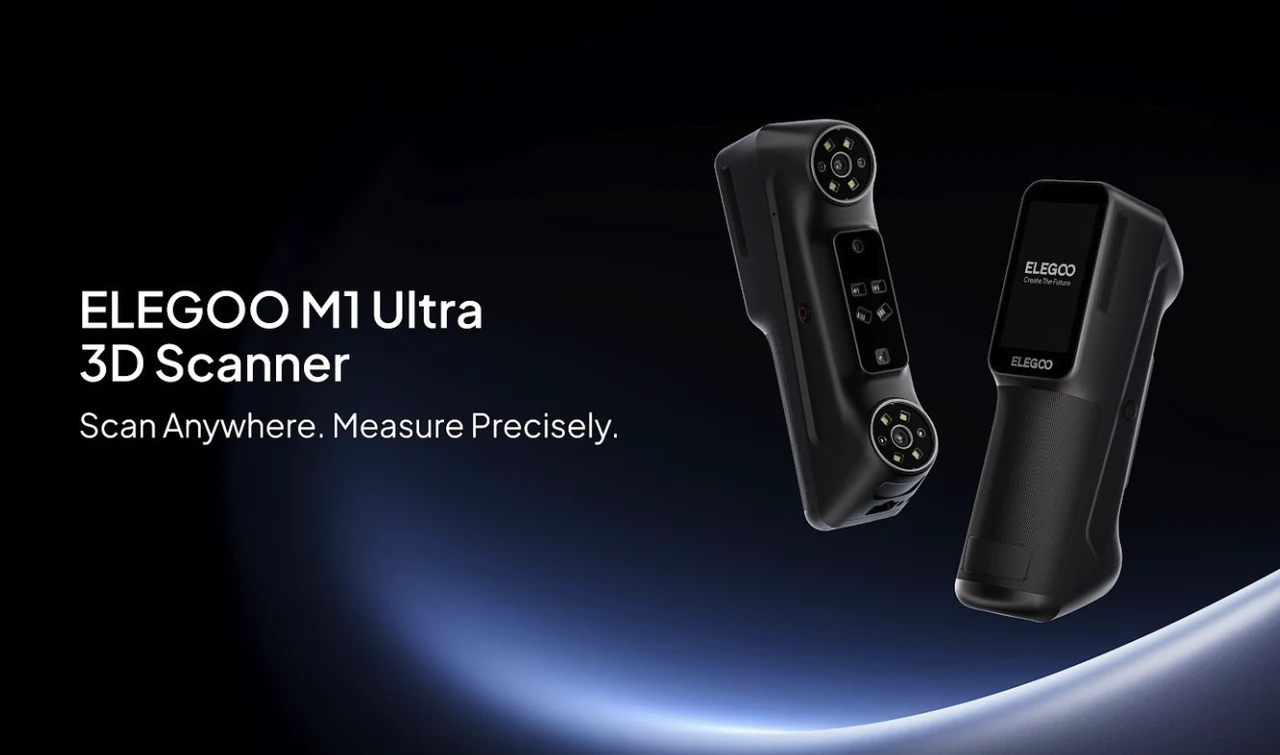
The ELEGOO M1 Ultra 3D scanner combines professional-grade scanning technology with a portable, all-in-one design, offering creators, engineers and designers a versatile way to turn physical objects into detailed digital 3D models. Officially launched on October 29, 2026, the M1 Ultra is ELEGOO’s first all-in-one smart 3D scanner, featuring five scanning modes, blue laser accuracy of up to 0.02 mm, infrared structured light scanning and wireless connectivity. With early bird pricing starting at $1,599 (£1,319), it aims to make high-precision 3D scanning more accessible for professional and creative applications.
As highlighted in a hands-on review by TechteamGB, the scanner offers considerable flexibility, combining 34-line, 7-line and single-line blue laser scanning with infrared structured light and marker-free scanning capabilities. Its integrated touchscreen, swappable battery and ELEGOO SCAN software are designed to simplify the process of capturing objects and converting them into usable digital models. However, demanding computer requirements, certain wireless scanning restrictions and occasional difficulties with reflective surfaces are among the considerations worth exploring before purchasing.
In this detailed overview, we’ll examine the M1 Ultra’s hardware, scanning modes, accuracy, software, portability and practical limitations. We’ll also explore how its features translate into real-world applications, from automotive component scanning and reverse engineering to product customization and digital archiving, helping you determine whether ELEGOO’s first dedicated 3D scanner is the right choice for your projects.
Elegoo M1 Ultra 3D Scanner
TL;DR Key Takeaways :
- The ELEGOO M1 Ultra delivers blue laser scanning accuracy of up to 0.02 mm, with five scanning modes covering everything from miniature components to large objects measuring up to 4,000 × 4,000 × 4,000 mm.
- Its portable design includes a 3-inch HD touchscreen, Wi-Fi 6 connectivity and a 4,800 mAh swappable battery offering up to 1.5 hours of wireless scanning. The package also includes accessories such as a tripod, calibration board and spare battery.
- The scanner combines 34-line, 7-line and single-line blue laser scanning with infrared structured light and marker-free scanning. However, the hands-on review identifies limitations involving reflective surfaces and marker-free operation over Wi-Fi.
- ELEGOO SCAN software provides guided setup, multi-scan alignment, mesh optimization and color mapping, with STL, OBJ, PLY and ASC export support. Some operations may still require familiarization with the software interface.
- The M1 Ultra launches at an early bird price of $1,599 (£1,319) until November 12, 2026, before increasing to its standard retail price of $1,699 (£1,399).

Design and Build: Portable and Robust
ELEGOO has designed the M1 Ultra to combine professional scanning capabilities with the convenience of a portable handheld device. As the company’s first all-in-one smart 3D scanner, it represents an expansion beyond its established 3D printing products, offering users another way to capture real-world objects and incorporate them into digital design and manufacturing workflows.
The scanner features a compact, ergonomic body with an integrated 3-inch HD touchscreen for accessing settings and monitoring scanning operations. TechteamGB’s hands-on review describes the display as approximately 2.95 inches, which is consistent with ELEGOO’s rounded 3-inch specification. Although the touchscreen provides convenient access to essential controls, more advanced adjustments and processing functions are handled through the accompanying computer software.
Its optical hardware includes blue laser projectors, infrared scanning components and cameras for capturing geometry and surface details. The review identifies dual infrared cameras, visible and infrared illumination and an RGB camera, while ELEGOO also highlights an all-glass optical system, intelligent temperature compensation and high-precision camera calibration to support consistent results.
The M1 Ultra comes with a sturdy protective carrying case featuring foam compartments to help keep the scanner and its accessories secure during transport. The supplied accessories include:
- A tripod for stable scanning and positioning
- A calibration board for maintaining scanning accuracy
- Tracking marker sheets for compatible scanning modes
- A spare swappable battery for extended scanning sessions
- A USB-C cable for wired connectivity
These accessories provide a practical starting point for users working with different scanning environments and object sizes. The inclusion of a spare battery is particularly useful for mobile scanning, while the calibration board helps users prepare the device for accurate data capture.
Scanning Modes and Features: Versatility in Action

One of the M1 Ultra’s most significant advantages is its selection of five distinct scanning modes, allowing users to choose an appropriate capture method based on an object’s size, shape, surface and level of detail.
The available scanning modes include:
- 34-line blue laser scanning: Designed for efficiently capturing medium-to-large objects, making it suitable for automotive components, mechanical assemblies and other substantial parts.
- 7-line blue laser scanning: Optimized for capturing finer details on small-to-medium objects where precision and surface definition are particularly important.
- Single-line blue laser scanning: Intended for difficult geometry, including deep holes, narrow gaps, recessed features and other areas that can be challenging to capture using wider laser patterns.
- Infrared structured light scanning: Provides an alternative scanning method for faces, bodies and everyday objects, extending the scanner’s usefulness beyond mechanical components.
- Marker-free blue laser scanning: Allows compatible objects to be captured without applying tracking markers, offering greater convenience when attaching markers would be impractical.
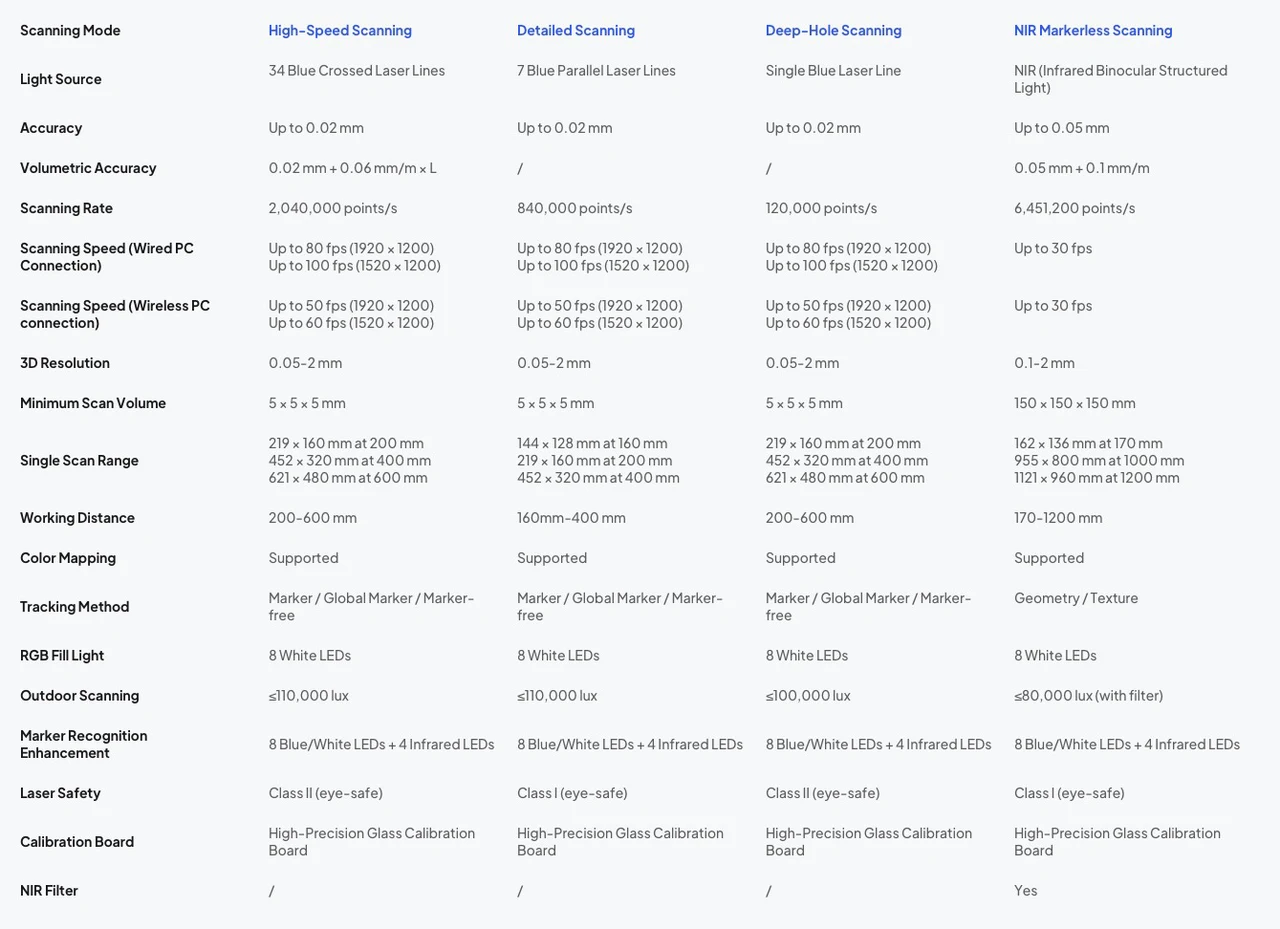
ELEGOO specifies a blue laser scanning accuracy of up to 0.02 mm, with volumetric accuracy rated at 0.02 mm + 0.06 mm/m. TechteamGB also references an infrared scanning accuracy of 0.05 mm, although this additional figure should be checked against ELEGOO’s detailed technical documentation.
The scanner supports objects ranging from just 5 × 5 × 5 mm to 4,000 × 4,000 × 4,000 mm, giving it considerable flexibility across projects of different sizes. Its specified working distance is approximately 160–1,200 mm, allowing users to adjust their positioning depending on the object and selected scanning mode.
Another useful capability is the ability to scan black and metallic surfaces without requiring coating powder. Such materials can present difficulties for conventional optical scanners, although real-world performance will still depend on surface reflectivity, geometry, lighting and the scanning method selected.
Before its initial use, the M1 Ultra requires calibration using the supplied calibration board. As demonstrated in the hands-on review, the process is relatively straightforward, helping prepare the scanner for accurate measurements and reliable tracking.

Check out more relevant guides from our extensive collection on scanners that you might find useful.
- iScanner Review: More Than Just a Mobile Scanner
- Last-Minute Leaks Surface Ahead of Apple’s September 9 Event
- Apple iPhone Duo Features 7.6-Inch and 5.4-Inch Displays
- FOXWELL HD500: A Professional Diagnostic Tool Tailored for Heavy-Duty Truck Owners
- Chromebooks Receive New Document SANE Scanner Support
- Creality Pika 3D Scanner Launches with 0.03 Mm Accuracy
- 3D Scanner Created Using Kinect and Raspberry Pi (Video)
Performance and Limitations: Balancing Strengths and Weaknesses
The M1 Ultra’s combination of blue laser and infrared scanning technologies provides considerable versatility, but achieving the best results requires an understanding of its operating requirements and limitations.
For demanding scanning and processing tasks, a high-performance Windows PC or compatible Mac may be necessary, particularly when working with large point clouds, high-resolution meshes or detailed color textures. TechteamGB highlights the importance of computer specifications, noting that the scanner relies heavily on ELEGOO SCAN software for processing and managing captured data.
Connectivity options include Wi-Fi 6 for wireless scanning and USB-C for a wired connection. The scanner also incorporates a 4,800 mAh swappable battery, with ELEGOO advertising up to 1.5 hours of wireless operation per battery. This makes it easier to move around large objects or scan in locations where a cable would be inconvenient.

However, wireless functionality does not necessarily provide access to every scanning mode. According to the hands-on review, marker-free blue laser scanning is unavailable when operating over Wi-Fi, meaning users may need a wired connection for certain tasks. This restriction is worth confirming against the latest firmware and software documentation, as functionality may change with future updates.
The review also reports that AMD GPU acceleration is not currently supported. Users with AMD-based systems should therefore check ELEGOO’s latest compatibility requirements before purchasing, particularly if they intend to process complex scans regularly.
Although ELEGOO promotes the scanner’s ability to capture black and metallic surfaces without coating powder, reflective or geometrically complex objects can still present challenges. Marker-free scanning may occasionally lose tracking or struggle to capture fine details, especially when an object lacks distinctive surface features.
These limitations do not necessarily undermine the scanner’s capabilities, but they demonstrate why selecting the appropriate scanning mode, calibrating the hardware and preparing the object remain important parts of achieving accurate results.
Software and Usability: Powerful but Unintuitive
The ELEGOO SCAN software provides the main interface for managing the M1 Ultra’s scanning and model-processing capabilities. It is designed to simplify the process of capturing physical objects and transforming the resulting data into digital 3D models suitable for further editing, visualization or manufacturing.
ELEGOO has incorporated several features intended to streamline the workflow, including guided setup, tracking assistance and multi-scan alignment. These functions help users prepare the scanner, maintain tracking during capture and combine scans taken from different angles into a more complete representation of an object.
Once scanning is complete, automated processing tools can assist with mesh wrapping, mesh optimization and color mapping. The software also includes functions such as hole filling and surface smoothing, which can help refine incomplete or uneven areas of a scanned model.
For projects requiring visual realism, the M1 Ultra supports 24-bit full-color texture mapping with image signal processing optimization. Its global-shutter cameras are designed to reduce motion-related distortion during capture, helping preserve both geometric details and the appearance of an object’s surface.
ELEGOO SCAN supports exporting files in STL, OBJ, PLY and ASC formats, providing compatibility with a range of third-party 3D modeling, visualization and manufacturing applications. This flexibility is useful for users who want to incorporate captured geometry into existing CAD, reverse-engineering or 3D printing workflows.
However, a scanned mesh is not automatically equivalent to a fully editable parametric CAD model. Projects involving precise mechanical modifications or reverse engineering may still require additional processing in dedicated design software.
Despite its extensive functionality, TechteamGB found that the software interface could be unintuitive, particularly for newcomers to 3D scanning. Certain operations require multiple steps, and some settings may benefit from clearer explanations or more prominent guidance.
While the integrated touchscreen provides convenient access to basic controls, users should expect to spend time learning the desktop software to take full advantage of the scanner’s capabilities. Improvements to the interface and workflow guidance could make the M1 Ultra more approachable for beginners without sacrificing the advanced features needed by experienced users.
Applications: Precision for Diverse Industries

The ELEGOO M1 Ultra is designed for a broad range of applications, including reverse engineering, product customization, education, digital archiving and creative design. Its combination of precision scanning and multiple capture methods makes it suitable for both technical and artistic projects.
In the automotive industry, users can capture the geometry of existing components to assist with designing replacement parts, developing custom modifications or checking how new components fit within an existing assembly. The single-line blue laser mode may be particularly useful for recessed areas and difficult-to-reach features.
Engineers and product designers can use the scanner to digitize physical prototypes, examine component geometry and incorporate existing objects into new designs. Its claimed 0.02 mm blue laser accuracy makes it a potentially useful tool for applications where dimensional detail is important, although actual measurement performance will depend on calibration, scanning conditions and object characteristics.
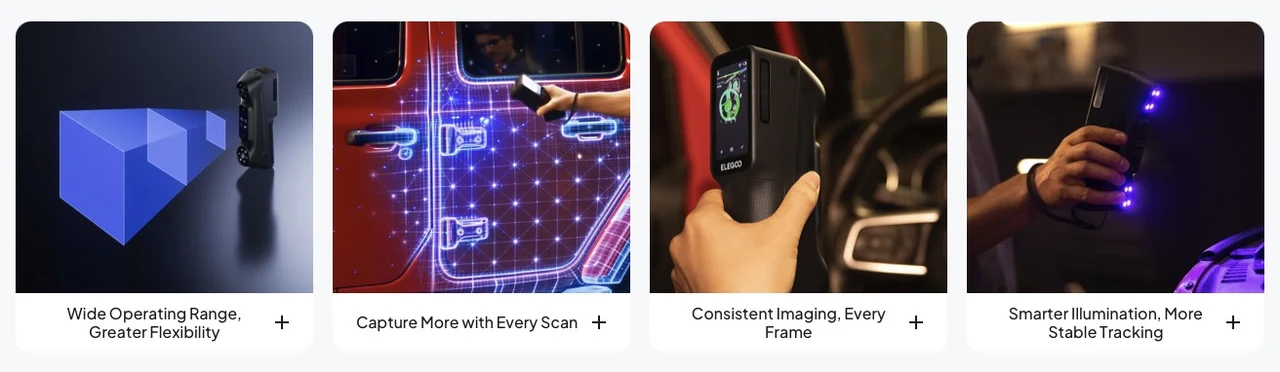
For artists, educators and digital creators, infrared structured light and full-color texture capture provide opportunities to digitize sculptures, models, historical artifacts and other physical objects. These scans can support virtual exhibitions, digital preservation, educational demonstrations and further creative work.
The scanner also fits naturally into ELEGOO’s wider 3D printing ecosystem. By capturing an existing object’s geometry and exporting it to compatible software, users can develop customized parts, modify designs or prepare models for additive manufacturing.
This ability to connect physical objects with digital workflows is one of the M1 Ultra’s most attractive features, potentially reducing the amount of manual measurement and modeling required when recreating existing shapes.
Pricing and Value: Competitive and Feature-Rich
The ELEGOO M1 Ultra officially launches today on October 29, 2026, with an early bird promotion running through November 12, 2026. During the promotional period, the scanner is available at the following advertised regional prices:
- United States: $1,599, increasing to $1,699 after the promotion
- United Kingdom: £1,319, increasing to £1,399
- Europe: €1,599, increasing to €1,699
- Canada: CAD $2,299, increasing to CAD $2,399
- Japan: ¥284,999, increasing to ¥299,999
At its early bird price of $1,599 (£1,319), the M1 Ultra offers an appealing combination of scanning technologies, portable hardware and software functionality. Its five scanning modes, wireless connectivity, swappable battery and 0.02 mm claimed accuracy provide a substantial feature set for users considering a professional-capable handheld scanner.
Specifications
The inclusion of a protective carrying case, tripod, calibration board and spare battery adds practical value, particularly for users who need to transport the scanner between workspaces or capture objects in different locations.
However, potential buyers should also consider the computer hardware required for processing, software compatibility and any restrictions affecting specific scanning modes. These factors can influence the overall cost and convenience of integrating the scanner into an existing workflow.
Availability and delivery schedules may vary by region, so customers should check the relevant ELEGOO store for current shipping information and promotional terms. Further details about the M1 Ultra are available through the official ELEGOO website.
Room for Refinement
Although the M1 Ultra introduces an impressive collection of features for ELEGOO’s first dedicated 3D scanner, the hands-on review by Tech Team in the video highlights several areas where the overall experience could be improved. Potential improvements include:
- Expand wireless functionality: Enabling marker-free blue laser scanning over Wi-Fi would make the scanner more flexible when capturing objects away from a workstation.
- Improve marker-free tracking: More reliable tracking on reflective, featureless or complex surfaces would reduce interruptions and the need to repeat scans.
- Simplify the software interface: Clearer guidance, more intuitive controls and streamlined processing options would help beginners become productive more quickly.
- Broaden hardware compatibility: Additional GPU acceleration options, including support for AMD graphics hardware where technically feasible, would benefit users with different computer configurations.
- Improve standalone functionality: Greater on-device control and processing capabilities could reduce reliance on a connected computer for certain scanning tasks.
It is worth noting that ELEGOO may address particular limitations through future firmware updates, software improvements or expanded compatibility. For now, users should evaluate the scanner against their intended workflow rather than assuming that every scanning mode and processing feature will be available in all operating configurations.
A Strong Contender in 3D Scanning
The ELEGOO M1 Ultra represents a significant expansion of the company’s 3D creation ecosystem, bringing together precision blue laser scanning, infrared structured light, wireless operation and dedicated processing software in a portable handheld device.
Its headline accuracy of up to 0.02 mm, five scanning modes and support for objects ranging from miniature components to large assemblies make it a versatile option for engineers, designers, educators and creative professionals. Features such as the integrated touchscreen, swappable battery and automated mesh processing further strengthen its appeal for users looking to streamline the transition from physical objects to digital models.
Nevertheless, the scanner is not without compromises. Computer performance requirements, reported restrictions on marker-free wireless scanning and the learning curve associated with ELEGOO SCAN are all worth considering. Reflective and complex surfaces may also require additional preparation or alternative scanning techniques to achieve satisfactory results.
With early bird pricing starting at $1,599 (£1,319), the M1 Ultra enters the market with a competitive feature set and considerable potential. Its ultimate value will depend on how reliably its precision, scanning versatility and software capabilities perform across different real-world projects.
For users seeking a flexible way to capture physical objects for reverse engineering, customization, digital archiving or 3D printing, the ELEGOO M1 Ultra is a promising addition to the growing selection of professional-capable handheld 3D scanners.
Media Credit: TechteamGB
Disclosure: Some of our articles include affiliate links. If you buy something through one of these links, Geeky Gadgets may earn an affiliate commission. Learn about our Disclosure Policy.
