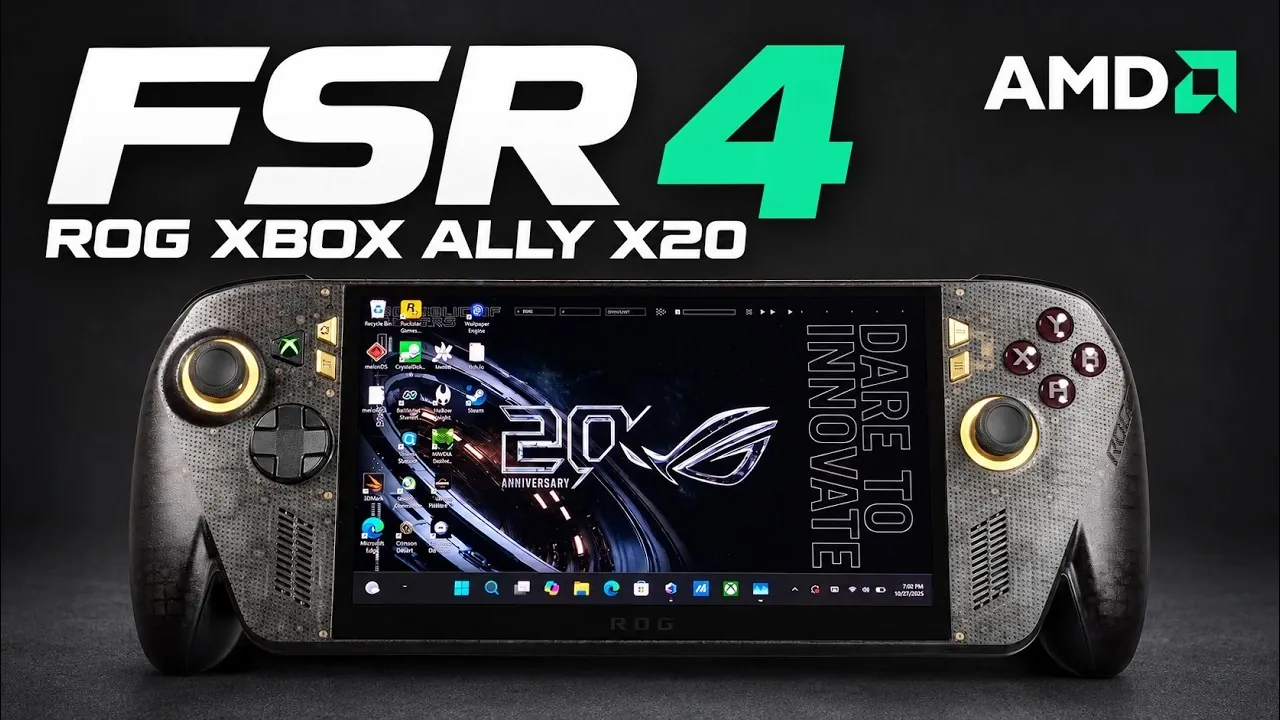
AMD’s latest update to its FidelityFX Super Resolution (FSR) technology, version 4.1, brings a fresh focus to handheld gaming by optimizing visuals for devices powered by AMD Ryzen Z2 Extreme processors and RDNA 3.5 GPUs. As highlighted by ETA Prime, this iteration prioritizes image quality in graphically demanding titles, though it introduces trade-offs in frame rates compared to earlier versions. Currently available as a preview, FSR 4.1 requires manual activation through the Armory Crate SE software and is compatible with a limited selection of games, making it a feature best suited for gamers who are comfortable experimenting with emerging technologies.
Explore how FSR 4.1 performs across popular titles such as Cyberpunk 2077, Black Myth: Wukong, and Forza Horizon 5, with insights into its impact on both image clarity and frame rates. You’ll also gain a clear understanding of the steps required to enable this feature and how it compares to previous FSR versions in real-world scenarios. Whether you’re curious about its potential for enhancing handheld gaming or weighing its trade-offs, this feature offers a detailed breakdown of what FSR 4.1 brings to the table.
Understanding FSR 4.1
TL;DR Key Takeaways :
- AMD has launched FidelityFX Super Resolution (FSR) 4.1, optimized for handheld gaming devices with AMD Ryzen Z2 Extreme processors and RDNA 3.5 GPUs, focusing on improved image quality.
- FSR 4.1 is available as a preview feature requiring specific driver installations and manual activation, making it suitable for tech-savvy users and early adopters.
- The update enhances visual clarity in supported games but comes with trade-offs, such as reduced frame rates compared to earlier FSR versions.
- Performance testing shows FSR 4.1 excels in image quality for graphically demanding games like “Cyberpunk 2077” and “Forza Horizon 5,” but frame rate drops remain a concern.
- FSR 4.1 is still in its preview stage, with potential for future optimizations and broader compatibility, signaling AMD’s commitment to advancing handheld gaming technology.
FSR 4.1 represents a refined version of AMD’s upscaling technology, optimized to meet the unique demands of handheld gaming. By using the advanced capabilities of AMD Ryzen Z2 Extreme processors and RDNA 3.5 architecture, this iteration seeks to strike a balance between enhanced image quality and efficient performance. Unlike its desktop counterpart, FSR 4.1 is specifically streamlined to operate within the computational constraints of portable devices.
This update is accessible through a preview GPU driver, which can be downloaded via the Armory Crate SE software. However, its functionality is currently limited to a select number of games that explicitly support FSR 4.1. This targeted approach focuses on improving visual clarity in graphically demanding titles, offering a more immersive gaming experience for users who prioritize image fidelity.
Steps to Enable FSR 4.1
Activating FSR 4.1 requires a few straightforward steps, making sure that users can take full advantage of this technology:
- Download and install the preview GPU driver using the Armory Crate SE software.
- Manually activate FSR 4.1 through the quick menu in supported games.
This manual activation process allows users to decide whether to prioritize the enhanced image quality offered by FSR 4.1 or opt for older versions that may deliver higher frame rates. However, it is important to note that compatibility remains a limitation, as only games that have integrated FSR 4.1 can use this feature. While promising, its immediate impact is confined to a limited selection of titles, making it a niche option for now.

Check out more relevant guides from our extensive collection on FSR 4.1 that you might find useful.
- FSR 4.1 Helps 30 FPS Xbox Series X Games Hit 60 FPS
- How to Activate AMD FSR 4.1 on Xbox Ally Using Armory Crate
- FidelityFX Super Resolution 4 Debuts on Steam Deck Soon
- Xbox Ally X Gets AMD FSR 4.1 Preview Driver via Armory Crate SE
Performance Insights and Image Quality
Testing FSR 4.1 across various popular games has revealed both its strengths and its limitations. Below is an analysis of its performance in three key titles:
- Cyberpunk 2077: FSR 4.1 delivers a noticeable improvement in image quality, particularly in dense urban environments where visual details are critical. However, this comes at a cost, with frame rates dropping by 8.9% in performance mode compared to FSR 2.1. For players who prioritize smooth gameplay, earlier versions of FSR may still be the preferred choice.
- Black Myth: Wukong: The differences between FSR 4.1 and FSR 3 are subtle in terms of frame rates. However, FSR 4.1 excels in scenarios where higher scaling and image quality are prioritized, while FSR 3 offers smoother visuals at lower scaling percentages.
- Forza Horizon 5: In this fast-paced racing game, FSR 4.1 provides slight improvements in image clarity during high-speed scenes, delivering a more polished visual experience. However, its performance remains comparable to FSR 3, with only marginal gains in specific scenarios.
These findings highlight the trade-offs inherent in FSR 4.1, where the focus on image fidelity may come at the expense of frame rates, particularly in performance-intensive games.
Balancing Trade-offs and Future Potential
FSR 4.1 places a strong emphasis on image fidelity, making it an attractive option for gamers who value visual quality over raw performance. However, this focus results in lower frame rates compared to earlier iterations like FSR 2.1. For competitive or fast-paced games, where high frame rates are essential, sticking with older FSR versions may be more practical.
It is also worth noting that FSR 4.1 is still in its preview stage, leaving room for further optimization. As AMD continues to refine this technology, future updates could address some of the current trade-offs, potentially narrowing the gap between image quality and performance. This ongoing development underscores AMD’s commitment to enhancing the gaming experience on handheld devices.
The Road Ahead for FSR 4.1
As FSR 4.1 gains traction, its adoption by other manufacturers could lead to broader compatibility across a wider range of handheld gaming devices powered by AMD Ryzen Z2 Extreme processors. This expansion could result in increased game support and further advancements in upscaling algorithms, ultimately benefiting a larger audience of gamers.
Looking forward, AMD’s dedication to FidelityFX Super Resolution suggests that future iterations will continue to push the boundaries of what is possible in handheld gaming. For now, FSR 4.1 offers a glimpse into the potential of optimized upscaling technology, providing a compelling option for gamers seeking a balance between performance and image quality. As the technology matures, it is likely to play an increasingly significant role in shaping the future of portable gaming experiences.
Media Credit: ETA PRIME
Disclosure: Some of our articles include affiliate links. If you buy something through one of these links, Geeky Gadgets may earn an affiliate commission. Learn about our Disclosure Policy.
