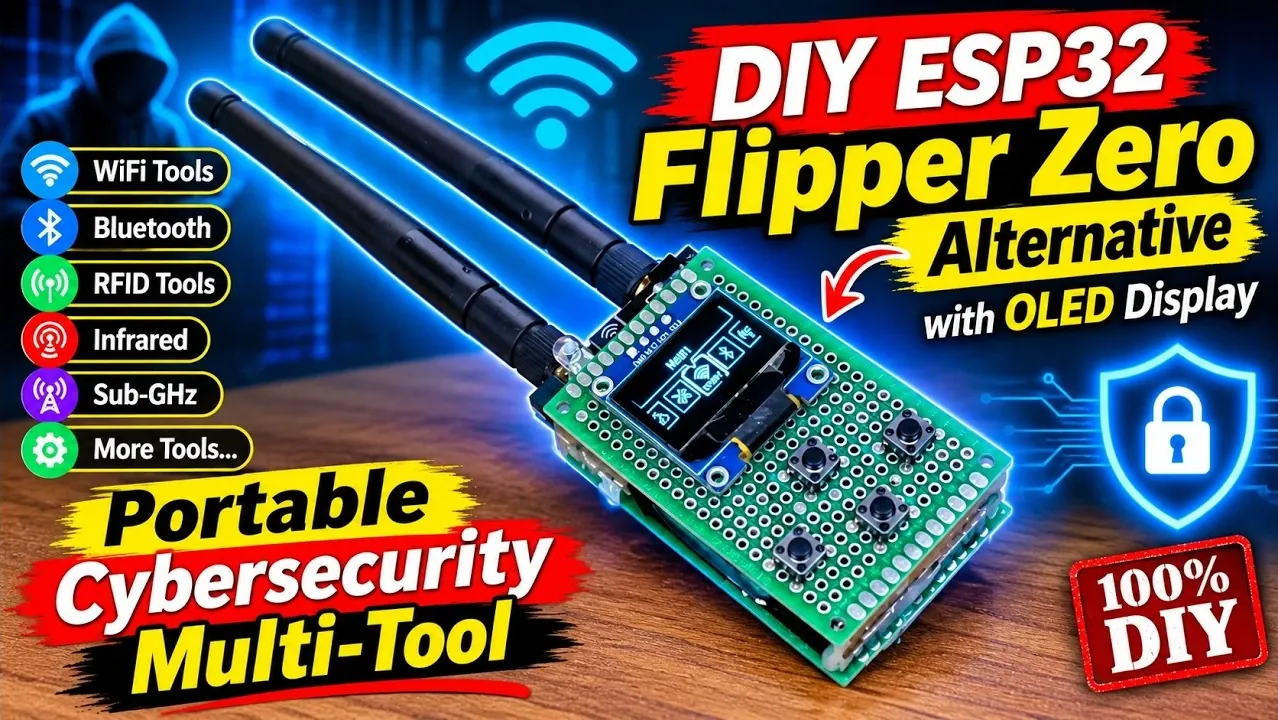
This project showcases a DIY alternative to the Flipper Zero, built using an ESP32 microcontroller paired with an OLED display to create a portable cybersecurity device. One key feature is its ability to perform Wi-Fi testing, restricted to the creator’s own network to prioritize ethical practices. The focus is on exploring compact hardware for educational purposes, as demonstrated by Yellow Purple.
Explore the key components of this build, including how the ESP32 and OLED display integrate to support interactive features. Learn about the ethical boundaries of cybersecurity experimentation and practical ways to ensure responsible use. Gain insight into the technical aspects of assembling and programming a device like this for personal learning.
TL;DR Key Takeaways :
- A DIY alternative to the Flipper Zero has been demonstrated using an ESP32 microcontroller and an OLED display, designed as a portable cybersecurity multi-tool for educational purposes.
- The project emphasizes strict adherence to legal and ethical guidelines, with all demonstrations, such as Wi-Fi-related functions, conducted on the creator’s own network and warnings against unauthorized access.
- The build uses an ESP32 microcontroller paired with an OLED display, showcasing the potential of compact DIY hardware for exploring cybersecurity concepts, though detailed assembly instructions are not provided.
- The creator repeatedly stresses the importance of responsible use, reminding users to comply with laws and ethical standards when experimenting with such tools.
- This project serves as an accessible entry point for learning about cybersecurity, but the creator highlights that users bear full responsibility for using the tools appropriately.
Building a DIY ESP32 Flipper Zero Alternative
A recent project demonstrates how to create a DIY alternative to the Flipper Zero using an ESP32 microcontroller and an OLED display. Designed as a portable cybersecurity multi-tool, this custom build offers an interactive way to explore and experiment with cybersecurity concepts. However, the project emphasizes the critical importance of adhering to legal and ethical guidelines when engaging with such technology.
Educational Purposes Only
This project is presented strictly for educational purposes, with repeated reminders to avoid any unlawful activities. Users are urged to comply with relevant laws and regulations, particularly when testing the device’s capabilities. For instance, Wi-Fi-related functions were demonstrated exclusively on the creator’s own network, accompanied by a clear warning against accessing networks without explicit permission.

Here are additional guides from our expansive article library that you may find useful on ESP32.
- $5 ESP32-S3 Super Mini Packs Wi-Fi and Bluetooth
- The $4 ESP32 S3 Super Mini Packs a 240 MHz Dual-Core Chip
- How an $8 ESP32 S3 Microcontroller Runs a 28.9M Parameter Local LLM
- 5 ESP32 Projects Worth Building in 2026: Such as an Apple HomeKit Controller
- $4 ESP32 Module Brings Wi-Fi and Bluetooth to IoT Projects
- Replacing Security Cameras with Three $10 ESP32S3 Wi-Fi Boards
- ESP32-S3 Super Mini Costs $5 and Packs Wi-Fi and Bluetooth
- Gemini 4 Argon Writes ESP Mosaico Firmware to Control RGB LEDs
- ESP32-S3 Super Mini Brings 240 MHz Dual-Core Power For $4
- ESP32 S31 Devkit Hands-on: 320 MHz RISC-V Chip Adds Wi-Fi 6
Core Components
At the heart of the build is the versatile ESP32 microcontroller, paired with an OLED display for output. This combination creates a compact yet powerful platform for experimenting with cybersecurity tools. Although the project does not provide detailed specifications or step-by-step assembly instructions, it highlights the potential of DIY hardware as a means to learn and explore within the cybersecurity domain.
Ethical Considerations
The project consistently underscores the importance of responsible use. It serves as a reminder that while technology can be a valuable educational tool, it must be employed within the confines of the law and ethical standards. This emphasis on responsibility reinforces the educational purpose of the build.
The DIY ESP32 Flipper Zero alternative illustrates the possibilities of portable cybersecurity tools while highlighting the necessity of strict adherence to legal and ethical standards. For those interested in delving into cybersecurity concepts, this project offers an accessible starting point. However, as the creator concludes, the responsibility for using such tools appropriately rests entirely with the user.
Media Credit: Yellow Purple
Disclosure: Some of our articles include affiliate links. If you buy something through one of these links, Geeky Gadgets may earn an affiliate commission. Learn about our Disclosure Policy.
