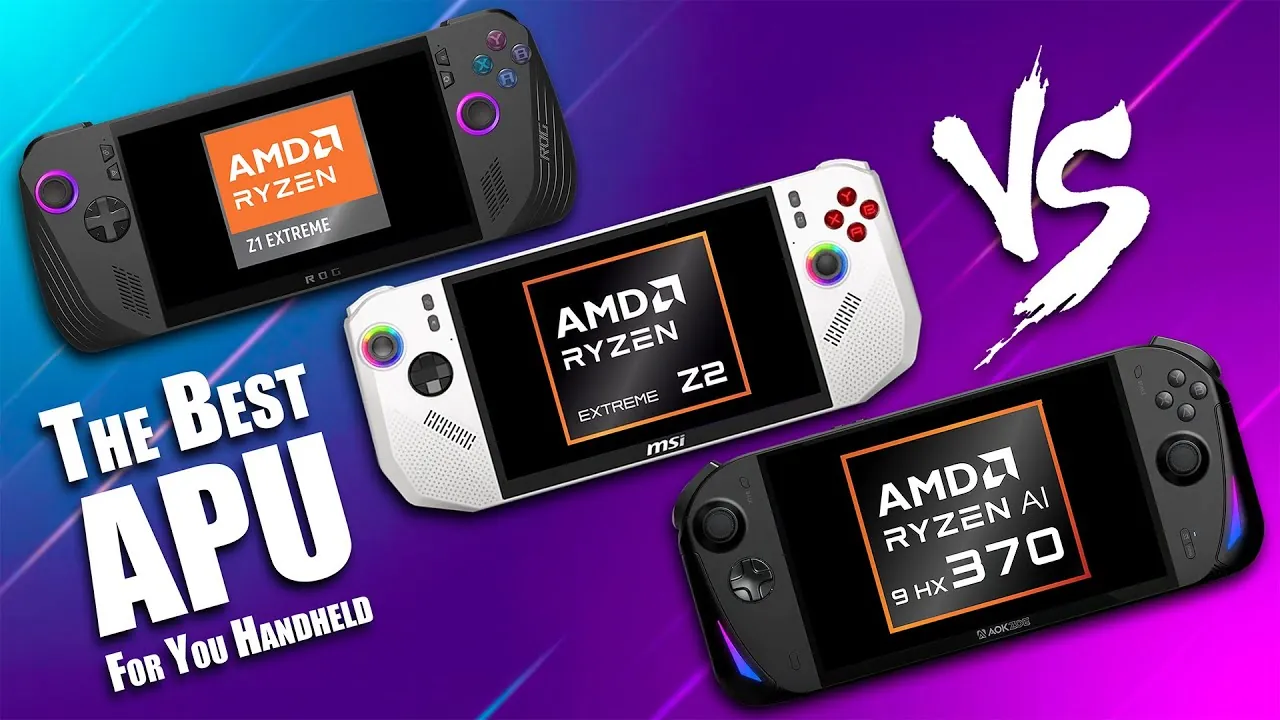
What if the promise of handheld gaming perfection isn’t as simple as upgrading to the newest hardware? With the Z1 Extreme, Z2 Extreme, and HX 370 vying for dominance, gamers are left with a tough choice: stick with a proven performer, or chase the allure of innovative technology. Each of these APUs claims to redefine the handheld gaming experience, but the reality isn’t so clear-cut. From bold performance claims to subtle efficiency tweaks, the differences between these chips may not be as fantastic as they seem. So, how do you decide which one truly delivers the best balance of power, battery life, and value?
ETA Prime tests the strengths and weaknesses of these three contenders, diving into real-world gaming benchmarks, efficiency metrics, and practical usability. You’ll discover whether the Z2 Extreme’s hybrid core design lives up to its promise, if the HX 370’s extra cores justify its higher power draw, and why the Z1 Extreme might still be the most reliable option for handheld gaming. Whether you’re chasing smoother frame rates or longer play sessions, this comparison will help you make an informed choice. After all, when every watt and frame counts, the right APU can make or break your gaming experience.
Best APU for Handheld Gaming
TL;DR Key Takeaways :
- The Z1 Extreme, based on AMD’s Zen 4 architecture, offers a strong balance of performance and efficiency, making it ideal for handheld gaming with its 8 cores, 16 threads, and 12 RDNA 3 compute units.
- The Z2 Extreme, featuring AMD’s Zen 5 architecture, provides a 15% performance boost in benchmarks but shows only marginal real-world gaming improvements over the Z1 Extreme, especially at lower wattages.
- The HX 370 excels in multi-core workloads with 12 cores and 24 threads but is less practical for handheld gaming due to higher power requirements and limited battery efficiency gains.
- Real-world gaming tests reveal only slight frame rate improvements (5-10%) for the Z2 Extreme and HX 370 over the Z1 Extreme at typical handheld wattages, with higher wattages reducing battery life significantly.
- For most gamers, the Z1 Extreme remains the best choice for handheld gaming, offering excellent value and efficiency, while the Z2 Extreme and HX 370 provide only incremental upgrades that may not justify an upgrade.
What Sets the Z1 Extreme Apart?
The Z1 Extreme, based on AMD’s Zen 4 architecture, has established itself as a strong contender for handheld gaming. Its specifications include:
- 8 cores and 16 threads, providing robust multi-threaded performance.
- A boost clock of 5.1 GHz, making sure smooth gameplay in demanding titles.
- 12 RDNA 3 compute units for integrated graphics, delivering solid visual performance.
This APU is designed to strike a balance between performance and efficiency, making it ideal for compact, battery-powered devices. It handles modern games effectively at lower wattages, making sure stable frame rates without excessive power consumption. For gamers prioritizing reliability and efficiency, the Z1 Extreme remains a dependable choice.
How Does the Z2 Extreme Improve Upon Its Predecessor?
The Z2 Extreme introduces AMD’s Zen 5 architecture, which incorporates a hybrid core design for enhanced performance and efficiency. Its key features include:
- 3 Zen 5 cores and 5 Zen 5C cores, optimizing power distribution for different workloads.
- 16 RDNA 3.5 compute units, offering a slight boost in graphical capabilities.
In synthetic benchmarks, the Z2 Extreme demonstrates approximately 15% better performance compared to the Z1 Extreme. However, in real-world gaming scenarios, the improvements are less pronounced. At the lower wattages typically used in handheld devices, the Z2 Extreme provides only marginal gains over its predecessor. While it represents a step forward in efficiency, the practical benefits for gamers may be limited.
Z1 vs Z2 vs HX 370 Which APU Wins for Handheld Gaming?

Browse through more resources below from our in-depth content covering more areas on handheld gaming.
- PyGamer open source handheld games console $39.95
- RG35XX H mini handheld games console
- Retroid Pocket 4 Pro retro handheld games console
- Retroid Pocket 4 Pro handheld games console preorders open from
- AYANEO Slide handheld games console from $699 hands-on review
- Abxylute 3D One Handheld Games Console : No Glasses Required
- Raspberry Pi PiBoy XRS handheld games console reviewed
- Raspberry Pi handheld games console
- Evercade retro handheld game console from $80
HX 370: The Multi-Core Heavyweight
The HX 370 takes performance to the next level with its higher core count and advanced architecture. Its specifications include:
- 12 cores and 24 threads, featuring 4 Zen 5 cores and 8 Zen 5C cores for exceptional multi-threaded performance.
- 16 RDNA 3.5 compute units, matching the Z2 Extreme in graphical capabilities.
This APU excels in multi-core workloads, making it a versatile option for tasks beyond gaming, such as video editing or 3D rendering. In gaming, the HX 370 delivers an average 16% performance improvement over the Z1 Extreme. However, these gains are primarily noticeable at higher wattages, which are less practical for handheld devices due to battery constraints. For gamers focused solely on handheld gaming, the HX 370’s advantages may not justify its higher power requirements.
Performance Benchmarks and Real-World Gaming
Synthetic benchmarks such as Geekbench and 3DMark highlight the incremental improvements of the Z2 Extreme and HX 370 over the Z1 Extreme. However, real-world gaming tests provide a clearer picture of their practical performance. Popular titles like Cyberpunk 2077, Shadow of the Tomb Raider, and Forza Horizon 5 reveal the following trends:
- At 17W, the Z2 Extreme and HX 370 show only slight frame rate improvements over the Z1 Extreme, often within a 5-10% range.
- Higher wattage settings unlock more significant performance gains but reduce battery life, limiting their practicality for handheld gaming.
For most gamers, these modest FPS increases are unlikely to provide a noticeably better gaming experience, especially when playing on battery power.
Power Efficiency and Battery Life
Efficiency is a critical factor for handheld gaming, where battery life directly impacts usability. While the Z2 Extreme and HX 370 are marginally more efficient than the Z1 Extreme, the differences are not substantial enough to significantly extend battery life. At higher wattages, the efficiency gap narrows further, making the improvements less noticeable in everyday use. For gamers who prioritize extended playtime on a single charge, the Z1 Extreme remains a competitive option.
Should You Upgrade?
Upgrading from the Z1 Extreme to the Z2 Extreme or HX 370 may not be the best choice for most users. Here are the key considerations:
- Performance gains are modest, particularly at the lower wattages typical of handheld gaming.
- Battery life improvements are minimal, offering little practical benefit for extended gaming sessions.
- Real-world gaming scenarios show only slight FPS increases, which are unlikely to significantly enhance the gaming experience.
However, if you are considering a new handheld device with additional features, such as an OLED display, improved cooling, or detachable controllers, the newer APUs might be worth exploring. Otherwise, waiting for the next generation of APUs, which promises more substantial advancements, could be a better option.
The Z1 Extreme continues to deliver excellent value for handheld gaming, offering a balanced mix of performance and efficiency. While the Z2 Extreme and HX 370 introduce incremental improvements, their advantages are unlikely to be noticeable in most gaming scenarios. For now, the Z1 Extreme remains a reliable choice, and the next generation of APUs is expected to bring more significant performance leaps.
Media Credit: ETA PRIME
Disclosure: Some of our articles include affiliate links. If you buy something through one of these links, Geeky Gadgets may earn an affiliate commission. Learn about our Disclosure Policy.
