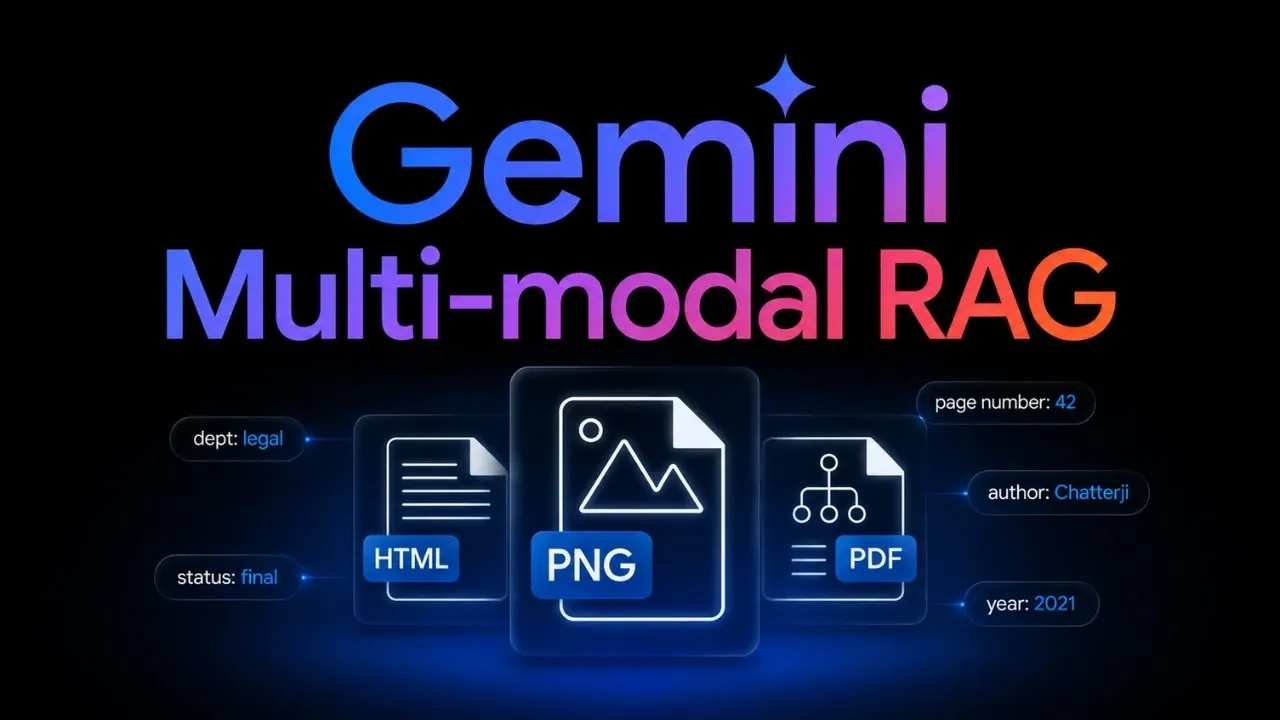
Google’s Gemini API introduces multimodal retrieval, allowing users to query both text and image data within a shared vector space. This capability supports complex use cases, such as analyzing PDFs with diagrams or scanned pages, by integrating features like page-level citations and metadata-based filtering. According to Prompt Engineering, these features enhance precision by allowing targeted searches, such as identifying specific sections in legal documents or extracting insights from technical reports that combine text and visuals.
Explore this explainer to gain insight into the mechanics of metadata filtering for narrowing search results, understand how multimodal embeddings integrate diverse data formats and learn how the API’s structured pipeline processes mixed content efficiently. These topics provide a clear framework for applying the Gemini API to tasks involving enterprise documents, visual analysis and cross-format synthesis.
TL;DR Key Takeaways :
- The Gemini API now supports advanced multimodal retrieval, allowing simultaneous querying of text and image data within a unified vector space, enhancing workflows like retrieval-augmented generation (RAG).
- New features include metadata-based filtering for refined searches and page-level citations for precise traceability, improving efficiency and accuracy in document management.
- The API processes complex documents (e.g., PDFs with images and diagrams) through a structured pipeline, embedding text and images into a shared vector space for seamless retrieval.
- Applications span industries such as healthcare, engineering and legal, allowing users to synthesize insights from diverse formats like technical manuals, patient records and annotated diagrams.
- Flexible pricing includes a free tier with 1 GB storage, free vector storage and scalable options, making the API accessible for both small teams and large enterprises.
What is Multimodal Retrieval?
The Gemini API now allows you to query both text and image data simultaneously within a shared vector space. This means you can extract insights from documents that combine textual content with visual elements, such as technical reports containing annotated diagrams or scanned pages. By embedding both modalities into a unified vector space, the API ensures your queries are contextually relevant and grounded, regardless of the data format.
For instance, consider analyzing a product manual with written instructions and accompanying diagrams. With this multimodal capability, you can retrieve information from both the text and visuals in a single query, streamlining your workflow and enhancing efficiency. This feature is particularly useful for industries where documents often blend text and images, such as engineering, healthcare and legal sectors.
Enhanced Precision with Metadata Support
The Gemini API introduces metadata-based filtering, allowing you to attach key-value metadata to documents. This feature enables you to refine your searches based on specific criteria, such as “department: finance” or “region: North America.”
In enterprise environments, where documents often span multiple categories or departments, metadata filtering ensures that your queries return only the most relevant results. For example, you can quickly locate engineering-related documents in a global repository or filter financial reports by region, saving time and reducing information overload. This capability is invaluable for organizations managing large-scale, diverse datasets.
Unlock more potential in Multimodal AI by reading previous articles we have written.
- DeepSeek V4 Adds Blackwell SM100 and FP4 Support for Lower-Cost Scaling
- Google Drops Gemma 4 for Consumer Hardware
- AI Concepts Software Engineers Need in 2026
- New Mistral 3 Large AI Models : Coding, Multilingual, Multimodal AI with Sparse Experts
- What is Multimodal Artificial Intelligence (AI)?
Page-Level Citations for Traceability
One of the standout features of the update is page-level citations, which enhance traceability and reliability. When you query the API, it not only retrieves relevant information but also identifies the exact page within the source document where the data is located.
This feature is particularly beneficial for tasks requiring precision and verification. For example, when reviewing a legal document, you can pinpoint the specific page containing the clause you need, making sure accuracy in your analysis. Similarly, researchers can easily reference the exact page of a study or overview, streamlining the process of cross-referencing and validation.
How the Pipeline Works
The Gemini API employs a structured pipeline to process multimodal data efficiently. Here’s an overview of how it works:
- Ingest: Upload documents, including PDFs, images and scanned pages, via the API.
- Chunking: Text is divided into token-bound chunks, while images are split into smaller tiles for processing.
- Embedding: Both text and image data are embedded into a shared vector space using Gemini embeddings.
- Storing: Embedded vectors are stored in a file search store, along with their associated metadata.
- Querying: Retrieve top-ranked chunks using metadata-based filtering, with grounded responses that include page-level citations.
This systematic approach ensures accurate and efficient results, even when dealing with complex multimodal documents. By integrating text and image data into a unified workflow, the API simplifies the retrieval process, making it more intuitive and effective.
Applications Across Industries
The Gemini API’s multimodal capabilities unlock a wide range of applications across various industries. Key use cases include:
- Enterprise Document Management: Manage diverse documents such as insurance claims, engineering specifications and medical reports.
- Visual Content Querying: Search for specific visual elements, like charts, diagrams, or annotated images.
- Metadata-Filtered Retrieval: Conduct targeted searches using metadata to narrow down results.
- Synthesizing Information: Combine insights from multiple sources, including text and images, to generate comprehensive responses.
For example, in the healthcare sector, you can retrieve both textual patient records and diagnostic images in a single query, streamlining decision-making processes and improving outcomes. Similarly, in engineering, you can analyze technical manuals that combine schematics with detailed instructions, making sure a more holistic understanding of the material.
Flexible Pricing and Storage Options
The updated API offers a flexible pricing model designed to accommodate a variety of use cases. Key details include:
- Files are capped at 100 MB each, making sure efficient processing and storage.
- A free tier provides 1 GB of total storage, allowing you to explore the API’s capabilities without upfront costs.
- Vector storage and query-time embeddings are free, while charges apply for document ingestion and token usage during generation.
This pricing structure makes the API accessible to both small teams and large enterprises, with scalable options to meet growing demands. Whether you’re a startup exploring its potential or a large organization managing extensive datasets, the API’s cost-effective model ensures flexibility and accessibility.
Seamless Migration and Integration
If you’re already using the Gemini file search API, transitioning to the updated version is straightforward. The new multimodal capabilities integrate seamlessly into your existing workflows, allowing you to use advanced features with minimal disruption. Whether you’re managing legal documents, technical manuals, or multimedia archives, the API’s enhanced functionality ensures a smooth and efficient user experience.
By combining text and image data in a unified vector space, supporting metadata-based filtering and offering page-level citations, the Gemini API addresses the challenges of handling complex, non-textual data. Its versatility and precision make it a valuable tool for industries ranging from healthcare and finance to engineering and beyond.
Media Credit: Prompt Engineering
Disclosure: Some of our articles include affiliate links. If you buy something through one of these links, Geeky Gadgets may earn an affiliate commission. Learn about our Disclosure Policy.
