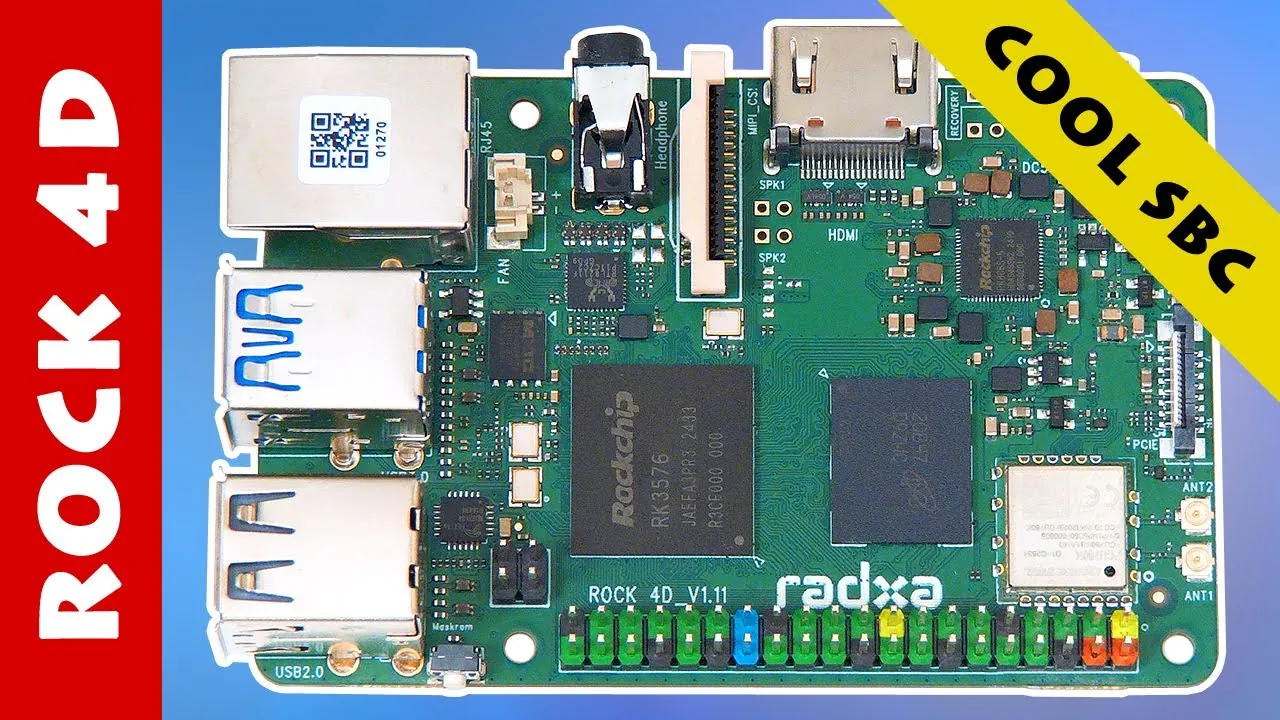
What if your next single-board computer didn’t just meet your expectations but redefined them? Enter the Rock 4D, a innovative SBC from Radxa that’s turning heads with its robust hardware and forward-thinking design. Built around an octa-core ARM architecture and boasting features like PCIe connectivity, Wi-Fi 6, and support for UFS storage, the Rock 4D isn’t just a competitor to the Raspberry Pi 5—it’s a bold statement in performance and versatility. Whether you’re tackling AI workloads, edge computing, or multimedia projects, this board promises to deliver a balance of power and efficiency that’s hard to ignore. But does it live up to the hype, or does its software ecosystem hold it back?
In this review, Explaining Computers explores what makes the Rock 4D a standout in the crowded SBC market. From its industrial-grade capabilities to its appeal for hobbyists, we’ll uncover how its hardware innovations—like the PCIe 2.1 connector for blazing-fast NVMe SSDs—set it apart. But it’s not all smooth sailing; we’ll also examine the challenges posed by its still-maturing software ecosystem and how that impacts its usability. If you’re curious about whether this board is the right fit for your next project, read on to discover its strengths, limitations, and the unique opportunities it offers. Sometimes, the best innovations come with trade-offs worth considering.
Rock 4D SBC Overview
TL;DR Key Takeaways :
- The Rock 4D by Radxa is an octa-core ARM-based single-board computer designed as a powerful alternative to the Raspberry Pi 5, with guaranteed availability until 2035, making it ideal for industrial and long-term projects.
- It features a robust hardware setup, including the RK3576 SoC with Cortex-A76 and Cortex-A53 cores, up to 16GB LPDDR5 RAM, UFS and eMMC storage support, and PCIe 2.1 for NVMe SSDs, allowing high performance for AI, edge computing, and multimedia tasks.
- Connectivity options include Wi-Fi 6, Bluetooth 5.4, Gigabit Ethernet with PoE, USB 2.0/3.0 ports, HDMI 2.1 for 4K video, and GPIO compatibility with Raspberry Pi accessories, making it versatile for diverse applications.
- While the Rock 4D excels in hardware, its software ecosystem, based on Radxa OS (Debian with KDE Plasma), is less mature compared to the Raspberry Pi 5, posing challenges for developers and hobbyists reliant on community support and software libraries.
- Compared to the Raspberry Pi 5, the Rock 4D offers superior hardware features like UFS storage, HDMI 2.1, and PoE support but lags slightly in performance benchmarks and software ecosystem maturity, making it better suited for specialized or industrial use cases.
Hardware Highlights: Power and Efficiency Combined
At the heart of the Rock 4D lies the RK3576 system-on-chip (SoC), which features an octa-core configuration designed for both performance and efficiency:
- Four Cortex-A76 cores clocked at 2.2 GHz for handling demanding tasks.
- Four Cortex-A53 cores running at 2 GHz for energy-efficient operations.
This architecture ensures a balance between processing power and optimized energy consumption, making it suitable for a wide range of applications. The inclusion of the ARM Mali-G52 GPU and a 6 TOPS machine processing unit (MPU) further enhances its capabilities, allowing it to handle AI workloads and graphics-intensive tasks effectively.
The Rock 4D offers flexible memory configurations, ranging from 2GB to 16GB of LPDDR5 RAM, allowing users to select the option that best suits their performance requirements. For storage, it supports UFS and eMMC modules, which deliver significantly faster data transfer speeds compared to traditional microSD cards. Additionally, the PCIe 2.1 connector allows for the integration of M.2 NVMe SSDs, achieving read speeds of approximately 301 MB/s. This makes the board particularly well-suited for data-intensive tasks such as video editing or database management.
Connectivity: Versatile Options for Diverse Applications
The Rock 4D is equipped with a comprehensive range of connectivity features, making it adaptable to various scenarios:
- Wireless: Wi-Fi 6 and Bluetooth 5.4 provide fast and reliable wireless communication, essential for modern IoT and edge computing applications.
- Wired: Gigabit Ethernet with Power over Ethernet (PoE) support ensures stable and efficient data transfer, particularly in industrial environments.
Peripheral connectivity is equally robust:
- Two USB 2.0 ports and two USB 3.0 ports, one of which supports OTG functionality.
- A 40-pin GPIO header compatible with Raspberry Pi accessories, allowing seamless integration with existing projects.
- A full-size HDMI 2.1 port capable of 4K resolution at 120fps, ideal for high-quality video output.
- Dual MIPI CSI connectors for cameras and a MIPI DSI connector for LCD panels, supporting multimedia and vision-based projects.
- A 3.5mm audio jack for audio output, catering to multimedia applications.
These features make the Rock 4D a versatile and practical choice for both professional and hobbyist users, offering flexibility for a wide range of projects.
Rock 4D Arm SBC with PCIe Connector

Here are more guides from our previous articles and guides related to SBC systems that you may find helpful.
- Milk-V Meles RISC-V single-board computer SBC
- PolarBerry secure PolarFire SoC Linux SBC and SoM
- Odroid M1S single board computer (SBC) from $49
- Orange Pi 5 Max Single Board Computer (SBC) from $95
- Discover the New AMD Ryzen 7 7840HS SBC for Gaming & More
- ASRock AI 350 SBC Review: AMD Ryzen AI 7 350 Performance
- Radaxa X4 single board computer (SBC) mini PC hands-on
- IBASE IB200 ultra-compact 2.5 Single Board Computer (SBC
- 81 Linux Single Board PCs (SBC) Under $200 Listed In New Guide
- 680 Edge Ryzen X86 single board computer (SBC)
Performance: Solid but Not Industry-Leading
The Rock 4D delivers reliable performance across various tasks, including smooth 1080p media playback and 4K playback with minor limitations. While it performs slightly below the Raspberry Pi 5 in most benchmarks, it remains capable of handling resource-intensive tasks such as video rendering and editing, provided adequate cooling solutions are in place.
One of the board’s standout features is its storage performance. The support for UFS modules enables significantly faster data transfer speeds compared to microSD cards, which typically achieve around 65 MB/s. However, the availability of UFS modules can be limited, potentially restricting this advantage for some users. The PCIe 2.1 connector further enhances storage capabilities, making the Rock 4D a strong contender for data-heavy applications.
Software Ecosystem: A Work in Progress
The Rock 4D runs on Radxa OS, a Debian-based operating system featuring the KDE Plasma desktop environment. While this provides a user-friendly interface, the software ecosystem is less mature compared to competitors like the Raspberry Pi 5. This can present challenges for developers and hobbyists who rely on extensive community support, pre-existing software libraries, and compatibility with a wide range of applications.
Despite these limitations, the board’s compatibility with UFS modules and its Debian-based OS offers potential for future software improvements. However, the limited availability of UFS modules continues to be a bottleneck for users aiming to maximize storage performance. For those willing to navigate these challenges, the Rock 4D offers a solid foundation for development and experimentation.
Target Audience and Use Cases
The Rock 4D is tailored to meet the needs of specific user groups, offering a combination of advanced hardware and connectivity options:
- Industrial and AI Applications: Its robust hardware, extended availability until 2035, and support for AI workloads make it an excellent choice for long-term projects and specialized applications.
- Hobbyists and Makers: The board’s flexibility and advanced features appeal to enthusiasts, although its less mature software ecosystem may require additional effort to fully use its potential.
Its versatility makes it particularly appealing for edge computing, AI-driven tasks, and multimedia projects, where its hardware capabilities can be fully used.
Comparison with Raspberry Pi 5: Pros and Cons
When compared to the Raspberry Pi 5, the Rock 4D offers several distinct advantages:
- A full-size HDMI 2.1 port for superior video output quality.
- Support for UFS modules, allowing faster storage performance.
- Additional MIPI connectors for cameras and LCD panels, enhancing multimedia capabilities.
- Power over Ethernet (PoE) support for streamlined power and data delivery in industrial setups.
However, the Rock 4D has its drawbacks:
- The Raspberry Pi 5 benefits from a more mature software ecosystem, with extensive community support and a broader range of compatible software libraries.
- It also delivers slightly better performance in most benchmarks, making it a more versatile option for general-purpose computing tasks.
The Rock 4D is best suited for users who prioritize hardware capabilities and connectivity options over software ecosystem maturity, particularly in specialized or industrial applications.
Media Credit: ExplainingComputers
Disclosure: Some of our articles include affiliate links. If you buy something through one of these links, Geeky Gadgets may earn an affiliate commission. Learn about our Disclosure Policy.
