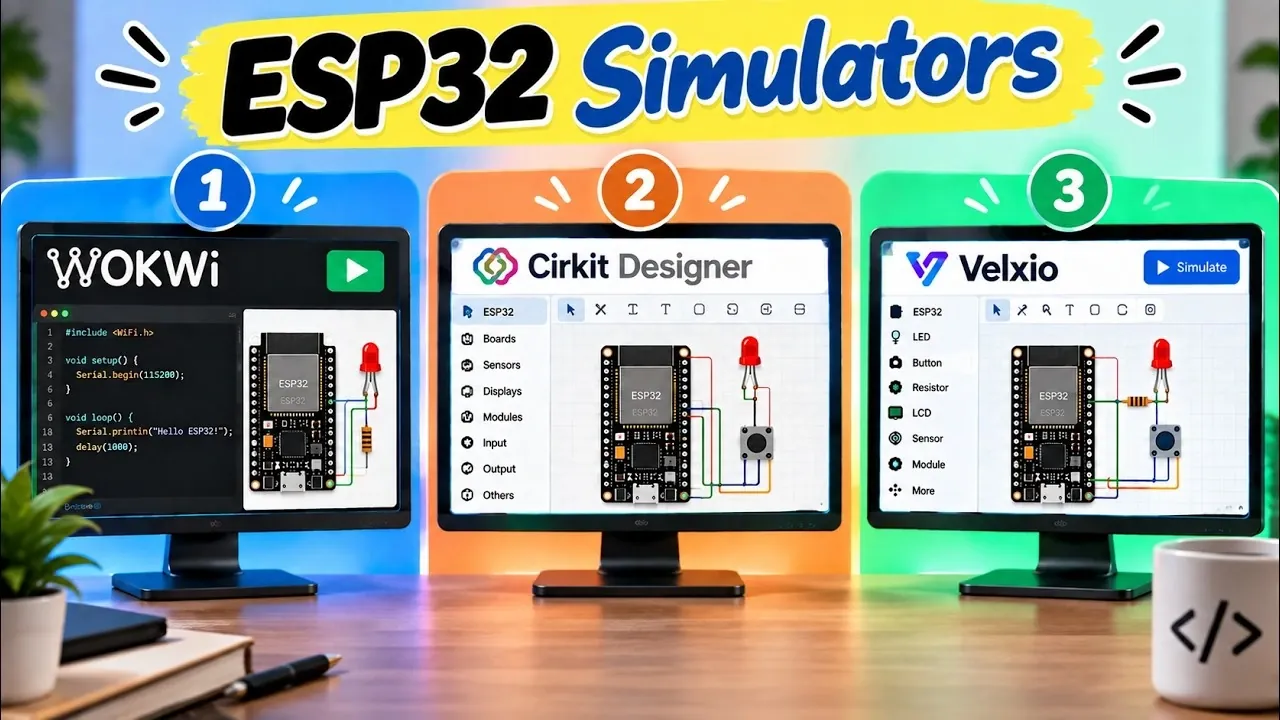
Free ESP32 simulators have become an integral resource for developers, allowing project testing and prototyping without the need for physical hardware. According to ToP Projects Compilation, platforms like Wokwi, Circuit Designer and Vexlio stand out for their distinct functionalities. For instance, Wokwi includes pre-built templates for ESP32 S3, C6 and H2 models, along with a logic analyzer that supports real-time debugging. These features address a range of development scenarios, from straightforward prototyping to advanced system emulation.
Explore how these simulators align with different project requirements. Gain insight into Wokwi’s shared workspace capabilities for collaborative IoT development, examine Circuit Designer’s AI-driven features for streamlining workflows and decode Vexlio’s approach to multi-board simulation for testing complex setups. This overview provides actionable details to help you navigate the options available for ESP32 simulation.
Browser ESP32 Simulators
TL;DR Key Takeaways :
- Free browser-based ESP32 simulators like Wokwi, Circuit Designer and Vexlio enable efficient prototyping, debugging and testing without physical hardware.
- Wokwi: Offers extensive component libraries, Wi-Fi simulation, custom chip creation and collaborative features, making it ideal for IoT workflows and team projects.
- Circuit Designer: AI-powered platform tailored for beginners, featuring a vast component library, code generation and educational tools, though with limited advanced feature support.
- Vexlio: Focuses on high-fidelity emulation, multi-board simulation and advanced debugging tools, catering to experienced developers handling complex projects.
- Choosing the right simulator depends on your expertise and project needs: Wokwi for flexibility, Circuit Designer for beginners and Vexlio for advanced emulation and debugging.
Wokwi: A Versatile and Collaborative Simulation Platform
Wokwi stands out as a highly versatile, browser-based simulator tailored for a wide range of ESP32 IoT workflows. Its accessibility is a key advantage, requiring no downloads or installations. Whether you are working with ESP32 S3, C6, or H2 variants, Wokwi provides pre-built templates that allow you to jumpstart your projects with ease.
Key features of Wokwi include:
- An extensive component library for integrating sensors, actuators and peripherals seamlessly.
- Support for Wi-Fi simulation, including protocols such as HTTP and MQTT.
- Custom chip creation for advanced and unique hardware configurations.
- A built-in logic analyzer for real-time data visualization and debugging.
Another notable feature of Wokwi is its collaborative functionality. You can save and share projects or collaborate with team members on the same design, making it an excellent choice for group-based development. With its combination of flexibility, ease of use and robust features, Wokwi is a top-tier option for both hobbyists and professional developers.
Circuit Designer: AI-Powered Guidance for Beginners
Circuit Designer is an intuitive platform designed to simplify circuit design for beginners. By using AI, it assists users with component connections and code generation, significantly reducing the learning curve. This platform supports multiple microcontrollers, including ESP32 S3 (currently in beta), Arduino and Raspberry Pi Pico, making it a versatile choice for entry-level developers.
Notable features of Circuit Designer include:
- A library of over 20,000 components, complete with a simulation filter for compatibility checks.
- Custom component creation and export options in formats like PNG, SVG and detailed documentation.
- AI-driven assistance for faster prototyping and troubleshooting, ideal for educational purposes.
Despite its strengths, Circuit Designer has some limitations. Features such as Bluetooth, CAN and USB input are only partially supported, which may restrict its use for more advanced applications. However, its user-friendly interface and AI-powered guidance make it an excellent tool for beginners and educators looking to introduce circuit design concepts.

Here are more guides from our previous articles and guides related to ESP32 that you may find helpful.
- $5 ESP32-S3 Super Mini Packs Wi-Fi and Bluetooth
- How an $8 ESP32 S3 Microcontroller Runs a 28.9M Parameter Local LLM
- $4 ESP32 Module Brings Wi-Fi and Bluetooth to IoT Projects
- ESP32 S31 Devkit Hands-on: 320 MHz RISC-V Chip Adds Wi-Fi 6
- $4 ESP32-S3 Super Mini Packs a 0.96-Inch IPS TFT Screen
- Build a DIY Open-Source Flipper Zero Using a ESP32-DIV
- $9 CYD ESP32 Module Includes a 2.88-Inch LCD Screen
- ESP32-S3 Automation System Packs 16 Relays for Smart Homes
- $5 ESP32 S3 Board Packs a 240 MHz Dual-Core Chip
- $20 ESP32 Paired with Claude Code to Automate Programming, Tasks and Projects
Vexlio: High-Fidelity Emulation for Complex Projects
Vexlio is a robust platform designed for developers who require detailed emulation and advanced debugging capabilities. It provides high-fidelity microcontroller emulation that closely replicates real CPU behavior, making it ideal for complex projects involving multiple boards and interconnected systems. Vexlio supports ESP32, Arduino and Raspberry Pi, offering flexibility for a wide range of applications.
Vexlio’s standout features include:
- Local browser-based operation, making sure consistent performance without reliance on external servers.
- Multi-board simulation to test interactions between interconnected systems, crucial for IoT applications.
- Advanced debugging tools, such as a serial monitor and oscilloscope, for precise issue diagnosis.
While its component library is still growing, Vexlio’s focus on accurate emulation and debugging makes it a valuable resource for experienced developers tackling intricate designs. Its ability to simulate complex interactions between multiple systems sets it apart as a powerful tool for advanced projects.
How to Choose the Right ESP32 Simulator
Selecting the right ESP32 simulator depends on your specific needs, expertise level and project requirements. Each platform offers unique advantages:
- Wokwi: Ideal for comprehensive IoT workflows and collaborative projects, offering flexibility and ease of use.
- Circuit Designer: Best suited for beginners and those seeking AI-assisted guidance for faster learning and prototyping.
- Vexlio: Perfect for advanced users requiring detailed emulation, multi-board simulation and precise debugging tools.
By using these free ESP32 simulators, developers can streamline their design processes, test complex systems and refine their projects without the need for physical hardware. Whether you are a hobbyist exploring innovative ideas or a professional working on intricate designs, these tools provide the functionality and flexibility to bring your concepts to life efficiently and effectively.
Media Credit: ToP Projects Compilation
Disclosure: Some of our articles include affiliate links. If you buy something through one of these links, Geeky Gadgets may earn an affiliate commission. Learn about our Disclosure Policy.
