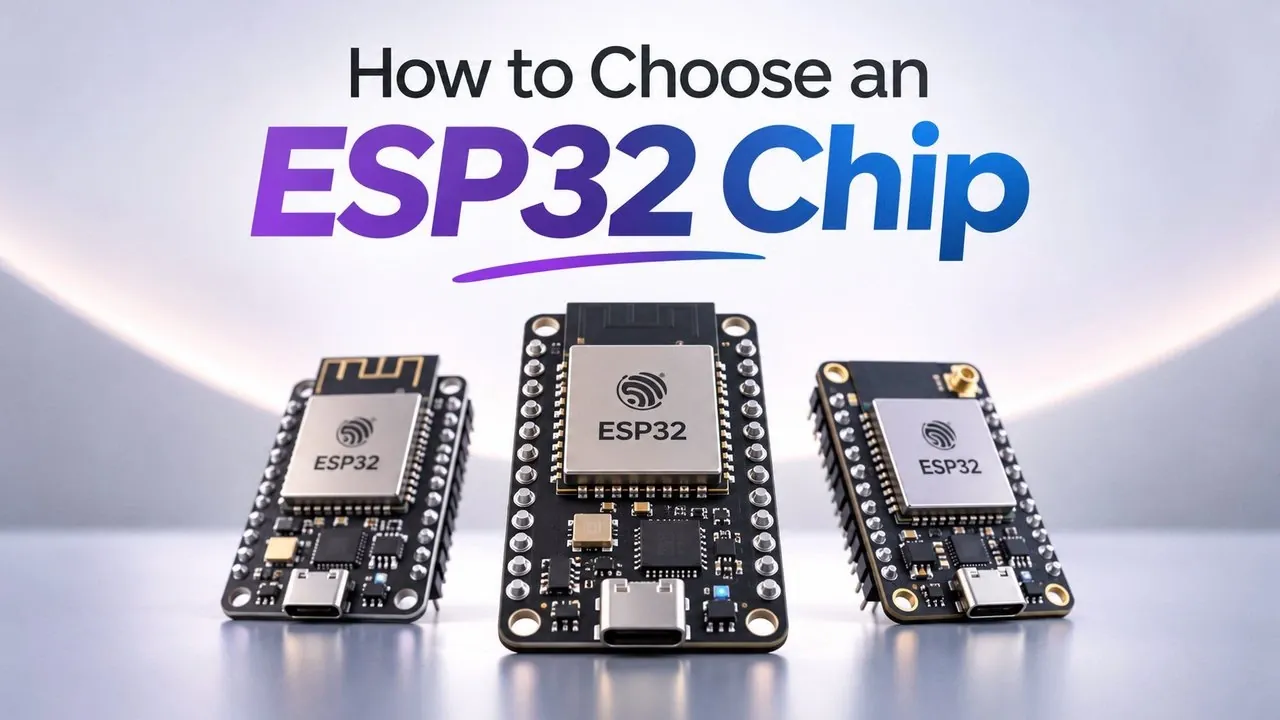
The ESP32-S3 offers a mature mix of processing and wireless connectivity, while the ESP32-C6 favors battery life and the ESP32-P4 handles displays and cameras without a built-in radio. These microcontrollers give you different ways to build a connected or display-equipped product, but each comes with trade-offs. In the video below John Teel takes a closer look at where each chip fits, from wireless standards to the route into production. Explore why the C6 suits low-power devices and how the P4 can pair with a companion chip when you need wireless.
ESP32-S3: a Mature All-Rounder
TL;DR Key Takeaways :
- The ESP32-S3 is a mature all-rounder with dual 240 MHz cores, Wi-Fi 4, Bluetooth Low Energy and native USB. It lacks Wi-Fi 6, Thread and Zigbee; Predictable Designs with John Teel recommends it for products needing wireless connectivity and moderate processing power.
- The ESP32-C6 combines a 160 MHz RISC-V core with Wi-Fi 6, Bluetooth Low Energy, Thread and Zigbee. Predictable Designs with John Teel gives it the edge when battery life is the top priority, though it has less processing headroom and fewer resources than the ESP32-S3.
- The ESP32-C5 offers the same wireless stack as the C6, with a 240 MHz main core, a 48 MHz low-power core and dual-band Wi-Fi 6 including 5 GHz. It is in mass production, and modules are available.
- The ESP32-P4 targets displays, cameras and compute with dual 400 MHz RISC-V cores and multimedia hardware. It has no wireless radio, so a wireless design needs a companion chip such as the C6 or C5.
- The S3 and C6 offer a production path from development kits to pre-certified modules and bare-chip designs. P4 development kits are available, but selection is limited and Espressif has no official pre-certified P4 modules; its Arduino support remains in early beta.
The ESP32-S3 combines two cores running at 240 MHz with Wi-Fi 4, Bluetooth Low Energy, native USB and 45 GPIO pins for sensors and peripherals. Its ecosystem has more libraries, community support, third-party boards and module options than the rest of the ESP32 family.
Native USB eliminates the need for a separate converter chip and makes production firmware updates easier. The dual cores can handle Wi-Fi and sensor work at the same time, while pre-certified WROOM and mini modules make FCC and CE certification more manageable.
Predictable Designs with John Teel recommends the ESP32-S3 for products that need Wi-Fi, Bluetooth and moderate processing power, with a mature route to production. Suitable applications include consumer electronics, display-equipped wearables, audio products and moderate-resolution camera devices.
The wireless trade-off is that the chip supports neither Wi-Fi 6 nor Thread or Zigbee. It can run Matter over Wi-Fi, but a product that requires Thread needs a companion chip. Its low-power coprocessor is also more limited than the ESP32-C6’s. Continuous sensor polling while the main processor sleeps can use more current and shorten battery life.
The ESP32-S3 uses Espressif’s older Tensilica architecture, while new Espressif releases use RISC-V cores. The ESP32-S3 is likely to be the last major Tensilica chip in the company’s lineup.
ESP32-C6 and ESP32-C5: Connected Devices
The ESP32-C6 pairs a single 160 MHz RISC-V core with a 20 MHz low-power core. It brings Wi-Fi 6, Bluetooth Low Energy, Thread and Zigbee together on one chip. The ESP32-C6 and ESP32-C5 are the only ESP32 chips with that full wireless combination natively.
For products that transmit periodically, Wi-Fi 6’s Target Wake Time lets the ESP32-C6 negotiate wake-up schedules with a router, helping battery life. Wi-Fi 6 also handles crowded networks better. Unlike the ESP32-S3, the ESP32-C6 can use its low-power core to poll sensors and handle Bluetooth Low Energy advertising while the main core is off.
Predictable Designs with John Teel gives the ESP32-C6 the edge when battery life is the top priority and recommends the ESP32-C6 or ESP32-C5 for Matter and Thread products. Their wireless capabilities also suit battery-powered sensors and environmental monitors where efficiency matters more than raw compute.
The ESP32-C6 has less processing headroom than the dual-core ESP32-S3, as well as fewer libraries, examples and third-party resources. It has no hardware floating-point unit or USB on-the-go support, so it cannot act as a USB host or emulate custom USB devices.
The ESP32-C5 keeps the same wireless stack but raises the main core to 240 MHz and the low-power core to 48 MHz. It adds dual-band Wi-Fi 6 with 5 GHz support, which can help where 2.4 GHz is congested. The ESP32-C5 is in mass production, and modules are available.

Find more information on ESP32 variants and features by browsing our extensive range of articles, guides and tutorials.
- Which ESP32 Should You Choose? Variants and Features 2026 Guide
- ESP32 S31 Devkit Hands-on: 320 MHz RISC-V Chip Adds Wi-Fi 6
- WaveShare ESP32-C5 Offers 32MB Flash and Sensors For $20
- Build a $20 Desk Buddy with an ESP32 C6 Microcontroller
ESP32-P4: Displays, Cameras and Compute
The ESP32-P4 puts processing and multimedia ahead of built-in wireless. Its main specifications include:
- 400 MHz dual-core RISC-V processor
- 40 MHz separate low-power core
- 768 KB of on-chip SRAM
- Up to 32 MB of in-package PSRAM
- High-speed interfaces for cameras and displays
- Hardware video encoding and decoding
Those capabilities suit products such as touchscreen control panels, full-color thermostats, barcode scanners, visual inspection tools and edge AI devices that process data locally. Rich interfaces, camera-based detection, video streaming and on-device AI previously required a move to a Linux single-board computer such as a Raspberry Pi Compute Module. The ESP32-P4 offers that class of processing with microcontroller-level power consumption and boot times.
The ESP32-P4 has no wireless radio. For a wireless product, you can pair it with an ESP32-C6, leaving the ESP32-P4 to handle compute and the companion chip to handle connectivity. That means two chips and two firmware images. An ESP32-C5 can replace the companion ESP32-C6 to add 5 GHz without changing the ESP32-P4 side.
Predictable Designs with John Teel notes that the ESP32-P4 is probably more costly and powerful than necessary for an application that does not need a display, camera or heavy compute.
From Development Board to Production
The ESP32-S3 and ESP32-C6 can move from a development kit to a pre-certified module, then to a bare-chip design when production volumes justify it. A module on a relatively simple carrier board can inherit most wireless certifications. ESP32-S3 kits and modules are widely available, and its bare-chip option is documented for high-volume custom designs.
The ESP32-C6 follows the same path, and its WROOM modules are pin compatible with the original ESP32 WROOM footprint. That can simplify hardware migration for a board designed around the older module.
ESP32-P4 development kits exist, but selection is limited, and Espressif has no official pre-certified ESP32-P4 modules. The chip needs no wireless certification on its own because it has no radio. A wireless production design can instead use an ESP32-P4 bare chip and a separate pre-certified ESP32-C6 module on a custom board.
For ESP32-P4 development, Espressif’s ESP-IDF is the mature framework, while Arduino support remains in early beta. A product requiring Bluetooth Classic needs the original ESP32: the ESP32-S3, ESP32-C6 and ESP32-P4 do not support it. Predictable Designs with John Teel favors the RISC-V ESP32-C6, ESP32-C5 or ESP32-P4 for roadmaps spanning five years or more, although Espressif still commits to long production support for the ESP32-S3.
Media Credit: Predictable Designs
Disclosure: Some of our articles include affiliate links. If you buy something through one of these links, Geeky Gadgets may earn an affiliate commission. Learn about our Disclosure Policy.
