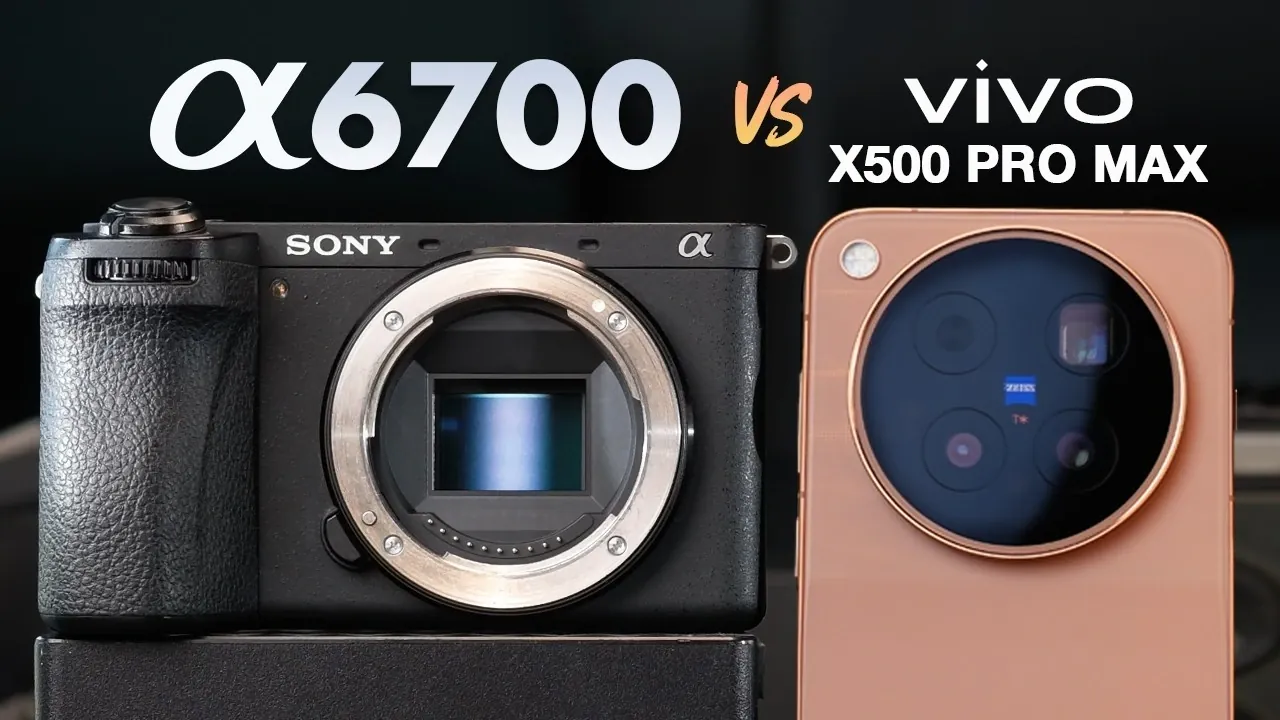
Can a phone keep up with a dedicated camera? The Film Alliance found that the Vivo X500 Pro Max produced steadier footage than the Sony A6700 in controlled studio lighting setup, while the Sony offered more control and was preferred for photography. The Vivo puts three cameras in your phone, so you can leave a separate camera and its accessories behind. The Sony has a larger sensor and interchangeable lenses, plus aperture adjustment. Discover how their footage, slow motion and photography options differ, and see why each has its place.
X500 Pro Max vs Sony A6700: Control or Convenience
TL;DR Key Takeaways :
- The Vivo X500 Pro Max produced steadier footage than the Sony A6700 in the controlled studio lighting setup used for the comparison.
- The A6700 produced more natural colors, preserved skin tones better and showed more dynamic range in a standard-profile fire shot.
- The X500 Pro Max records 4K at up to 240 fps, while the A6700 reaches 120 fps in 4K.
- The Film Alliance recommends the A6700 for photography because of its larger 26-megapixel APS-C sensor, interchangeable lenses and electronic viewfinder.
- Both cameras support log recording and LUTs, with camera-specific LUTs producing more dynamic range and grading freedom than standard profiles.
These are two very different tools asked to do the same job. The Vivo X500 Pro Max is a phone with three fixed rear cameras, while the Sony A6700 is a dedicated camera whose results depend on the lens you fit.
The phone’s rear cameras and video specifications are:
- 1x main camera: 24 mm, with the phone’s largest sensor and 50-megapixel photos.
- 3.5x telephoto: 85 mm.
- 0.6x ultra-wide: 15 mm.
- Video: 4K at up to 240 frames per second, with 10-bit log.
The A6700 answers with a larger 26-megapixel APS-C sensor and the E-mount lens system, which gives you control over focal length and depth of field that fixed cameras cannot offer. The comparison used a Sigma 18-50 mm f/2.8 and a Viltrox 13 mm f/1.4 on the Sony.
The Sony Keeps More Natural Color and Darker Shadows
In standard color profiles, the phone processes its footage more heavily. It lifts midtones and shadows and adds saturation, which in one identically exposed shot revealed more color in a background couch, while the Sony kept its darker tones and with them more flexibility in post-production. The same pattern showed in a backlit shot, where the phone’s blacks were less deep, and under frontlit studio lighting, where the A6700 looked more natural and closer to the scene as seen by eye.
Skin tones follow suit: the phone raised their saturation, while the Sony preserved them better and showed more facial detail. The A6700 also showed more dynamic range in a shot of fire against a background, which its larger sensor may help explain, and in a night lapse with both cameras exposed the same way it stayed closer to the natural night sky.
The phone had its wins too. It looked better in a straight-out-of-camera overhead shot with controlled lighting, and in a pumpkin shot it only added some saturation, where the Sony looked more natural but showed color shifting that could not be fixed in post.

Here is a selection of related articles from our archive.
- Vivo X500 Pro Max Beats iPhone 18 Pro with a 200MP Telephoto Lens
- Osmo Pocket 4P vs Vivo X500 Pro Max: Cinematic Video Performance Compared
- Sony A6700 26MP APS-C Sensor Beats iPhone 18 Pro in Low Light
The Phone Produces Steadier Footage
Stabilization is where the X500 Pro Max came out ahead, at least in the lighting used for the comparison. Its footage looked steadier, while the Sony’s stabilization was distracting to watch.
The phone’s stabilization is described as gimbal-level, and its active mode applies a small crop. To match it, the Sony would need a gimbal, a stabilized lens or post-processing in Catalyst Browse. The phone’s result should hold in most lighting, with night the likely exception.
Log and LUTs Give Both Cameras More Grading Room
Both cameras can go beyond their standard profiles. The X500 Pro Max shoots 10-bit log and the A6700 uses S-Log 3, and both can load LUTs to preview the look while filming, so you see the intended result on the camera instead of waiting until after the shoot.
With camera-specific LUTs applied to log footage, both produced more dynamic range, better-looking colors and more freedom to grade than their standard profiles. Matching LUTs could also let the two work together as an A-camera and B-camera, perhaps with a little extra color work, because the footage should sit closer than it does in the standard profiles, whether outdoors, in bright sun or in low light.
The Phone Reaches 240 fps Without Leaving 4K
For slow motion, the X500 Pro Max records 4K at up to 240 fps. The A6700 stops at 120 fps in 4K and must drop to 1080p to reach 240 fps.
Frame rate is not the whole story, though. In a slow-motion fire shot using standard profiles, the phone’s flames looked almost digital and the Sony handled the shot better, although its standard profile left only a little room to adjust colors afterward compared with log.
The Sony Offers More Photographic Control
For stills, the A6700 is the stronger camera. Its larger sensor and interchangeable lenses are joined by an electronic viewfinder, which lets you frame a shot with your eye to the camera instead of relying on the display in bright conditions.
The phone is limited to its three built-in cameras and has no aperture adjustment. The Sony also takes interchangeable batteries and memory cards, and its flip screen suits vlogging.
The Film Alliance would pick the Sony A6700 for photography and for anyone who wants full manual control over exposure. The Vivo X500 Pro Max is the one for those who would rather not carry a camera bag at all, and on stabilization and slow motion it is the one ahead.
Media Credit: The Film Alliance
Disclosure: Some of our articles include affiliate links. If you buy something through one of these links, Geeky Gadgets may earn an affiliate commission. Learn about our Disclosure Policy.
