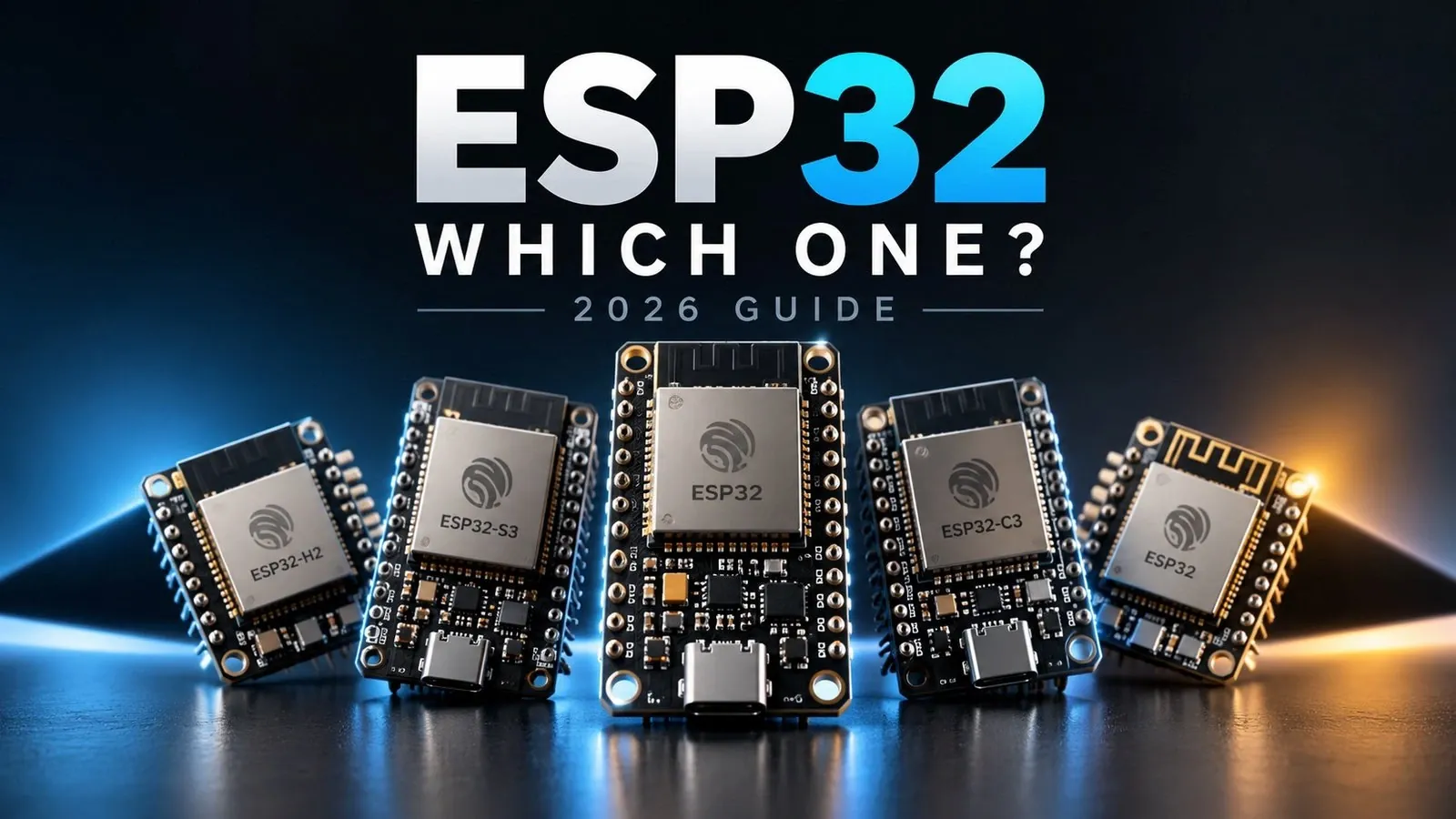
The ESP32 family of microcontrollers has become a go-to choice for developers working on IoT, multimedia and smart home projects, thanks to its versatility and robust wireless capabilities. In this guide, DroneBot Workshop explores the key features and applications of ESP32 boards, highlighting their compatibility with frameworks like Arduino IDE and MicroPython. For instance, the ESP32S3 stands out with its dual-core processor, BLE 5.0 support and AI accelerator, making it particularly suited for multimedia and AI-driven tasks. By understanding the distinctions between models such as the ESP32C6 for Wi-Fi 6 and Matter protocols or the ESP32P4 for high-performance multimedia, developers can better align their hardware choices with project goals.
Gain insight into how to choose the right ESP32 board for your needs, whether you’re focused on compact designs, IoT integration, or display-heavy applications. This guide will also walk you through specific use cases, such as using the ESP32H2 for Zigbee and Thread-based smart home devices or using budget-friendly options like the Seduino Xiao ESP32C3 for educational projects. By the end, you’ll have a clear understanding of which ESP32 variant and development framework best suit your technical requirements and creative ambitions.
What is the ESP32 Family?
TL;DR Key Takeaways :
- The ESP32 microcontroller family, developed by Espressif Systems, is a versatile platform widely used in IoT, smart home and multimedia applications due to its robust wireless capabilities and adaptability.
- ESP32 boards support multiple communication protocols, including Wi-Fi, Bluetooth, Zigbee, Thread and Matter, making sure compatibility with diverse project requirements.
- The ESP32 ecosystem offers various models tailored to specific use cases, such as AI, multimedia, IoT and compact designs, with notable variants like ESP32S3, ESP32C6 and ESP32P4.
- Popular development frameworks like Arduino IDE, ESP IDF, MicroPython and CircuitPython provide flexibility for developers of all skill levels to program ESP32 boards.
- Specialized ESP32 boards and categorized recommendations (e.g., for IoT, multimedia, or budget projects) help developers choose the most suitable option for their needs.
Developed by Espressif Systems, the ESP32 series builds upon the success of the ESP8266, delivering enhanced wireless capabilities and expanded functionality. These microcontrollers support a wide range of communication protocols, including Wi-Fi, Bluetooth, Zigbee, Thread, and Matter, making them suitable for a variety of applications. Additionally, their FCC-certified wireless compliance ensures reliable performance in diverse environments.
The ESP32 family is compatible with popular development frameworks such as Arduino IDE, ESP IDF, MicroPython, CircuitPython, and Rust, offering flexibility for developers of all skill levels. However, with numerous ESP32 models available, selecting the right board can be challenging. Each variant is tailored to specific use cases, from general-purpose experimentation to high-performance multimedia processing.
Key ESP32 Variants and Their Features
The ESP32 family includes a range of models, each optimized for particular applications. Below is an overview of the most notable variants:
- ESP32 Original: A dual-core processor with Bluetooth Classic and Wi-Fi support. While foundational, it is now considered outdated for modern designs.
- ESP32S2: A single-core processor featuring Wi-Fi and USB OTG support, but it lacks Bluetooth connectivity.
- ESP32S3: A dual-core processor with BLE 5.0, an AI accelerator and USB OTG, making it ideal for AI and multimedia projects.
- ESP32C2/C3: Cost-effective options with single-core RISC-V processors, Wi-Fi 4 and BLE support.
- ESP32C5/C6: Advanced models supporting Wi-Fi 6, BLE, Zigbee, Thread and Matter. The ESP32C5 also includes 5 GHz Wi-Fi for faster data transfer.
- ESP32H2/H4: Designed for Zigbee, Thread and BLE applications, these models do not include Wi-Fi connectivity.
- ESP32P4: A high-performance dual-core processor optimized for multimedia applications but lacking wireless capabilities.

Deep dive into the latest in ESP32 by exploring our other resources and articles.
- $5 ESP32-S3 Super Mini Packs Wi-Fi and Bluetooth
- The $4 ESP32 S3 Super Mini Packs a 240 MHz Dual-Core Chip
- How an $8 ESP32 S3 Microcontroller Runs a 28.9M Parameter Local LLM
- 5 ESP32 Projects Worth Building in 2026: Such as an Apple HomeKit Controller
- $4 ESP32 Module Brings Wi-Fi and Bluetooth to IoT Projects
- Replacing Security Cameras with Three $10 ESP32S3 Wi-Fi Boards
- ESP32-S3 Super Mini Costs $5 and Packs Wi-Fi and Bluetooth
- ESP32-S3 Super Mini Brings 240 MHz Dual-Core Power For $4
- ESP32 S31 Devkit Hands-on: 320 MHz RISC-V Chip Adds Wi-Fi 6
- Build a DIY Open-Source Flipper Zero Using a ESP32-DIV
Choosing the Right ESP32 Board
Selecting the right ESP32 board depends on your project requirements. Below are categorized recommendations to help you identify the most suitable option:
General-Purpose and Experimentation Boards
These boards are beginner-friendly and ideal for small-scale projects, offering a balance of features and ease of use.
- Arduino Nano ESP32
- Seduino Xiao ESP32S3
- SparkFun Thing Plus ESP32S3
- Adafruit ESP32 Feather
Display and Multimedia Boards
Designed for projects involving displays, cameras, or audio processing, these boards excel in multimedia applications.
- Waveshare ESP32S3 Touch LCD
- Adafruit ESP32S3 Reverse TFT Feather
- LilyGo T-Display S3
- Waveshare ESP32P4 Nano
Compact and Portable Boards
Compact boards are optimized for battery-powered and space-constrained designs, making them ideal for portable devices.
- SparkFun ESP32C6 QuickPocket Dev
- Seduino Xiao ESP32C6
- Adafruit CutiePie ESP32C3/S3
IoT and Smart Home Boards
These boards support protocols like Zigbee, Thread, Matter and Wi-Fi 6, making them perfect for smart home integration.
- Seed Studio Xiao ESP32C5/C6
- DF Robot Fire Beetle 2 ESP32C5
- Espressif ESP32H2 Devkit
Budget and Starter Boards
Affordable and beginner-friendly, these boards are excellent for educators and hobbyists.
- Seduino Xiao ESP32C3
- Espressif ESP32S3 Devkit C1
- Adafruit CutiePie ESP32C3
Specialized ESP32 Boards
Certain ESP32 boards are designed for niche applications, offering unique features for specific use cases:
- M5Stack Atom Echo: Functions as a compact smart speaker, ideal for audio-based projects.
- ESP32S3 USB Dongle: A portable development platform in a USB form factor, suitable for quick prototyping.
- Espressif ESP32S3 Box 3: A smart home development kit with voice control and multimedia capabilities.
Programming and Development Tools
The ESP32 ecosystem supports a variety of programming languages and tools, allowing developers to choose the best fit for their projects. Key tools include:
- Arduino IDE: A beginner-friendly environment for rapid prototyping and experimentation.
- ESP IDF: Espressif’s official development framework, offering advanced features for experienced developers.
- ESPHome: A tool designed for seamless integration with Home Assistant, making it ideal for smart home projects.
Maximizing the Potential of ESP32 Boards
The ESP32 family offers a diverse range of options, catering to both beginners and advanced developers. By understanding the unique features and capabilities of each variant, you can select the board that best aligns with your project requirements. Whether you’re building IoT devices, multimedia systems, or smart home solutions, the ESP32 ecosystem provides the tools and flexibility to bring your ideas to life. With its robust performance and adaptability, the ESP32 series continues to empower innovation across industries.
Media Credit: DroneBot Workshop
Disclosure: Some of our articles include affiliate links. If you buy something through one of these links, Geeky Gadgets may earn an affiliate commission. Learn about our Disclosure Policy.
