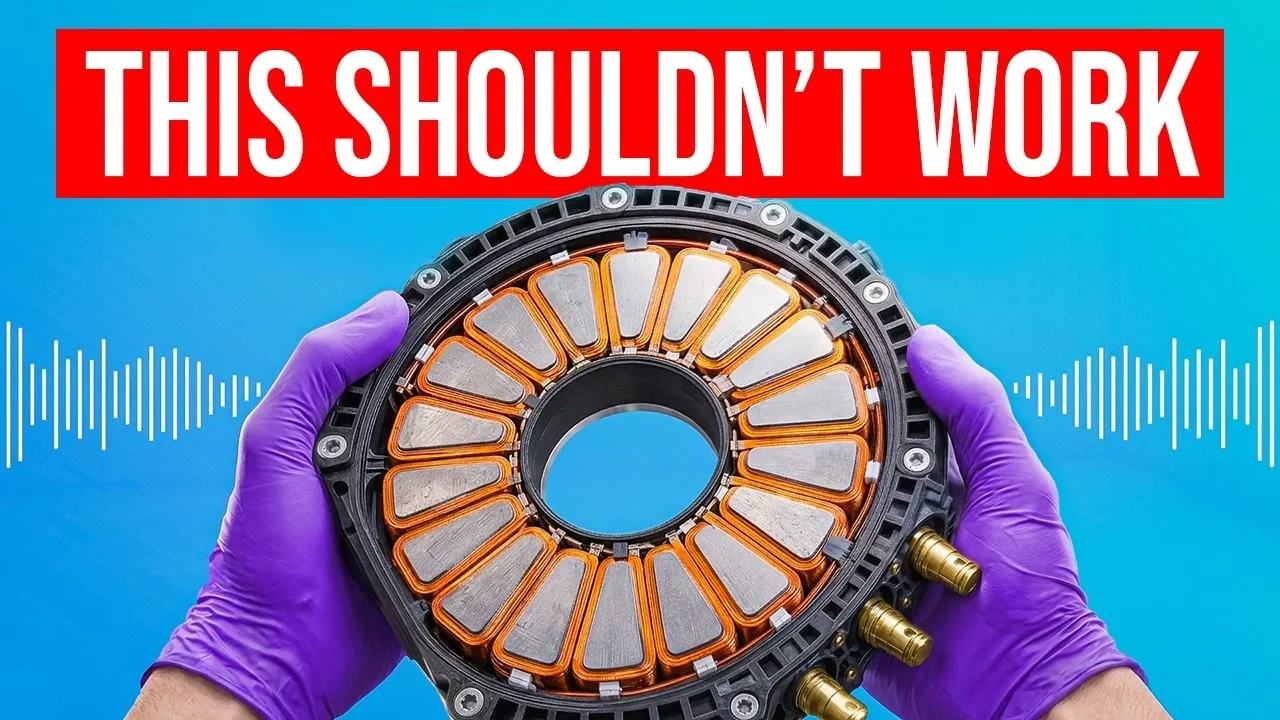
YASA’s axial flux motor packs high power into a thin, flat disc, and it stays quiet by cancelling its own noise. Ryan Inis reports that the motor uses active noise cancellation to counter vibrations that would otherwise make it loud. Rather than adding heavier parts, it sends a cancelling signal through its electrical current, which cut a force behind the vibration roughly tenfold in YASA’s patent measurement. Discover how that signal works and why it can quiet the motor without changing the force that drives it.
YASA’s Motor Cancels Its Own Noise
TL;DR Key Takeaways :
- YASA’s axial flux motor uses active noise cancellation on nearly all production motors, according to founder and CTO Dr. Tim Woolmer.
- YASA’s patent reports that cancellation reduced the rotor’s varying axial force from about 42 newtons peak-to-peak to about 4 newtons.
- The correction uses D-axis current to counter forces on the rotor without changing the torque that drives the motor.
- YASA’s rotor discs naturally resonate at about 1 kHz, according to Woolmer, potentially amplifying noise and vibration.
- A new facility is expected to produce more than 100,000 motors annually at full production for Mercedes-Benz’s high-performance vehicles.
The technique is past the experimental stage. It is now used on nearly all YASA production motors, according to founder and chief technology officer Dr. Tim Woolmer, and the motor is a core part of Mercedes-Benz’s AMG EA platform, which asks one car for both track performance and a quiet ride on the school run.
YASA began as a University of Oxford spin-out built on Woolmer’s PhD work, and Mercedes-Benz acquired the company in 2021.
Why the Flat Motor Vibrates
An axial flux motor uses flat discs instead of the cylinder-like stators and rotors of most motors, which are known as radial flux designs. In YASA’s motor, a stationary disc called the stator sits between two rotating discs that carry permanent magnets, and the layout generally produces more torque and power than an average electric vehicle motor of the same size.
The catch is that magnetic forces can make a spinning disc vibrate. YASA’s discs naturally resonate at about 1 kHz, Woolmer says, so when the motor reaches a speed related to that frequency, the forces reinforce the movement and the rotor’s rim can flap about a thousand times a second.
That is more than a noise problem. The discs turn thousands of times a minute only a millimeter from a stationary part, so excessive movement could be catastrophic. The noise also disrupted visits by automotive companies, made refined luxury hard to achieve and threatened to keep the motor out of wider production.

Take a look at other insightful guides from our broad collection that might capture your interest in more automobile related content.
- Mercedes-AMG PureSpeed: Power, Performance, and Exclusivity
- Mercedes-AMG PureSpeed in the final stages of testing
- Mercedes-AMG GT 63 PRO 4MATIC+ “Motorsport Collectors Edition” Unveiled
- High-Tech SUV with Sports Car DNA: the New Mercedes-AMG GT SUV
The Loudest Wobble Pumps Like a Speaker
A disc can wobble in different patterns, known as orders, named for the number of ripples around its circumference:
- Zeroth order: the whole rim rises and falls together.
- First order: one peak and one trough.
- Second order: two peaks, bending the disc into a saddle.
- Third order: three peaks.
The zeroth order is the loudest, with the disc pumping in and out like a pulsating speaker. YASA’s winding design makes it a particular challenge: each electromagnet has a coil wrapped around its own tooth, a layout called a concentrated winding, and its forces can push or pull the whole rotor disc in the same direction at once. Many other axial flux motors use distributed windings, which concentrate the forces on the rotor less.
Why Stiffer Parts Were Not Enough
YASA first tried to suppress the vibration by making the rotor stiffer, experimenting with materials and reshaping parts to smooth the magnetic pulls. Those changes helped, but adding weight to a rotor spinning at thousands of RPM reduces the motor’s power density, and even a stiffer rotor keeps a natural frequency at which it can resonate.
Woolmer asked instead whether the motor could counter its own noise the way active noise-cancelling headphones do. Those use a microphone to listen and then play an opposing waveform, so that where one wave pushes, the other pulls.
The D-Axis Leaves Torque Alone
The answer came from the way a motor controller handles current, which it treats as two separate directions. Q-axis current generates the rotational force, or torque, that drives the motor. D-axis current produces no torque but changes the magnetic force between the stator and the rotor.
YASA’s software engineers put the cancelling signal on the D-axis, which changes the force pushing and pulling the discs while leaving the torque untouched. Had the signal gone on the torque current, it could have produced a buzz felt throughout the car.
Cancellation Cuts the Force From 42 Newtons to 4
Woolmer says an early version silenced a 1 kHz whine when the motor was running at resonance and the cancellation was switched on. A measurement in YASA’s patent puts a figure on it: without the cancelling current, the axial force pushing and pulling the rotor varied by about 42 newtons peak-to-peak, and with it the variation fell to about 4 newtons.
The motor’s inverter sends the signal, and unlike headphones it needs no microphone listening all the time. Each motor’s resonance is measured during development and testing and the signal timing is stored in the inverter software, so on the road the inverter plays the correction at the relevant motor speed.
Mercedes Plans More Than 100,000 Motors a Year
Mercedes-Benz is putting the design into a wide range of its high-performance vehicles, and a new facility is expected to build more than 100,000 motors a year once production is in full swing. Arguably, neither would have happened without the cancellation.
What makes the fix notable is that it adds nothing to the motor. A software signal on a current the controller already manages did what stiffer, heavier parts could not, which is how a thin, powerful design became quiet enough for a luxury car.
Media Credit: Ryan Inis
Disclosure: Some of our articles include affiliate links. If you buy something through one of these links, Geeky Gadgets may earn an affiliate commission. Learn about our Disclosure Policy.
