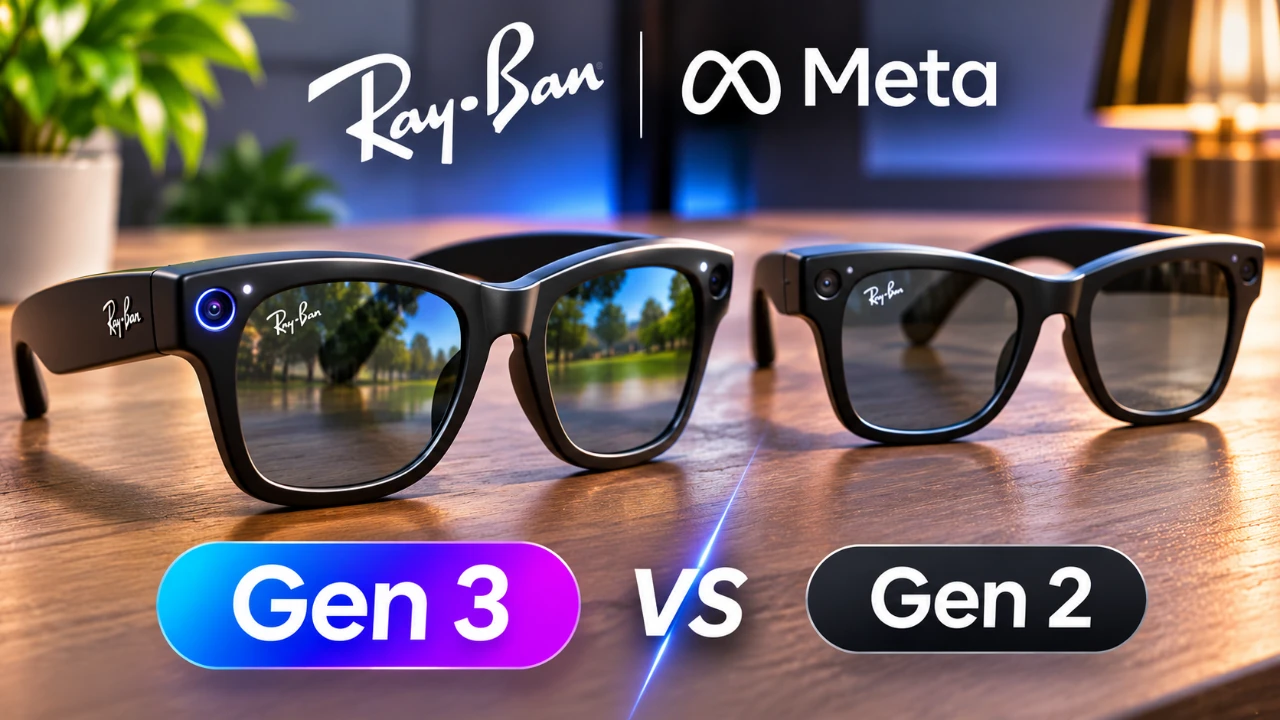
When comparing the Ray-Ban Meta Gen 3 and Gen 2 smart glasses, the differences may not be immediately obvious. However, these subtle distinctions can significantly impact your decision based on your specific needs and preferences. Both models share a strong foundation of features, but the Gen 3 introduces several notable upgrades in design, comfort, and battery performance. Below is a detailed video from GregglesTV to help you determine which model suits your lifestyle best.
TL;DR Key Takeaways :
- More Discreet Aesthetics: Gen 3 shrinks camera and LED indicator openings by 36%, adds optician-adjustable temple tips, and introduces a customizable physical action button.
- Incremental Battery Boost: Delivers up to 9 hours of mixed battery life per charge (50 hours with the case), edging out Gen 2’s 8-hour and 48-hour ratings.
- Unchanged 12MP Camera: Both models retain the exact same 12MP ultra-wide sensor with up to 3K 30fps video recording, meaning photo and video quality remains identical.
- $70 Price Difference: Gen 3 starts at $449 in Wayfarer, Aviator, and Zena frames, while Gen 2 offers strong everyday value starting at $379.
Design: Enhanced Comfort and Subtle Refinements
The Ray-Ban Meta Gen 3 takes a step forward in design with a more streamlined and discreet appearance. The camera openings and indicator lights are 36% smaller compared to the Gen 2, making the glasses less conspicuous and closer to traditional eyewear. Additionally, the Gen 3 introduces a dedicated configurable action button, giving you greater physical control over Meta AI shortcuts and quick functions.
Comfort is another area where the Gen 3 excels. It features slimmer temples with adjustable tips that opticians can shape for a secure and comfortable fit, especially during extended all-day wear. While both models maintain Ray-Ban’s iconic styling, the Gen 3 expands its frame lineup to include Wayfarer, Aviator and Zena styles. In contrast, the Gen 2 offers Wayfarer, Headliner, and Skylar styles. If frame variety and tailored fit are key factors for you, the Gen 3 stands out as the superior choice.
Battery Life: Small but Meaningful Improvements
Battery life is a critical consideration for wearable technology, and the Gen 3 delivers a modest yet practical boost. It offers up to 9 hours of mixed usage on a single charge, compared to 8 hours for the Gen 2. While a one-hour difference may seem minor on paper, it can be significant for users who wear their smart glasses from morning commutes through evening errands.
When paired with their respective charging cases, the Gen 3 provides up to 50 additional hours of battery life, slightly surpassing the Gen 2’s 48 hours—with both supporting fast charging to 50% in roughly 20 minutes. This improvement, though incremental, ensures that the Gen 3 is better equipped to handle longer days of use without frequent recharging.
Camera and Microphone: Subtle Enhancements
Both models are equipped with the exact same 12MP ultra-wide camera system capable of shooting up to 3K Ultra HD video at 30fps, making them equally capable for hands-free POV content creation. The Gen 3, however, upgrades to a six-microphone array, adding one extra mic over the Gen 2 alongside adaptive open-ear speaker volume. While this addition improves wind-noise reduction during outdoor calls and voice commands, the overall difference in everyday audio capture is relatively incremental. For users upgrading strictly for camera resolution, neither model holds a sensor advantage over the other.

Style Options: Broader Choices for Personal Expression
Style plays a significant role in the appeal of smart glasses, and the Gen 3 introduces the Aviator and Zena frames alongside the classic Wayfarer design. On the other hand, the Gen 2 features the Headliner and Skylar styles in addition to the Wayfarer. This shift in frame silhouettes gives buyers distinct aesthetic choices depending on face shape and personal taste. Whether you prefer the timeless wire-inspired look of an Aviator or the sculptural curves of the Headliner, each generation offers distinct silhouettes.
Price: Weighing Cost Against Features
For many buyers, price is a deciding factor. The Gen 2 starts at $379, making it the more budget-friendly option—especially since Meta continues to sell it alongside the newer lineup and retailers frequently offer discounts.
In contrast, the Gen 3 starts at $449, reflecting a $70 premium for its incremental upgrades in frame styling, adjustable fit, extra microphone, action button, and battery life. Ultimately, the decision comes down to whether you prioritize upfront savings or the subtle ergonomic refinements of the newer model.
Longevity and Software Support: Future-Proofing Your Investment
As the newer release, the Gen 3 is positioned to receive longer software support over its lifecycle, though Meta has confirmed that most new Meta AI capabilities—such as turn-by-turn walking directions—also roll out to the Gen 2. While the Gen 2 remains a highly capable smart wearable today, buyers planning to keep a single pair of prescription or everyday frames for several years may appreciate the extra runway of the Gen 3.
Specifications Compared
| Specification | Ray-Ban Meta (Gen 3) | Ray-Ban Meta (Gen 2) |
| Release Date | September 23, 2026 | September 17, 2025 |
| Starting Price | $449 USD | $379 USD |
| Frame Styles | Wayfarer, Aviator, Zena | Wayfarer, Skyler, Headliner |
| Camera | 12 MP ultra-wide (3024 × 4032 px; 36% smaller lens/LED opening) | 12 MP ultra-wide (3024 × 4032 px) |
| Video Resolution | Up to 3K Ultra HD at 30 fps; 1080p+ at 30/60 fps; 720p+ at 120 fps (adds slow-mo & hyperlapse) | Up to 3K Ultra HD at 30 fps; 1080p+ at 30/60 fps; 720p+ at 120 fps |
| Battery Life (Glasses) | Up to 9 hours (mixed use) | Up to 8 hours (mixed use) |
| Charging Case | Up to 50 additional hours (50% charge in 20 mins) | Up to 48 additional hours (50% charge in 20 mins) |
| Microphones | 6-mic array (with enhanced wind-noise reduction & Dolby Atmos support) | 5-mic array |
| Speakers | Dual open-ear speakers with adaptive volume | Dual open-ear speakers |
| Physical Controls | Dedicated capture button, touchpad, voice, plus a customizable Action Button | Dedicated capture button, touchpad, voice |
| Storage | 32 GB (1,000+ photos or 100+ 30s videos) | 32 GB (1,000+ photos or 100+ 30s videos) |
| Weight (Standard Wayfarer) | 51.5 g (53.8 g Large; 133 g case) | 51 g |
| Dimensions (Standard Wayfarer) | 129 mm hinge-to-hinge / 149 mm temple (slimmer arms with adjustable temple tips) | 131 mm hinge-to-hinge / 150 mm temple |
| Connectivity | Bluetooth 5.3, Wi-Fi 6 | Bluetooth 5.3, Wi-Fi 6E |
| OS Compatibility | iOS 17+ / Android 10+ | iOS 15.2+ / Android 10+ |
| Water Resistance | IPX4 (splash resistant) | IPX4 (splash resistant) |
| Prescription Support | Yes (-12.00 to +6.00 total power) | Yes |
Which Model Should You Choose?
Deciding between the Ray-Ban Meta Gen 3 and Gen 2 ultimately depends on your individual needs and priorities. If you want the new Aviator or Zena frames, a more discreet camera cutout, adjustable temple tips, and an extra hour of battery life, the Gen 3 is the better option.
However, if you already own the Gen 2 or want a cost-effective entry point that delivers identical 12MP camera quality, IPX4 splash resistance, and core Meta AI features, the $379 Gen 2 offers outstanding value. Both models cater to a range of preferences, making sure that you can confidently select the one that aligns with your lifestyle and budget.
Here is a selection of other guides from our extensive library of content you may find of interest on Ray Ban Meta.
- Skip the $449 Ray-Ban Meta Wayfarer Gen 3 If You Own the Gen 2
- Why These 5 Ray-Ban Meta Accessories Are Essential For 2026
- Leaked Meta Smart Glasses Lineup Reveals Four Upcoming Models
- Ray-Ban Meta Gen 3 Upgrades Camera to 3K Resolution Video
- Meta Connect 2026: Ray-Ban Meta Audio, Ray-Ban Meta Gen 3 and Compact VR Glasses
- How to Complete Setup for the Ray-Ban Meta Gen 3
Source: GregglesTV
Disclosure: Some of our articles include affiliate links. If you buy something through one of these links, Geeky Gadgets may earn an affiliate commission. Learn about our Disclosure Policy.
