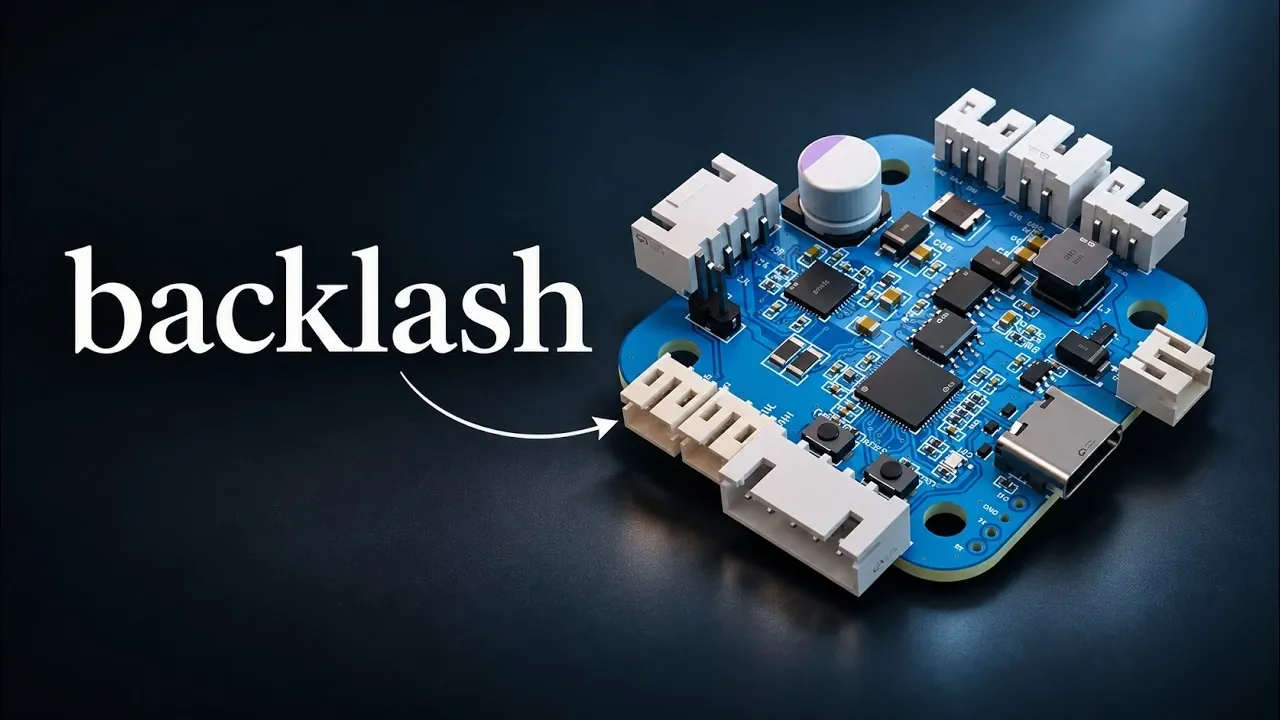
Building precise DIY robots often comes with challenges, especially when using 3D-printed gearboxes. One persistent issue is backlash, where gaps in the gears cause delays during direction changes, reducing accuracy. The CLMD 1.5, an open source closed-loop stepper driver priced at just $20, addresses this by using dual encoders to measure and correct both motor and joint positions. This approach significantly improves positioning accuracy, as demonstrated by Arctos Robotics.
Explore how the CLMD 1.5 simplifies integration into multi-joint robotic systems, including its support for CANbus communication to reduce wiring complexity. You’ll also learn how its open source design allows for easy customization, from firmware flashing to PCB assembly. Whether you’re building a robotic arm or experimenting with 3D-printed mechanisms, this guide highlights practical ways to enhance precision without overhauling your designs.
TL;DR Key Takeaways :
- The CLMD 1.5 is an open source closed-loop stepper driver priced at $20, designed to improve the accuracy of DIY robotic joints by compensating for gearbox backlash through software.
- Testing demonstrated that the CLMD 1.5 reduced settled error by 78% and achieved an RMS error as low as 0.014° when using a second encoder to correct joint position.
- The controller simplifies integration into DIY robotics projects with features like USB flashing, CANbus communication for reduced wiring complexity, and compatibility with various gearbox types.
- Its open source design provides access to schematics, PCB files, and firmware on GitHub, enabling enthusiasts to build or modify their own controllers easily.
- While the CLMD 1.5 does not physically eliminate gearbox backlash, it compensates for its effects, offering a cost-effective solution for improving the precision of low-cost geared mechanisms.
Affordable Robotics with CLMD 1.5
Building a robot has become more accessible with tools like affordable stepper motors, 3D-printed gearboxes, and low-cost motor controllers. These advancements allow for assembling a capable robotic arm for just a few hundred dollars. However, backlash in the gearbox remains a challenge. Backlash occurs when the motor reverses direction, causing a delay as the gear teeth move through a gap before engaging. This issue is particularly hard to eliminate in 3D-printed gearboxes.
The CLMD 1.5, a new open source closed-loop stepper driver, addresses this problem by compensating for backlash effects through software. Priced at $20, it combines an ESP32-S3 microcontroller, a TMC2209 power stage, and dual encoder inputs, offering an affordable way to improve the accuracy of DIY robotic joints.
How CLMD 1.5 Works
Traditional closed-loop stepper motors use an encoder to detect when the motor loses position. However, this only measures the motor’s position, not the gearbox output. As a result, even if the motor reaches its target, the joint may still be misaligned due to gearbox play.
The CLMD 1.5 addresses this by adding a second encoder to measure the actual joint output. By comparing the motor’s expected position with the gearbox’s actual position, the controller compensates for the delay caused by backlash. This correction happens entirely within the motor controller, requiring no additional adjustments elsewhere in the robot.
The ESP32-S3 microcontroller handles the control logic, while the TMC2209 drives the motor. The board also includes two encoder inputs and a CAN bus, expanding its functionality and integration options for complex setups.

Find more information on robot arm by browsing our extensive range of articles, guides and tutorials.
- Awesome Hand-Sized Robotics for Labs & Chips : With a Repeatability of 0.001 Mm
- How to build a Robot Arm using 3D printed Parts and Arduino
- AMBER B1 modular 7-axis robot arm
- Arduino DIY custom robotic arm with touchscreen controller
- Why the New WLKATA Haro380 is Changing Mini Industrial Robotics
- PiArm Raspberry Pi robotic arm
- Inside the 2-Year Project to Build a 6-DOF Robotic Arm From the Ground Up
- Rotrics desktop robot arm hits Kickstarter
- Rotrics robot arm raises more than $1,000,000 via Indiegogo
- Mirobot 6-axis mini robot arm
Testing the CLMD 1.5
Testing showed significant improvements in positioning accuracy with the CLMD 1.5. Using a 45:1 3D-printed gearbox, an 8° move was tested under four conditions:
- In open-loop mode, where only the motor encoder observed the motion, the settled shaft error was approximately 2.75°.
- With motor encoder feedback closing the loop, the settled error dropped to about 0.17°.
- When the second encoder monitored the gearbox output without correction, the RMS error was 0.065°.
- Using the second encoder to correct the joint position reduced the RMS error to 0.014°.
These results highlight the CLMD 1.5’s ability to reduce settled error by 78% and significantly improve output positioning accuracy for geared mechanisms. The tests compared six settled endpoints for each condition, emphasizing the controller’s effectiveness in addressing backlash.
Simplified Integration for DIY Robots
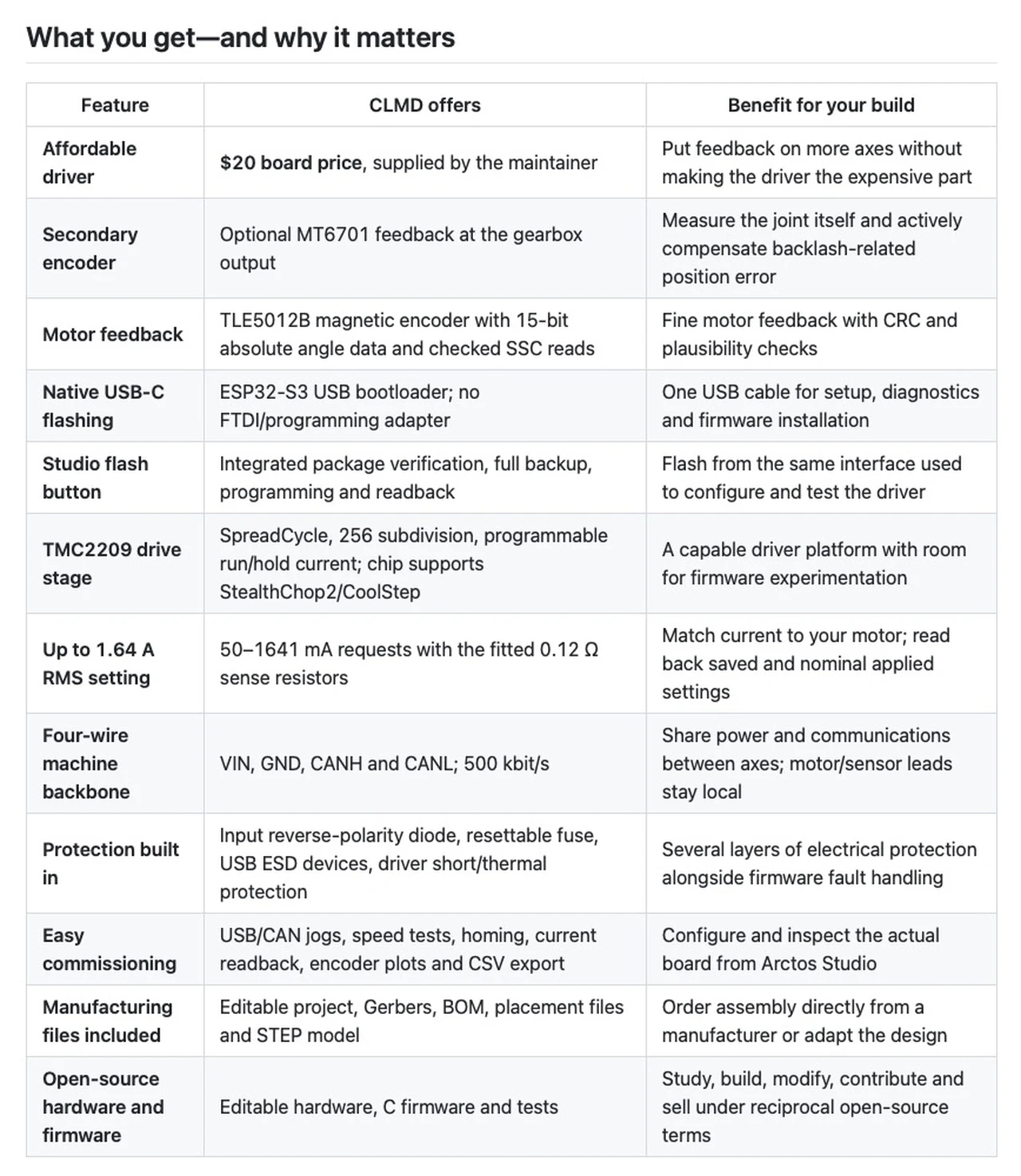
The CLMD 1.5 simplifies integration into DIY robotics projects. Its open source firmware can be flashed or configured via USB without needing an FTDI adapter, separate programmer, or ESP-IDF installation. The flashing process includes saving a backup, flashing the board, and verifying the result.
The board supports CANbus communication, allowing multiple controllers to connect along a four-wire power-and-CAN backbone. This reduces wiring complexity, especially in multi-joint robots where cables must pass through rotating joints. For example, a robotic arm with six motors and mostly 3D-printed reduction gearboxes benefits from this streamlined wiring. CANbus communication lets all six controllers communicate with the main computer using just two data wires.
Open source Design and Accessibility
The CLMD 1.5’s open source design makes it accessible to the DIY robotics community. Schematics, PCB design files, and firmware are available on GitHub, enabling enthusiasts to build their own controllers or modify the design. Manufacturing is straightforward: upload the Gerber files, parts list, and placement file to a PCB assembly service to receive fully assembled boards without manual soldering.
The controller works with various gearbox types, including planetary and cycloidal designs, as long as their output position can be measured. This flexibility makes it a practical choice for improving the accuracy of 3D-printed robots without requiring complex mechanical designs.
The CLMD 1.5 integrates an ESP32-S3, TMC2209 power stage, motor-shaft encoder, native USB, and CAN. It also offers a second encoder option to measure the actual joint output, further enhancing precision.
Backlash Compensation in Practice
While the CLMD 1.5 does not physically remove gearbox backlash, it compensates for its effects on positioning. The mechanical play remains, but the controller adjusts motor movements to account for it. This allows the robot’s joints to achieve greater precision without mechanical modifications.
Further testing is planned to evaluate the CLMD 1.5 under different loads and gearbox designs. These tests aim to assess its real-world performance, potentially confirming its role as a cost-effective solution for DIY robotics.
The CLMD 1.5 combines affordability, accuracy, and ease of use. By addressing gearbox backlash through software, it offers a practical way to improve the performance of low-cost geared mechanisms. For hobbyists and makers building precise robotic systems on a budget, it is described as a promising option.
Media Credit: Arctos Robotics
Disclosure: Some of our articles include affiliate links. If you buy something through one of these links, Geeky Gadgets may earn an affiliate commission. Learn about our Disclosure Policy.
