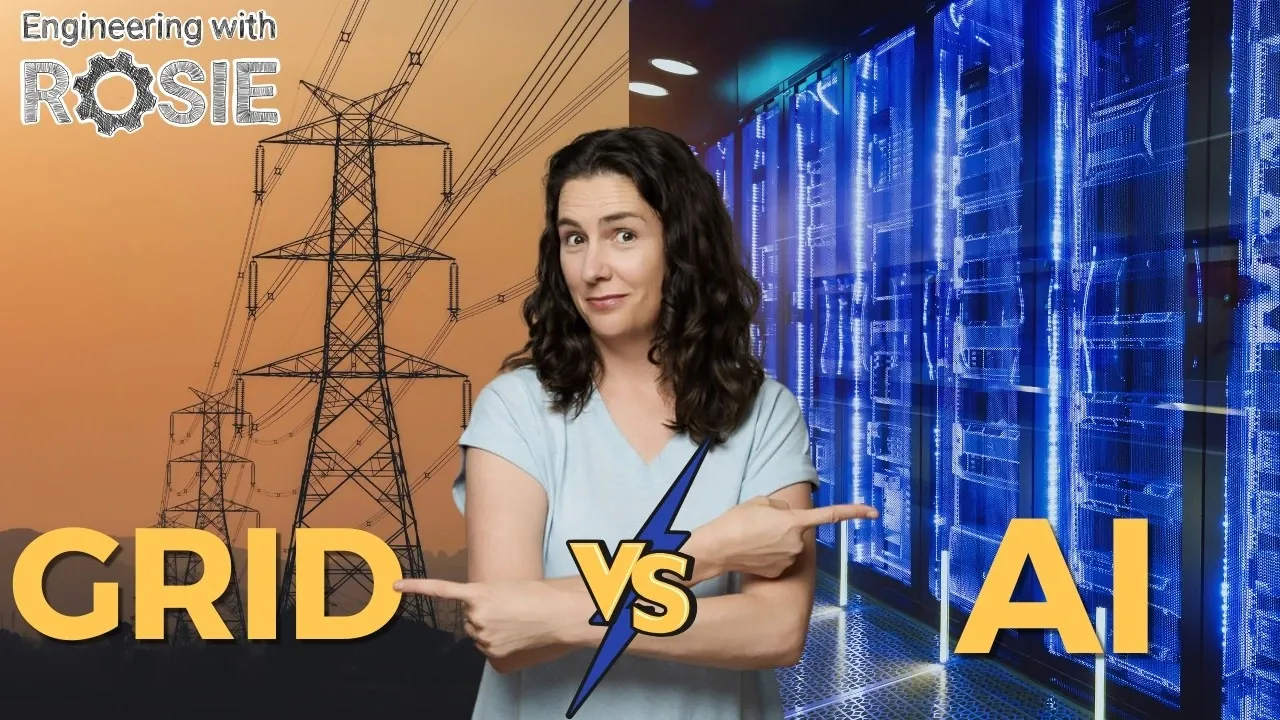
AI data centers are emerging as a significant challenge for electricity grids, with their energy consumption expected to soar from 460TWh in 2024 to as much as 1,300TWh by 2035. Unlike traditional data centers, AI facilities create unpredictable demand spikes, sometimes within seconds, which complicates grid stability. For instance, a 2024 incident in Northern Virginia saw 1.5GW of demand vanish instantly due to a transmission-line failure, highlighting the operational strain these facilities can impose, as explored by Engineering with Rosie.
Discover how AI data centers might evolve from grid stressors to stabilizing assets. This report examines strategies like demand flexibility, including workload tagging and pre-cooling systems, and explores the potential of using backup batteries as active grid resources. It also considers the barriers to adoption, from cost concerns to regulatory gaps, and what it will take for these facilities to support, rather than strain, the grid.
AI Data Centers: A Growing Challenge for Electricity Grids
TL;DR Key Takeaways :
- AI data centers consumed approximately 460TWh of electricity in 2024, with the International Energy Agency (IEA) projecting this demand could more than double to 1,000TWh by 2030 and potentially reach 1,300TWh by 2035, accounting for about one-tenth of global electricity demand increases over the next decade.
- AI data centers’ electricity demand is highly variable and unpredictable, unlike traditional data centers, creating challenges for grid operators. For example, a transmission-line failure in Northern Virginia on July 10, 2024, caused dozens of data centers to switch to backup power, instantly removing 1.5GW of demand and temporarily destabilizing the grid.
- Meeting the energy needs of AI data centers requires significant infrastructure investments, including new substations and transmission upgrades. In Texas, the Electric Reliability Council of Texas (ERCOT) reported 475GW of large loads seeking grid connections as of mid-2026, with 90% attributed to data centers, far exceeding the state’s current grid capacity.
- AI data centers have the potential to stabilize grids by becoming “dispatchable loads” that adapt their demand to grid conditions. For instance, Emerald AI’s software reportedly reduced a data center’s power use by 25% for three hours during testing while maintaining performance targets.
- Despite their potential, most data centers are reluctant to adopt flexibility measures voluntarily, as power costs are a small fraction of their expenses. Utilities also remain cautious about relying on flexible data centers due to concerns about their responsiveness and consistency, highlighting the need for trust and regulatory incentives to scale these solutions.
The rapid expansion of AI data centers is raising concerns about their impact on electricity grids. These facilities consumed approximately 460TWh of electricity in 2024, comparable to France’s total consumption. According to the International Energy Agency (IEA), this demand could more than double by 2030, reaching 1,000TWh, and potentially climb to 1,300TWh by 2035.
This growth would account for about one-tenth of global electricity demand increases over the next decade. However, the unique operational characteristics of AI data centers present challenges that could strain grids in new ways.
Unpredictable Demand and Grid Stress
AI data centers differ significantly from traditional ones in electricity consumption. While traditional facilities operate with steady, predictable loads, AI workloads can cause rapid demand fluctuations, sometimes within seconds. This variability is distinct from renewable energy intermittency, which can be forecasted based on weather. Instead, AI data centers can shift electricity demand “on demand,” creating challenges for grid operators tasked with maintaining real-time supply-demand balance.
Traditional data centers are often ideal utility customers due to their consistent energy use. In contrast, the dynamic and unpredictable nature of AI data centers’ demand requires new planning and operational strategies. For example, on July 10, 2024, a transmission-line failure in Northern Virginia caused dozens of data centers to switch to backup power systems, instantly removing 1.5GW of demand, equivalent to a large nuclear reactor’s output.
This sudden drop created a temporary imbalance, forcing operators to reduce generator output to stabilize grid frequency. While blackouts were avoided, the incident highlighted the challenges of integrating such large, unpredictable loads into the grid.

Here are more guides from our previous articles and guides related to energy technologies that you may find helpful.
- Proxima Fusion Plans the Alpha Stellarator for the Early 2030S
- Fraunhofer Small Wind Turbines Top Conventional Output By 83%
- Google Partner Project Red Yields Only 40-60% of Target Power
- Google Project Suncatcher Uses Space Solar Panels for AI
- Why Traditional Home Batteries Are Losing Ground to Plug-in Alternatives
- MIT Says Energy-Storing Concrete Improves 10-fold by Switching to Organic Electrolyte
- How NASA’s Mars Oxygen Tech Sparked a 100-Hour Battery Breakthrough
- Bloom Energy Server – Bloom Box Fuel Cell Gets Official
- Sun-Ways Installs 18 kW Removable Solar Panels on Train Tracks
- CATL Targets Lithium-Air Batteries for 1,000-Mile EV Range
Infrastructure Costs and Localized Pressure
The growth of AI data centers demands significant infrastructure investments. Meeting their energy needs often requires utilities to build new substations, reinforce transmission lines, and upgrade local distribution networks. In some cases, entirely new power stations are needed. These upgrades can cost billions of dollars, raising questions about how the financial burden is distributed.
In some markets, large customers like data centers bear most connection costs, while in others, these expenses are shared across the wider customer base through electricity tariffs, potentially increasing costs for households and businesses.
Most grid costs are fixed, meaning infrastructure like poles, wires, and substations costs the same regardless of usage levels. Increased demand from large customers like AI data centers could theoretically improve grid economics by spreading these fixed costs over more usage. However, the location of data centers complicates this dynamic.
Clusters of facilities relying on the same substations or transmission pathways can create severe local pressure, even if the overall demand increase appears manageable. For instance, in Texas, the Electric Reliability Council of Texas (ERCOT) reported 475GW of large loads seeking grid connections as of mid-2026, with 90% attributed to data centers. To put this into perspective, Texas’s all-time peak demand in July 2026 was about 91GW. Meeting such demand would require a grid six times larger than the state’s current capacity, an obviously unrealistic scenario.
Potential for Flexibility
Despite these challenges, AI data centers could help stabilize grids by adapting their demand to grid conditions, effectively becoming “dispatchable loads.” This flexibility could balance the grid, reduce costs for all users, and improve efficiency.
Emerald AI, for example, has developed software that tags workloads based on their tolerance for delays. In testing with Oracle and Phoenix, the system reportedly reduced a data center’s power use by 25% for three hours while maintaining performance targets. The software uses a digital twin to simulate operations, predicting power savings before adjustments. It can also slow chip clock speeds, pause non-urgent tasks, or shift workloads to other facilities with available capacity.
Other innovations include repurposing data center batteries, traditionally reserved for emergency backup, as active grid assets. These uninterruptible power supply (UPS) systems can temporarily power data centers during grid stress, reducing demand without disrupting operations. Cooling systems can also be adjusted to pre-cool buildings, allowing reduced electricity use during peak periods.
Some utilities are exploring faster grid connections for data centers that agree to be flexible, turning their demand down when the grid is under pressure. For instance, Emerald AI is conducting a commercial-scale pilot with Silicon Valley Power in Santa Clara, involving a data center running NVIDIA’s AI workloads. While the pilot’s scale, 96 GPUs, is far smaller than a campus with 100,000 GPUs, it demonstrates the feasibility of flexible demand management.
Barriers to Adoption
Despite the potential benefits, most data centers are reluctant to adopt flexibility measures voluntarily. Power costs represent a small fraction of their overall expenses, and many prefer to pay more to maintain operational freedom. Some even install on-site gas turbines to bypass connection queues, often with minimal environmental oversight. Flexibility is generally seen as an inconvenience unless it offers significant advantages, such as faster grid connections, or is mandated by regulations.
Utilities, meanwhile, remain cautious about relying on flexible data centers. Concerns persist about whether these facilities will respond quickly, consistently, and repeatedly to grid requests. Building trust between utilities and data centers will be essential for scaling these solutions.
Uncertain Future for Data Center Growth
While demand for AI data centers is surging, most proposed projects are unlikely to materialize. Historical data from Lawrence Berkeley National Laboratory shows that only 19% of energy projects seeking interconnection between 2000 and 2018 were completed, with just 14% of requested capacity becoming operational.
Clusters of several hundred megawatts or gigawatt-scale proposals behind the same substations and transmission pathways exacerbate these challenges, creating bottlenecks that delay or prevent projects from moving forward. Building additional power stations does not resolve certain grid challenges, such as congested substations or sudden demand changes.
It is estimated that only about 10% of proposed data centers will ultimately be built. Additionally, the current hype around data centers may surpass the energy hype of the past two decades, potentially leading to an even lower realization rate for data centers compared to energy projects. Nevertheless, the resulting increase in electricity demand will still be the largest in decades.
Reversing the Grid Relationship
For over a century, electricity grids have operated on the principle that generation follows demand. AI data centers could disrupt this dynamic by becoming the first major industrial loads capable of adapting to the grid instead of requiring the grid to adapt to them. This shift has the potential to reduce costs for all users by enabling more efficient use of existing infrastructure.
However, achieving this vision will require more than technological innovation. Policymakers, regulators, and communities must implement measures that incentivize or mandate flexibility. Without such interventions, data centers are unlikely to change their behavior voluntarily. On the evidence so far, AI data centers could either exacerbate grid challenges or become one of its most valuable assets, depending on how these issues are addressed.
Media Credit: Engineering with Rosie
Disclosure: Some of our articles include affiliate links. If you buy something through one of these links, Geeky Gadgets may earn an affiliate commission. Learn about our Disclosure Policy.
