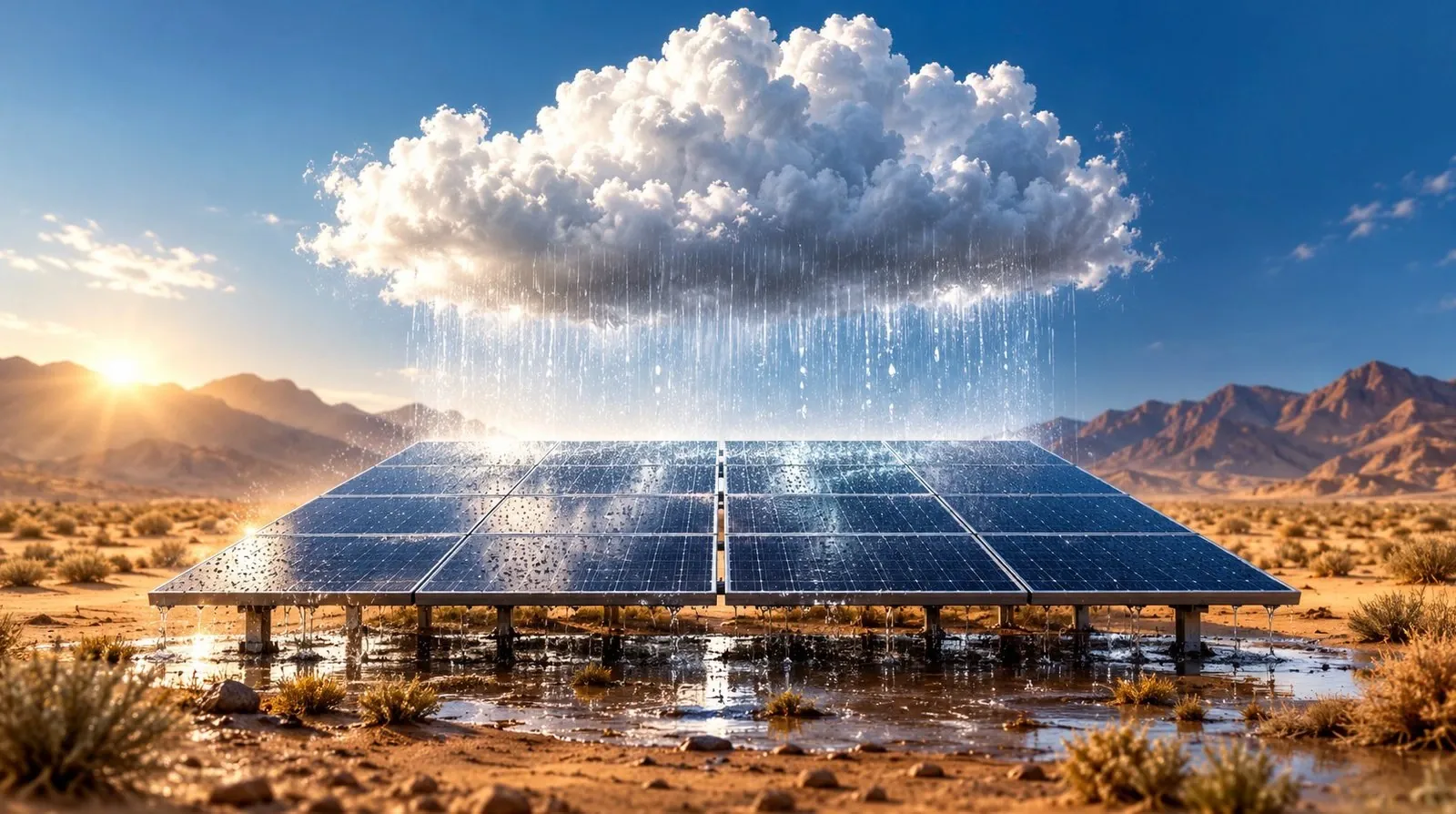
Solar farms in desert regions could provide more than just renewable energy by potentially addressing water scarcity. Research from Germany’s University of Hohenheim indicates that large-scale solar installations can influence atmospheric convection patterns, leading to increased rainfall in arid areas. For instance, simulations suggest that two 20×20 kilometer solar farms in a coastal desert could produce enough rain to supply water for up to 125,000 people annually. As explained by Undecided with Matt Ferrell, this phenomenon occurs because solar panels generate heat, which drives cloud formation and precipitation when moist air from nearby seas is present.
Discover how this concept could support agriculture in dry regions through practices like agrivoltaics, while also enhancing biodiversity and sustainable farming. Gain insight into the financial and logistical challenges, including the estimated $38 billion cost of large-scale implementation, as well as the trade-offs between rainfall generation and solar panel efficiency. The explainer also provide more insights into broader concerns, such as unintended climate effects and ethical considerations surrounding geoengineering.
How Solar Farms Influence Rainfall
TL;DR Key Takeaways :
- Large-scale solar farms in coastal deserts could potentially increase rainfall by disrupting atmospheric convection patterns, offering a novel solution to water scarcity in arid regions.
- High-resolution simulations suggest that solar farms could generate enough rainfall to sustain thousands of people annually, with the UAE already investing in research on this concept.
- Integrating agrivoltaics with solar farms could maximize land use by combining renewable energy production with sustainable agriculture, addressing both water scarcity and desertification.
- Challenges include high costs, potential trade-offs between rainfall and solar panel efficiency and unintended consequences such as altered weather patterns in neighboring regions.
- Ethical and practical concerns, such as decision-making authority and global climate impacts, highlight the need for cautious research and international cooperation before large-scale implementation.
Solar panels absorb sunlight to produce energy, but they also generate heat as a byproduct. This heat can disrupt atmospheric convection patterns, which involve the upward movement of warm air that drives weather systems. In coastal deserts, where moist air from nearby seas is present, these disruptions could lead to increased cloud formation and precipitation.
Using advanced LiDAR technology and high-resolution climate simulations, researchers have modeled scenarios where large solar farms could significantly enhance local rainfall. For instance, one study predicts that two 20×20 kilometer solar farms in a desert could produce enough rain to supply water for up to 125,000 people annually. The United Arab Emirates (UAE) has already invested in research grants to explore this potential, demonstrating the intersection of renewable energy and water scarcity solutions.
Potential Benefits of Rain-Generating Solar Farms
The implications of rain-making solar farms could be fantastic for regions suffering from water shortages. Increased rainfall could:
- Transform agricultural practices by providing essential water for crops.
- Support local ecosystems and enhance biodiversity in arid regions.
- Improve living conditions by addressing chronic water scarcity.
Additionally, integrating agrivoltaics, combining solar panels with agricultural activities, could amplify these benefits. Solar panels can provide shade for crops, reduce water evaporation and create microclimates that support sustainable farming. This dual-purpose approach maximizes land use and offers a potential solution to desertification, a pressing global issue.
Challenges and Costs
Despite its potential, the concept of rain-making solar farms faces significant challenges. The financial investment required is substantial. For example, constructing two 20×20 kilometer solar farms could cost an estimated $38 billion. Current solar farms are neither large enough nor strategically located to achieve the desired atmospheric effects.
Another challenge lies in the potential trade-off between increased rainfall and solar panel efficiency. Enhanced cloud cover resulting from additional rainfall could reduce the amount of sunlight reaching the panels, potentially offsetting some of the energy gains. These complexities underscore the difficulty of implementing such projects on a large scale.

Gain further expertise in solar by checking out these recommendations.
- How Amazfit T-Rex Dual Solar May Beat Ultra 2’S 30-Day Battery
- Garmin Fenix 9 Pro Features a 3,000-Nit AMOLED Display
- Garmin Fenix 9: Solar-Over-AMOLED Displays Could Change Garmin Watches Forever
- How Project Nexus Cuts Irrigation Water Evaporation By 82%
- Leaked Garmin Fenix 9 Price Ranges from $1,180 To $1,550
- Garmin Fenix 9 Pro Hands-on Reveals a 3,000-Nit Display
- Soliz smartphone solar charging case
- iNNOPOWER 200w solar panel charging system
- Garmin Fenix 9 Series Rumored to Launch with Three New Models
- Garmin Fenix 9 Pro Brings 3,000-Nit Screen and 57-Day Battery
Unintended Consequences
Altering atmospheric convection patterns in one region could have far-reaching effects on weather systems elsewhere. For example:
- Increased rainfall in a desert could reduce precipitation in neighboring areas, exacerbating water scarcity in those regions.
- Changes in weather patterns might intensify extreme events, such as tropical cyclones or prolonged droughts.
These risks highlight the importance of a cautious and measured approach. While the local benefits of increased rainfall are appealing, the broader climate impacts remain uncertain and require extensive investigation.
Ethical and Practical Considerations
Geoengineering projects like rain-making solar farms raise critical ethical questions. Key considerations include:
- Who has the authority to decide where and how these projects are implemented?
- What safeguards can ensure that the benefits outweigh the risks?
- How should the experimental nature of these initiatives be addressed?
Scaling up these projects also presents practical challenges. While simulations provide valuable insights, real-world testing is essential to validate findings and address unforeseen issues. Without careful planning and international cooperation, such projects could lead to unintended consequences that outweigh their benefits.
Alternative Solutions to Water Scarcity
While rain-making solar farms are an innovative concept, other solutions may offer more immediate and practical benefits. For example:
- Agrivoltaics can improve local vegetation and create favorable microclimates without altering weather patterns.
- Water-efficient irrigation systems and soil conservation techniques can sustain agricultural productivity in arid regions.
- Desalination technologies, powered by renewable energy, can provide fresh water without impacting atmospheric systems.
These non-geoengineering approaches are less likely to cause unintended consequences and can be implemented incrementally, making them more accessible for many communities.
Looking Ahead
The idea of using solar farms to generate rainfall in deserts is bold and innovative, but it remains in the experimental stage. Further research is essential to evaluate its feasibility, costs and potential risks. High-resolution simulations and advanced technologies like LiDAR will play a critical role in refining our understanding of these systems.
As global demand for renewable energy and water resources continues to grow, balancing local benefits with potential global risks will be crucial. While rain-making solar farms hold promise, they represent just one piece of the larger puzzle in addressing water scarcity and climate challenges.
Media Credit: Undecided with Matt Ferrell
Disclosure: Some of our articles include affiliate links. If you buy something through one of these links, Geeky Gadgets may earn an affiliate commission. Learn about our Disclosure Policy.
