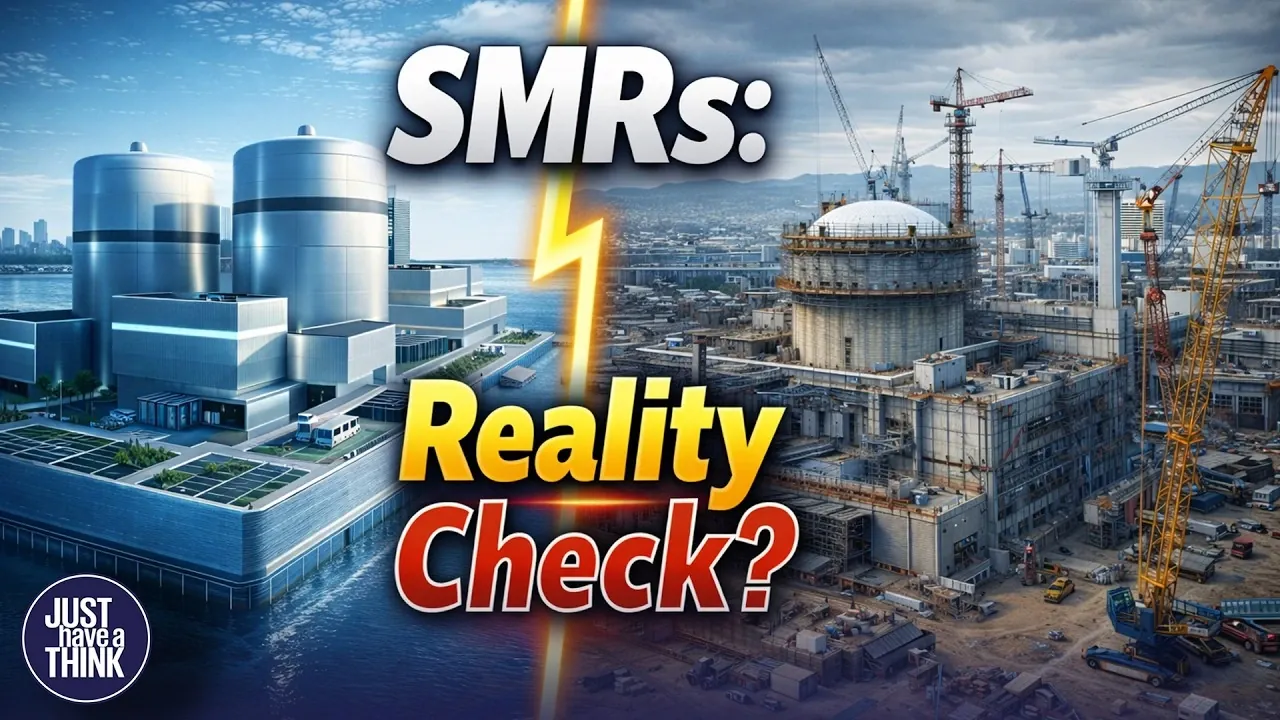
Small Modular Reactors (SMRs) are often presented as a promising innovation in the quest for low-carbon energy, but their potential impact remains a subject of debate. These reactors, capable of generating up to 300 megawatts of electricity per unit, are designed for modular construction and factory production, which could reduce costs and streamline deployment compared to traditional nuclear plants. However, as Just Have a Think explores, SMRs face significant hurdles, including the high costs of advanced fuels like high-assay low-enriched uranium (HALEU) and the challenge of scaling production to achieve meaningful economic benefits. These factors raise important questions about whether SMRs can deliver on their promises or risk diverting resources from established renewable energy solutions.
In this deep dive, you’ll gain insight into the specific advantages SMRs offer, such as their potential to retrofit retiring coal plants and provide continuous power for hard-to-decarbonize industries. You’ll also explore the critical challenges they face, from nuclear waste management to supply chain security for specialized fuels. By examining these factors, you’ll better understand the nuanced role SMRs could play in the global energy transition and the trade-offs involved in prioritizing their development alongside other clean energy technologies.
What Are Small Modular Reactors?
TL;DR Key Takeaways :
- Small Modular Reactors (SMRs) are compact nuclear reactors designed for modular production, offering potential benefits like faster assembly, reduced costs and enhanced safety through passive systems.
- SMRs could support industrial applications such as hydrogen production, high-temperature manufacturing and retrofitting coal plants, aiding in economic and environmental transitions.
- Challenges include high fixed costs, limited global supply of specialized fuel (HALEU), and the need for sustainable nuclear waste management solutions.
- SMRs may complement renewable energy by providing reliable, low-carbon power to address intermittency issues, but deployment timelines and scalability remain concerns.
- The future of SMRs depends on overcoming economic, technical and regulatory hurdles to prove their viability as a strategic tool in global decarbonization efforts.
SMRs represent a new generation of nuclear technology, designed to be smaller, more adaptable and easier to construct than traditional nuclear power plants. Unlike conventional reactors, which are often associated with delays and cost overruns due to their size and complexity, SMRs aim to simplify the construction process through modular designs and factory-based production. These reactors are shipped as pre-fabricated components and assembled on-site, reducing both construction timelines and costs.
SMRs come in various designs, including light-water reactors, molten salt reactors and high-temperature gas reactors. Each design offers unique features, such as improved safety mechanisms or the ability to operate at higher temperatures. Leading companies like Westinghouse, Rolls-Royce and GE Hitachi are at the forefront of SMR development, with several prototypes under construction or in advanced planning stages. These advancements highlight the growing interest in SMRs as a potential solution to the challenges of traditional nuclear energy.
Key Advantages of SMRs
Proponents of SMRs highlight several potential benefits that could make them a valuable addition to the global energy mix. These advantages include:
- Modularity: SMRs are designed for factory production, allowing for faster assembly and reduced construction complexity. This approach could significantly lower costs compared to traditional nuclear plants.
- Standardization: The mass production of identical units could lead to economies of scale, addressing one of the nuclear industry’s long-standing challenges of high upfront costs.
- Enhanced Safety: Many SMR designs incorporate passive safety systems that rely on natural forces, such as gravity and convection, to manage faults. These systems reduce the need for human intervention and enhance overall safety.
Beyond electricity generation, SMRs have the potential to support a range of industrial applications. These include hydrogen production, high-temperature heat for manufacturing processes and even retrofitting retiring coal plants. By using existing infrastructure and workforce expertise, SMRs could assist a smoother transition for communities currently dependent on fossil fuels, offering a pathway to economic and environmental sustainability.

Learn more about energy with other articles and guides we have written below.
- Z Pinch Fusion Costs Drop, Compact Reactor Skips Magnets & Lasers
- Useful Energy vs Primary Energy: Clearer Way to Measure Electrification Gains
- Kesterite Solar Cells vs Perovskite: Efficiency and Stability
- Solar Energy S 40,000 mAh retractable solar panel and power bank
- Best Battery Life Smartphones of 2025: OnePlus 15 Leads the Way
- Airnergy Havester Battery Charges From Thin Air
- Solid-State Battery Energy Density: Donut Labs Scrutiny
- Donut Lab Solid State Battery Claims, 400 Wh/kg and Fast Charge
- Donut Lab Solid State Battery or Pseudo-Capacitor, Experts Weigh In
- Donut Labs Solid-State Battery Tests : VTT Data & Doubts
Economic and Technical Challenges
Despite their potential, SMRs face significant economic and technical hurdles. Critics argue that reducing the size of reactors does not proportionally lower costs. Fixed expenses, such as safety systems, regulatory compliance and operational oversight, remain substantial regardless of reactor size. Achieving meaningful cost reductions through mass production requires high manufacturing volumes, a challenge that the nuclear industry has historically struggled to meet.
Another critical issue is the availability of fuel. Many advanced SMR designs rely on high-assay low-enriched uranium (HALEU), a specialized fuel with limited global supply. Currently, much of the HALEU production capacity is concentrated in Russia, raising concerns about supply chain security. Establishing a reliable and diversified HALEU supply chain will require significant investments in new fabrication facilities, regulatory approvals and international collaboration.
Environmental and Waste Management Concerns
Nuclear waste remains a persistent challenge for SMRs. While some designs claim to produce less waste or recycle spent fuel more efficiently, others may generate new types of waste or even higher volumes. These waste streams will require long-term storage solutions, which are already a contentious issue for traditional nuclear reactors. Developing safe and sustainable waste management strategies will be essential to gaining public trust and securing regulatory approval for SMR deployment.
Additionally, the environmental impact of mining and processing nuclear fuel cannot be overlooked. While SMRs offer low-carbon energy during operation, their full lifecycle emissions and environmental footprint must be carefully evaluated to ensure they align with broader sustainability goals.
Strategic Role in Decarbonization
SMRs have the potential to play a strategic role in the global energy transition by providing reliable, low-carbon power. Their ability to operate continuously makes them particularly well-suited for industrial applications, such as steelmaking and cement production, which are challenging to decarbonize using intermittent renewable energy sources. Retrofitting existing coal plants with SMRs could also extend the life of valuable infrastructure while significantly reducing emissions.
However, deployment timelines remain a significant concern. As of today, only two SMRs are operational worldwide and widespread commercial viability is not expected until the mid-2030s. This delay raises questions about whether SMRs can contribute meaningfully to urgent decarbonization efforts. Meanwhile, renewable energy technologies like solar, wind and battery storage are rapidly scaling and becoming more cost-effective, further intensifying the debate over resource allocation.
Renewables vs. SMRs: Competing Priorities
The debate surrounding SMRs often centers on the allocation of public funding and policy support. Renewable energy technologies, such as solar, wind and battery storage, have already demonstrated their scalability and cost-effectiveness in reducing greenhouse gas emissions. Critics argue that investing in SMRs, a relatively unproven technology, could divert resources from these proven solutions.
On the other hand, advocates contend that SMRs could complement renewables by providing firm, low-carbon power to balance the variability of wind and solar energy. This hybrid approach could enhance grid reliability and accelerate the transition to a decarbonized energy system. By filling gaps in renewable energy production, SMRs could help address the challenges of intermittency and ensure a stable energy supply.
The Future of SMRs in the Energy Mix
The future of SMRs will depend on their ability to overcome economic, technical and regulatory challenges. If they can deliver on promises of cost reduction, scalability and timely deployment, SMRs could become a valuable tool in the fight against climate change. Their potential to support industrial decarbonization and complement renewable energy sources positions them as a promising, albeit uncertain, addition to the energy landscape.
For now, SMRs remain a technology in development, with much work needed to prove their viability. Whether they emerge as a cornerstone of the global energy transition or a costly diversion will depend on how effectively the industry addresses its challenges. As the world races to meet ambitious climate goals, the clock is ticking for SMRs to demonstrate their value in the evolving energy mix.
Media Credit: Just Have a Think
Disclosure: Some of our articles include affiliate links. If you buy something through one of these links, Geeky Gadgets may earn an affiliate commission. Learn about our Disclosure Policy.
