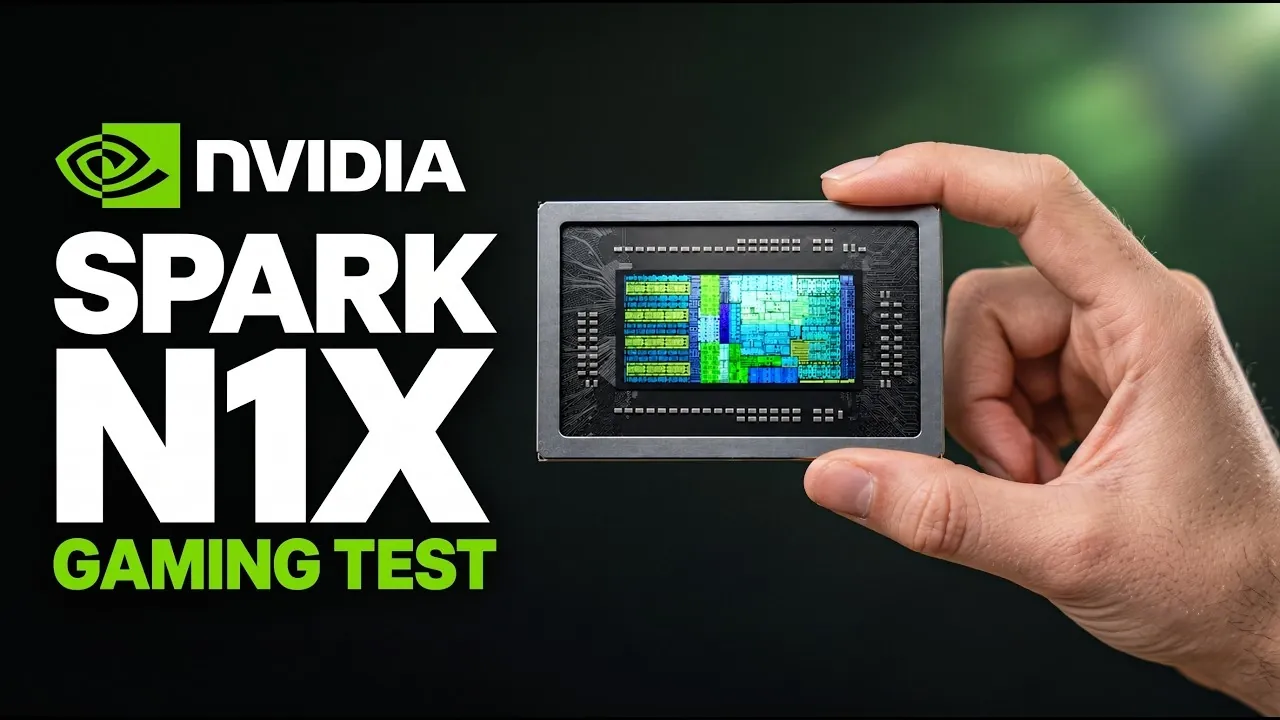
The NVIDIA RTX Spark N1X marks a significant entry into the integrated GPU market, blending a 20-core ARM CPU with NVIDIA’s 6,144-core Blackwell GPU architecture. Designed to handle AI workloads and modern gaming, it features a hybrid core setup with 10 high-performance Cortex A925 cores clocked at 4.1 GHz and 10 efficiency-focused Cortex A725 cores at 2.8 GHz. With 128 GB of unified LPDDR5X memory and a shared 85-watt TDP, the platform emphasizes energy efficiency while delivering competitive performance. As highlighted by ETA Prime, its ability to achieve a 4.3% performance edge over NVIDIA’s RTX 5070 laptop GPU underscores its potential, though its reliance on shared memory and software optimization introduces certain trade-offs.
Explore how the RTX Spark N1X balances its hardware capabilities with real-world performance, from its strengths in AI-driven tasks to its nuanced results in gaming. You’ll gain insight into its performance at 1080p and 1440p resolutions, where technologies like DLSS and multi-frame generation enhance visuals and frame rates. Additionally, the analysis examines challenges such as shader compilation delays in Unreal Engine games and the impact of the Prism Translation Layer on Windows compatibility. These details provide a thorough understanding of how the RTX Spark N1X fits into the evolving landscape of integrated GPUs.
Hardware Overview
TL;DR Key Takeaways :
- The NVIDIA RTX Spark N1X features a 20-core ARM CPU with a hybrid architecture, combining 10 high-performance Cortex A925 cores (4.1 GHz) and 10 efficiency-focused Cortex A725 cores (2.8 GHz) for balanced performance and energy efficiency.
- Its GPU, based on NVIDIA’s 6,144-core Blackwell architecture, is paired with 128 GB of unified LPDDR5X memory, though its 300 GB/s bandwidth is slower than dedicated GPUs with GDDR7 memory.
- Performance benchmarks show a 4.3% advantage over NVIDIA’s RTX 5070 laptop GPU and a 34.9% lead over AMD’s Radeon 8060S, excelling in AI and computational tasks but showing mixed results in gaming performance.
- Gaming strengths include smooth performance in optimized titles with DLSS and multi-frame generation, but challenges arise in non-optimized games due to shader compilation delays and inefficiencies in the Prism Translation Layer for Windows compatibility.
- Future potential includes higher TDP configurations, suitability for handheld gaming devices and software optimizations to address current limitations, positioning it as a versatile and energy-efficient iGPU platform.
At the heart of the RTX Spark N1X lies a 20-core ARM CPU developed in collaboration with MediaTek. This processor is engineered to balance performance and efficiency through a hybrid core architecture:
- 10 high-performance Cortex A925 cores clocked at an impressive 4.1 GHz, making sure robust computational power for demanding tasks.
- 10 efficiency-focused Cortex A725 cores running at 2.8 GHz, optimized for lower power consumption during less intensive workloads.
The GPU component is built on NVIDIA’s 6,144-core Blackwell architecture, delivering the raw computational power required for AI-driven tasks and modern gaming. Supporting this is 128 GB of unified LPDDR5X memory, with up to 96 GB allocated to the GPU. This unified memory design facilitates efficient data sharing between the CPU and GPU, though its 300 GB/s bandwidth is notably slower than the GDDR7 memory used in dedicated GPUs, which can exceed 600 GB/s. The platform operates within an 85-watt thermal design power (TDP), shared between the CPU and GPU, emphasizing energy efficiency while maintaining competitive performance.
Performance Benchmarks: How Does It Stack Up?
The RTX Spark N1X delivers competitive results in synthetic benchmarks, positioning itself as a formidable player in the iGPU market. Key performance highlights include:
- A 4.3% performance advantage over NVIDIA’s RTX 5070 laptop GPU, showcasing its ability to rival mid-range dedicated GPUs in specific workloads.
- A 34.9% lead over AMD’s Radeon 8060S, further solidifying its standing in the integrated GPU space.
These results underscore the platform’s strength in AI and computational tasks, where its advanced architecture and unified memory design shine. However, its performance in real-world applications, particularly gaming, reveals a more nuanced picture.

Expand your understanding of NVIDIA RTX with additional resources from our extensive library of articles.
- NVIDIA DGX Spark Price Hits $4,699 Amid Memory Shortages
- NVIDIA RTX 4060 Runs Cyberpunk 2077 on Snapdragon X2 Elite
- How NVIDIA Packed an RTX 5070 and 128GB of RAM Into a 14Mm Laptop
- Best Low-Profile GPU for Compact Builds? Meet the Yeston RTX 3050
- NVIDIA RTX 5060 : Best Low-Profile Graphics Card for Gamers
- Microsoft Prices the Surface RTX Spark AI Dev Box At $5,999.99
- Pocket AI RTX A500 palm sized GPU accelerator designed for AI acceleration
- NVIDIA RTX A400 and A1000 Professional graphics cards unveiled
- MSI Raider A16 HX Laptop Debuts with NVIDIA GeForce RTX 5080 GPU
- Alibaba Panjiu AL128 Replaces NVIDIA with 128 Linked Chips
Gaming Performance: Strengths and Weaknesses
In gaming scenarios, the RTX Spark N1X demonstrates both strengths and limitations. At 1080p and 1440p resolutions, it performs admirably in optimized titles such as Resident Evil Requiem and Doom: The Dark Ages. When paired with NVIDIA’s DLSS (Deep Learning Super Sampling) and multi-frame generation technologies, the iGPU delivers smooth frame rates and enhanced visuals, using AI-driven upscaling and frame interpolation to maximize performance. However, its performance is less consistent in non-optimized games. For instance:
- Forza Horizon 6 experiences performance overheads due to the Prism Translation Layer, a software layer that enables Windows compatibility on ARM-based systems but introduces inefficiencies.
- Unreal Engine-based games suffer from shader compilation delays, which can disrupt gameplay fluidity and detract from the overall experience.
These challenges highlight the platform’s reliance on software optimization to achieve consistent gaming performance, particularly in titles that are not specifically tailored for ARM-based architectures.
Challenges and Limitations
While the RTX Spark N1X offers impressive capabilities, it is not without its drawbacks. Key limitations include:
- Memory Bandwidth: The shared LPDDR5X memory, though efficient, lacks the bandwidth of GDDR7 memory found in dedicated GPUs. This limitation impacts performance in memory-intensive applications, such as high-resolution gaming and complex simulations.
- Prism Translation Layer: While this software layer enables compatibility with Windows, it introduces inefficiencies in CPU-GPU coordination, particularly in gaming scenarios.
- Power Constraints: The 85-watt TDP, while energy-efficient, limits the platform’s ability to sustain peak performance during prolonged workloads, which may deter users seeking consistent high performance.
These factors may make the RTX Spark N1X less appealing to gaming enthusiasts who prioritize raw power and seamless performance over energy efficiency and versatility.
Future Potential: What Lies Ahead?
Despite its current limitations, the RTX Spark N1X holds significant promise for future advancements. Potential developments that could enhance its appeal include:
- Higher TDP Configurations: Deploying the platform in mini-PCs or other systems with higher power budgets could unlock additional performance, allowing it to compete more effectively with dedicated GPUs.
- Handheld Gaming Devices: Its compact design and energy efficiency make it an ideal candidate for portable gaming systems. When paired with lower-end NVIDIA GPUs, it could deliver a compelling balance of performance and portability.
- Software Optimizations: Addressing shader compilation delays and inefficiencies in the Prism Translation Layer through updates could significantly improve gaming performance and broaden its appeal to a wider audience.
These advancements could position the RTX Spark N1X as a versatile solution for users seeking a balance between performance, energy efficiency and adaptability.
A Step Forward in iGPU Technology
The NVIDIA RTX Spark N1X sets a new standard for integrated GPUs, offering a compelling mix of performance, efficiency and versatility. While it excels in synthetic benchmarks and optimized gaming scenarios, its reliance on shared memory and software layers introduces challenges that may limit its appeal for gaming-focused users. Nevertheless, the RTX Spark N1X represents a pivotal step in ARM-based computing, paving the way for more efficient and adaptable platforms in the future. With continued innovation and optimization, it has the potential to redefine expectations for integrated GPU performance in a variety of applications.
Media Credit: ETA PRIME
Disclosure: Some of our articles include affiliate links. If you buy something through one of these links, Geeky Gadgets may earn an affiliate commission. Learn about our Disclosure Policy.
