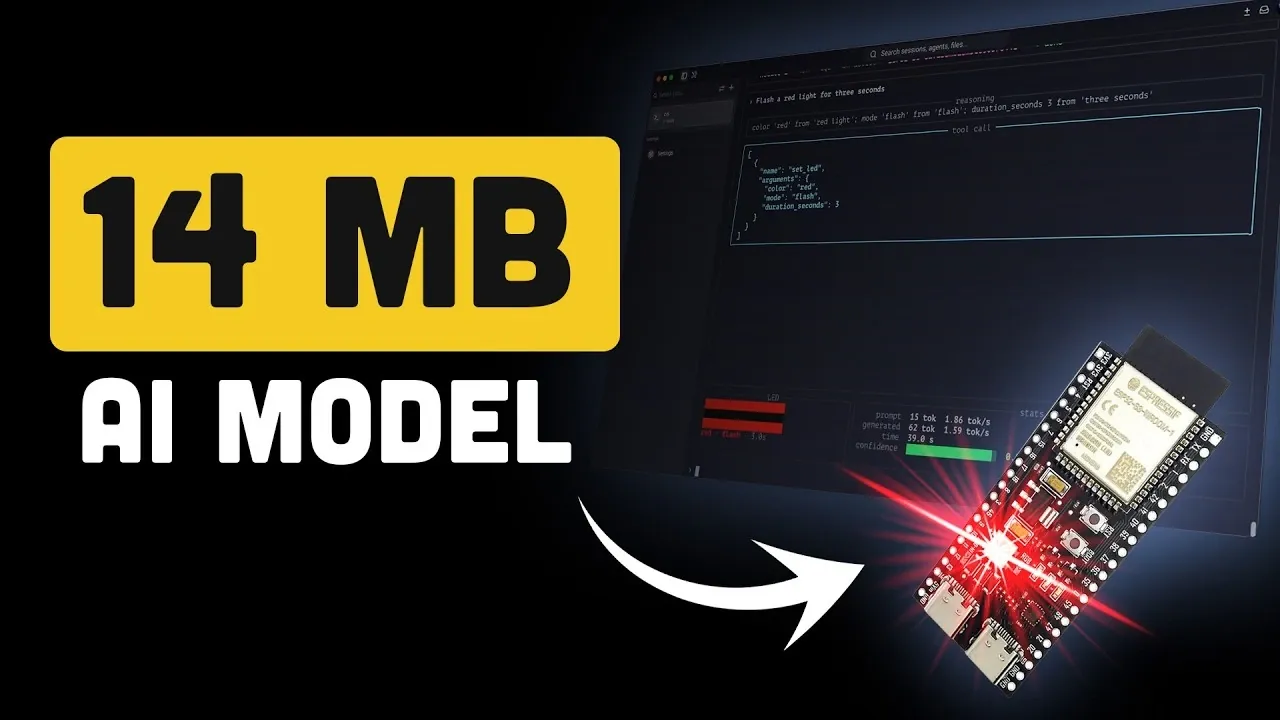
Needle 2, a 14-megabyte Agentic Large Language Model (LLM) developed by Cactus Compute, demonstrates how compact AI can thrive in resource-constrained environments. With just 45 million parameters, it is designed to run on minimal hardware like the ESP32S3 microcontroller, allowing advanced functionality without the need for high-end devices. Unlike general-purpose AI systems, Needle 2 focuses on converting natural language prompts into precise, predefined device actions. As highlighted by Better Stack, this makes it particularly effective for applications such as robotics control, smart home automation and mobile device operations, where efficiency and precision are paramount.
In this feature, you’ll gain insight into the technical innovations that make Needle 2 possible, including its use of hashed lookup tables and two-bit quantization for optimized performance. Explore how its architecture supports offline functionality, making it ideal for remote or low-connectivity scenarios. Additionally, discover practical examples of its deployment, from automating smart home systems to enhancing robotics workflows. By the end, you’ll understand how Needle 2 balances size, efficiency and task-specific accuracy to meet the demands of modern edge computing.
What Makes Needle 2 Unique?
TL;DR Key Takeaways :
- Needle 2 is a compact 14MB Agentic Large Language Model (LLM) with 45 million parameters, designed for edge computing and capable of running on minimal hardware like the ESP32S3 microcontroller.
- It specializes in converting natural language prompts into precise tool calls for tasks such as smart home automation, robotics control and mobile device operations, rather than handling open-ended conversations or general knowledge queries.
- Key technical innovations include hashed lookup tables, Hadamard transforms and two-bit quantization, allowing high performance with minimal resource consumption.
- Despite its small size, Needle 2 achieves 98.3% accuracy in tool-calling benchmarks and processes up to 500 tokens per second on higher-end devices, though it performs slower on low-power hardware.
- Its offline functionality, open source Apache 2.0 license and customizable design make it ideal for secure, resource-constrained and remote applications, setting a new standard for lightweight AI solutions.
Needle 2 is specifically designed to function as a “dispatcher” model, converting natural language prompts into precise tool calls for device operations. This targeted functionality makes it particularly effective for tasks such as:
- Smart Home Automation: Managing devices like lights, thermostats and security systems.
- Robotics Control: Directing robotic movements in industrial or personal automation systems.
- Mobile Device Operations: Executing commands efficiently in resource-constrained environments.
Unlike general-purpose AI models, Needle 2 does not aim to handle open-ended conversations or answer broad knowledge-based questions. Instead, its architecture is optimized for task-specific execution, making sure precision and efficiency in its designated use cases.
Technical Innovations Behind Needle 2
The compact yet powerful design of Needle 2 is achieved through a combination of advanced techniques that optimize its performance while minimizing resource consumption. Key innovations include:
- Hashed Lookup Tables: These enable efficient data storage and retrieval, significantly reducing computational overhead.
- Hadamard Transforms: By replacing traditional multilayer perceptron (MLP) layers, this approach enhances parameter efficiency and reduces memory usage.
- Two-bit Quantization: A compression technique that maintains model stability while keeping it lightweight.
These features allow Needle 2 to deliver high performance even on devices with limited processing power, making it a practical choice for edge computing applications.

Discover other guides from our vast content that could be of interest on local AI.
- Ollama Runs 32B Local AI Models on a $599 Mac via Quantization for Free
- How DeepSeek Fits a 284B Parameter AI Model on a Single Laptop
- Awesome DIY Raspberry Pi 5 Offline AI Companion Inspired by BMO from Adventure Time
- New AMD’s $1,500 Strix Halo PC Runs 120B AI Models Locally
- Apple Silicon AI Performance: Local Al on Apple Silicon Uses 7X Less RAM
- 128GB Ryzen AI Halo Replaces Cloud Servers for Local AI
- Why NVIDIA’s New 748GB Desktop is Replacing Enterprise Cloud AI Subscriptions
- Meta AI Releases Muse Glimmer 30B for 24GB VRAM Systems
- Rumored Apple M7 Chip Targets 2027 with 1.5 TB of Memory
- Apple Silicon Can Run Local Al with Just 2GB of RAM Using Turbo Fieldfare
Performance Highlights
Despite its small size, Needle 2 demonstrates impressive capabilities, rivaling models that are significantly larger. It excels in tool-calling benchmarks, achieving a remarkable 98.3% accuracy rate for mobile device actions. On higher-end devices like the Raspberry Pi 5, it processes up to 500 tokens per second, making sure rapid and efficient task execution. However, on lower-power devices such as the ESP32S3, processing times can extend to 40 seconds, reflecting a trade-off between speed and hardware constraints.
Limitations and Considerations
While Needle 2 offers significant advantages, it is important to recognize its limitations to ensure it is applied effectively:
- No General Knowledge Capabilities: The model is not designed for answering factual questions or engaging in open-ended conversations.
- Performance on Low-Power Devices: Task execution may be slower on devices with limited processing capabilities, making it less suitable for time-sensitive applications.
These constraints highlight the importance of aligning Needle 2’s capabilities with specific, well-defined tasks to maximize its utility.
Practical Applications and Customization
The versatility of Needle 2 is evident in its wide range of real-world applications. It can be effectively deployed to:
- Automate Smart Home Systems: Control lighting, climate settings and other connected devices.
- Enhance Robotics Operations: Manage robotic systems in industrial, commercial, or personal environments.
- Optimize Mobile Device Functions: Execute commands efficiently in environments with limited resources.
Additionally, Needle 2’s open source nature under the Apache 2.0 license makes it highly accessible for developers. Its well-documented customization process allows users to adapt the model to their specific needs in just three steps, making sure seamless integration into diverse projects.
Offline Functionality and Accessibility
One of Needle 2’s standout features is its ability to operate entirely offline. This capability makes it an excellent choice for environments where internet connectivity is limited or unavailable, such as remote locations or low-cost deployments. By eliminating the need for constant online access, Needle 2 enhances both security and reliability. Furthermore, its open source licensing encourages community-driven innovation, allowing developers to build upon its foundation and expand its applications.
Setting a New Benchmark for Lightweight AI
Needle 2 exemplifies how advanced AI capabilities can be delivered in a compact and efficient form. By focusing on specific, practical applications, it provides a tailored solution for edge computing and resource-constrained devices. Its innovative architecture, offline functionality and open source accessibility make it a valuable tool for developers and organizations alike. Needle 2 proves that powerful AI technology doesn’t require a massive footprint, it can be as small as 14 megabytes while delivering impactful results.
Media Credit: Better Stack
Disclosure: Some of our articles include affiliate links. If you buy something through one of these links, Geeky Gadgets may earn an affiliate commission. Learn about our Disclosure Policy.
