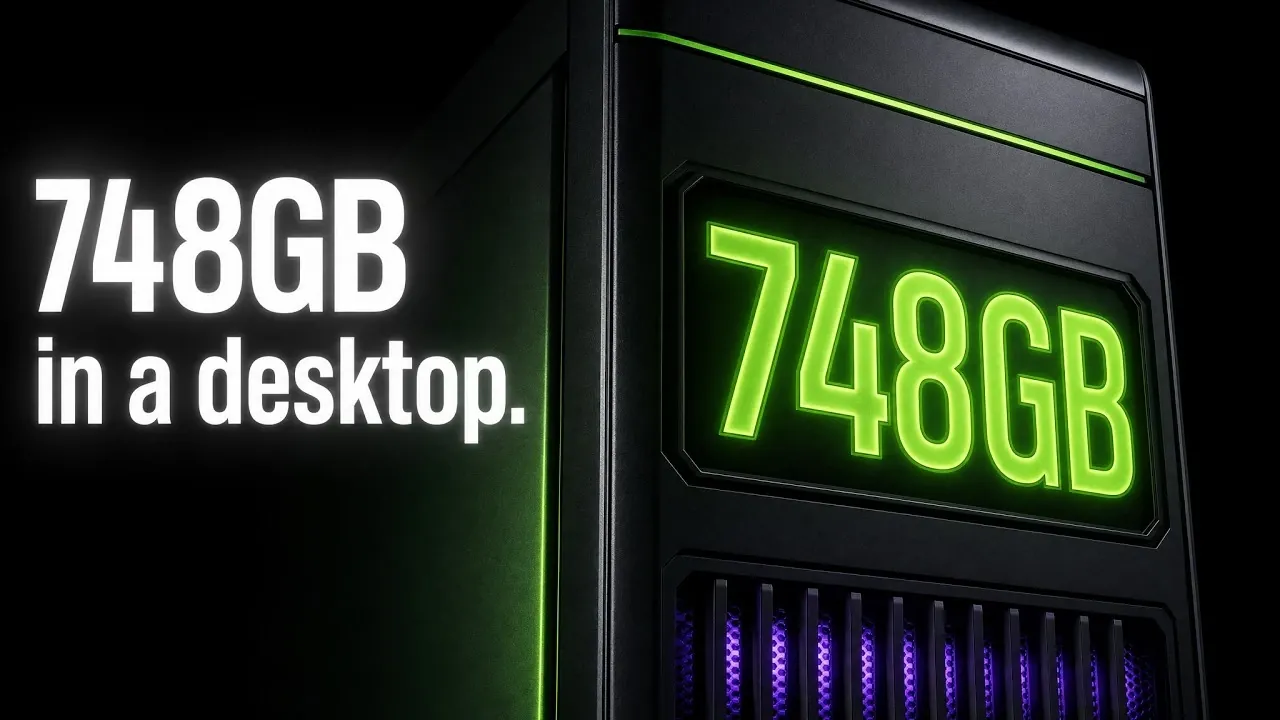
NVIDIA’s DGX Station, equipped with 748GB of unified memory, represents a significant advancement in local AI computing. Designed for enterprise use, this desktop can handle AI models with up to 70 billion parameters entirely on-premises, removing the need for cloud-based infrastructure. Central to its performance is the GB300 Grace Blackwell Ultra chip, which combines a 72-core ARM CPU with a Blackwell Ultra GPU, making sure efficient processing of demanding workloads. According to The Stack, this system provides a practical solution for organizations managing sensitive data or computationally intensive AI tasks.
Discover how the DGX Station’s unified memory architecture minimizes data transfer delays between CPU and GPU, improving overall efficiency. Learn about its support for techniques like model quantization, which allows for the deployment of larger AI models without sacrificing accuracy. Additionally, gain insight into the financial implications of transitioning AI operations in-house, including potential savings compared to ongoing cloud service costs.
What Sets the DGX Station Apart?
TL;DR Key Takeaways :
- NVIDIA’s DGX Station features 748GB of unified coherent memory, allowing seamless operation of large-scale AI models with up to 70 billion parameters locally, without relying on cloud infrastructure.
- Powered by the GB300 Grace Blackwell Ultra chip, the system integrates a 72-core ARM CPU and Blackwell Ultra GPU, eliminating memory bottlenecks and enhancing performance for demanding AI workloads.
- The DGX Station is designed for enterprise teams handling sensitive or large-scale AI projects, offering private, scalable and cost-efficient AI infrastructure with potential ROI in as little as two months.
- It supports advanced AI model quantization techniques for handling models with up to a trillion parameters, providing greater control over data and operations, especially for industries prioritizing privacy and security.
- NVIDIA plans to expand accessibility with future developments, including a Windows-compatible DGX Station by Q4 2026 and the RTX Spark chip for smaller-scale users, reflecting its commitment to providing widespread access to AI technology.
At the core of the DGX Station is NVIDIA’s innovative GB300 Grace Blackwell Ultra chip, which integrates a 72-core ARM CPU with the Blackwell Ultra GPU. This advanced architecture is complemented by its 748GB of unified memory, a feature that eliminates traditional memory bottlenecks by seamlessly combining GPU and system RAM. This innovation enables the system to process large AI models locally with exceptional speed and efficiency.
Key features of the DGX Station include:
- Unified memory architecture that ensures smooth data flow between the CPU and GPU, enhancing performance.
- Support for running large AI models with up to 70 billion parameters at full precision.
- Optimization for enterprise teams managing sensitive or large-scale AI projects.
This combination of hardware and architecture makes the DGX Station a standout choice for organizations seeking to push the boundaries of local AI computing.
Allowing Local Execution of Large AI Models
The DGX Station’s robust memory and processing capabilities allow it to run 70 billion parameter models locally without sacrificing precision or performance. For even larger models, such as those with up to a trillion parameters, the system supports advanced AI model quantization techniques. These techniques enable enterprises to handle increasingly complex workloads while maintaining efficiency and accuracy.
By eliminating the latency and dependency associated with cloud-based infrastructure, the DGX Station provides organizations with greater control over their data and operations. This capability is particularly valuable for industries where data privacy and security are paramount, such as healthcare, finance and defense.

Below are more guides on NVIDIA AI from our extensive range of articles.
- Why NVIDIA Wants to Install a Mini Data Center in Your Home
- Inside NVIDIA’s Four Groundbreaking AI Announcements at GTC Taipei
- OpenAI’s Stealth Tests Reveal ChatGPT 5.6 Pro’s True Power
- Why Apple’s on-Device AI is NVIDIA’s New Problem
- Why NVIDIA’s Nemotron 3 Ultra Outperforms Trillion-Parameter AI Models
- NVIDIA Launches New AI Model Focused on Maximum Efficiency
- ChatGPT 5.5 Instant Launches : Navigating Its Strengths and Weaknesses
- NVIDIA Unveils New Open AI Models at CES 2026 & New AI Platform with 5x Speed
- NVIDIA Llama 3.1 Nemotron 70b is Outperforming GPT-4o and Claude 3.5
- NVIDIA Nitrogen AI Open Source Gaming AI Without Game-Specific Tuning
Who Benefits from the DGX Station?
With a price range of $90,000 to $100,000, the DGX Station is designed for enterprise teams rather than individual users. It is particularly well-suited for organizations that:
- Require private AI infrastructure to safeguard sensitive data.
- Handle high-performance AI workloads that demand significant computational power.
- Seek to reduce reliance on cloud services for reasons of cost-efficiency or security.
For smaller-scale users or those with less demanding AI needs, NVIDIA offers alternatives such as the DGX Spark, priced at $4,000, which caters to more modest AI workloads. Additionally, Apple’s Mac Studio provides a budget-friendly option for users exploring local AI on a smaller scale.
Cost Efficiency and Return on Investment
One of the DGX Station’s most compelling advantages is its potential for cost savings. For enterprises with substantial AI workloads, the system can deliver a return on investment (ROI) in as little as two months when compared to the ongoing expenses of cloud GPU usage. By bringing AI computation in-house, organizations can:
- Significantly reduce cloud service costs.
- Maintain complete control over sensitive data, making sure compliance with privacy regulations.
- Enhance operational efficiency for AI-driven projects.
This cost efficiency, combined with the system’s advanced capabilities, makes the DGX Station an attractive option for enterprises aiming to optimize their AI operations.
NVIDIA’s Vision for the Future
Looking ahead, NVIDIA is committed to expanding the accessibility and scalability of its AI hardware solutions. Key developments on the horizon include:
- A Windows-compatible version of the DGX Station, expected by Q4 2026, which will use the Windows Subsystem for Linux (WSL) to attract a broader range of developers.
- The launch of the RTX Spark, a consumer-grade AI chip designed for desktops and laptops, aimed at making high-performance AI hardware more accessible to individual users and smaller organizations.
These advancements reflect NVIDIA’s dedication to providing widespread access to AI technology and supporting a diverse range of users, from large enterprises to individual developers.
Redefining the Future of Local AI
The DGX Station represents a significant leap forward in local AI computing. By addressing traditional memory constraints and offering scalable, high-performance solutions, NVIDIA is empowering organizations to run large AI models locally with unprecedented ease. This innovation not only reduces dependency on cloud infrastructure but also enhances data privacy and operational efficiency.
With a clear roadmap for future developments and a focus on scalability, NVIDIA is poised to lead the next wave of advancements in local AI technology. For enterprises seeking to harness the power of AI without compromising on privacy, performance, or cost, the DGX Station offers a compelling and forward-thinking solution.
Media Credit: The Stack
Disclosure: Some of our articles include affiliate links. If you buy something through one of these links, Geeky Gadgets may earn an affiliate commission. Learn about our Disclosure Policy.
