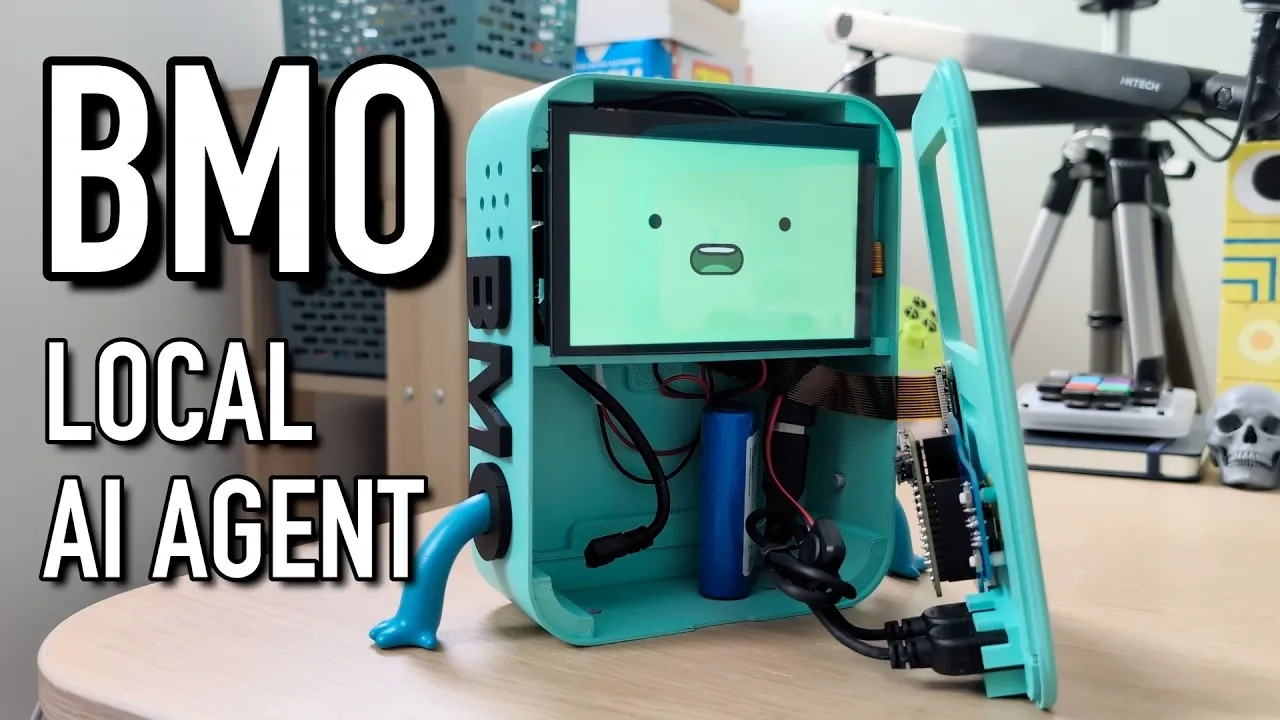
What if you could build your own personal AI companion, one that’s entirely offline, respects your privacy, and fits in the palm of your hand? brenpoly explores how a Raspberry Pi 5, a few carefully chosen components, and some clever AI integrations can bring this idea to life in the form of “BMO,” a local AI agent inspired by BMO from Adventure Time. This ambitious project doesn’t just showcase innovative hardware and software; it challenges the norm of cloud-dependent AI by proving that powerful, decentralized systems are possible. Imagine having a device that can chat, recognize images, and even play games, all without sending your data to the internet. It’s not just a tech experiment; it’s a glimpse into a more ethical and empowering AI future.
In this deep dive, you’ll uncover the intricate balance of hardware and software that makes BMO tick. From the Raspberry Pi 5’s impressive 16GB of RAM to the seamless integration of local AI models like Ollama and Whisper, every detail is designed to maximize performance while keeping everything offline. You’ll also discover how features like voice interaction, image recognition, and even gaming functionality come together to create a device that feels both futuristic and personal. Whether you’re a hobbyist looking for your next challenge or someone intrigued by the broader implications of decentralized AI, this project offers a fascinating blend of creativity, ethics, and innovation. What could a world of offline AI mean for privacy, accessibility, and the way we interact with technology?
Building BMO: Offline AI Agent
TL;DR Key Takeaways :
- BMO is a local AI agent inspired by BMO from Adventure Time, built using a Raspberry Pi 5 and designed to operate entirely offline, prioritizing user privacy and data security.
- The hardware setup includes a Raspberry Pi 5, 5-inch touchscreen, USB microphone, speakers, camera module, custom PCBs, and a 3D-printed modular enclosure, making sure performance, portability, and modularity.
- BMO integrates open source software like Whisper, Piper, Ollama, and RAG to enable voice interaction, text-to-speech, local large language models, and multimodal AI capabilities without relying on cloud services.
- Core functionalities include voice interaction, image recognition, gaming, and autonomous decision-making, making BMO a versatile and interactive AI companion.
- The project highlights the potential of decentralized AI systems, addressing technical and ethical challenges while promoting responsible AI development and user empowerment in offline environments.
Key Hardware Components
The construction of BMO requires a carefully selected set of hardware components, each playing a vital role in its functionality and adaptability. These components include:
- Raspberry Pi 5: The heart of the system, equipped with 16GB of RAM, providing the computational power necessary to run AI models locally without relying on cloud services.
- 5-inch IPS touchscreen display: Serves as an intuitive and interactive interface for user engagement.
- USB microphone, speakers, and camera module: Enable voice-based interaction, audio output, and image recognition capabilities.
- Custom-designed PCBs: Provide physical controls for gaming and other interactive functionalities.
- 3D-printed modular enclosure: Ensures durability, easy upgrades, and repairs, while maintaining a compact design.
- Battery-powered operation: Enhances portability, with power management circuits making sure efficient energy usage and extended operational time.
This hardware setup strikes a balance between performance, portability, and modularity, making BMO a versatile platform that can evolve with future advancements.
Software and AI Integration
The intelligence behind BMO is powered by a combination of open source tools and locally hosted AI models. This approach ensures user privacy and independence from cloud-based systems. The software components work together seamlessly to deliver a wide range of functionalities:
- Whisper: Handles voice-to-text transcription, allowing BMO to understand spoken commands with high accuracy.
- Piper: Converts text to speech, allowing BMO to respond audibly in a natural and engaging manner.
- Ollama: Runs local large language models (LLMs) to provide conversational AI capabilities without requiring an internet connection.
- Open Wake Word: Implements wakeword detection, activating BMO with the phrase “Hey BMO” for hands-free interaction.
- Gemma 3 and Moondream: Enable multimodal AI capabilities, allowing BMO to process and analyze both text and images.
- Retrieval-Augmented Generation (RAG): Assists real-world data lookups, making sure accurate and contextually relevant responses to user queries.
This robust software integration enables BMO to perform a variety of tasks while maintaining complete offline functionality, making sure data security and user privacy.
Raspberry Pi & Ollama BMO Local AI Agent
Dive deeper into local AI models with other articles and guides we have written below.
- Local AI Models That Run Perfectly on Apple’s $599 M4 Mac Mini?
- Run Local AI Models on Your PC or Mac for Coding, Study & More
- From 2GB to 1TB: How to Maximize AI on Any Local Desktop Setup
- VSCode Ollama Guide: Add Llama 3.1 Chat for Local AI Coding
- Agent Zero : Private Local AI Agent with Docker & Terminal Access
- Best GPUs for Local AI, VRAM Needs and Price Tiers Explained
- Mistral Local Coding AI Tested : 3B to 24B Compared on One Task
- Run a 600 Billion Parameter AI Model Locally on Your PC
- Build a Private Local AI with Memory You Control, No Cloud Needed
- How to Install Deepseek R1 on a Raspberry Pi for Free Local AI
Core Features and Functionalities
BMO is designed to be a versatile and interactive AI agent, offering a range of features that make it both practical and engaging. Its key functionalities include:
- Voice interaction: BMO can respond to spoken commands, generate creative content like poems, answer questions, or assist with searches, all through natural language processing.
- Image recognition: Using its onboard camera and AI models, BMO can identify objects, analyze visual data, or even assist with tasks like sorting or categorization.
- Gaming functionality: Physical buttons and USB controllers enable gaming interactions, adding an element of entertainment to its capabilities.
- Autonomous decision-making: BMO intelligently selects the appropriate tools or models based on the context of your request, making sure efficient and accurate responses.
These features make BMO a highly interactive and adaptable companion, suitable for both casual use and more technical applications.
Overcoming Challenges
Building a project like BMO involves navigating several technical and ethical challenges. These challenges are addressed through innovative solutions, making sure the system operates efficiently and responsibly:
- Hardware limitations: The use of SSDs improves storage speed, while accelerator chips enhance the performance of AI models. Power management circuits optimize battery usage for extended operation.
- Memory and response time: Efficient resource allocation ensures smooth multitasking, even when running multiple AI models simultaneously.
- Ethical considerations: BMO relies on open source tools and models to avoid intellectual property concerns. Transparency in AI decision-making ensures that its actions are understandable and predictable, fostering trust in its functionality.
These solutions not only enhance BMO’s performance but also ensure that it adheres to ethical standards, making it a responsible and reliable AI system.
Broader Implications of Decentralized AI
BMO represents a significant step forward in the development of decentralized AI systems. By operating entirely offline, it prioritizes user privacy and security while reducing dependence on external servers. This approach is particularly beneficial in regions with limited internet access, empowering individuals and communities to harness the power of AI technology without compromising their data.
The project also underscores the importance of responsible AI development. As AI becomes increasingly integrated into daily life, understanding its risks and benefits is crucial to making sure its positive impact on society. BMO’s design reflects the creativity, kindness, and resilience of its inspiration, BMO, serving as a reminder that human values should guide technological innovation.
By combining innovative hardware and software with a thoughtful approach to AI development, BMO demonstrates the potential of local, offline AI systems to enrich lives while respecting privacy and ethical principles. Whether you are a hobbyist, a tech enthusiast, or someone exploring the possibilities of AI, this project offers a unique opportunity to create something both innovative and meaningful.
Media Credit: brenpoly
Disclosure: Some of our articles include affiliate links. If you buy something through one of these links, Geeky Gadgets may earn an affiliate commission. Learn about our Disclosure Policy.
