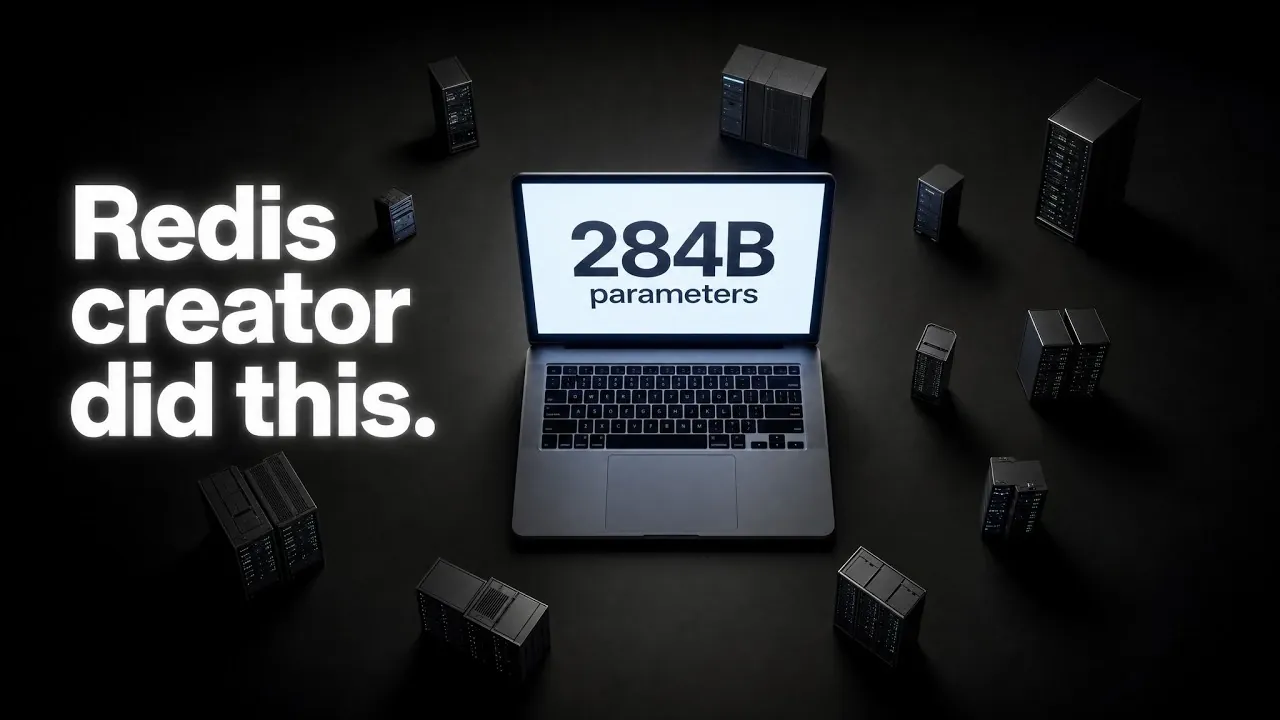
Running a 284-billion-parameter language model on a laptop might sound improbable, but DeepSeek’s V4 Flash makes it a reality. By combining a Mixture-of-Experts (MoE) architecture, advanced quantization techniques and the custom-built DwarfStar DS4 inference engine, DeepSeek achieves local execution of this massive model without cloud dependency. Notably, only 13 billion parameters are activated per token during inference, significantly reducing computational demands. The Stack explores how this approach balances efficiency and performance while addressing the hardware requirements and trade-offs involved in running such a large-scale model locally.
In this guide, you’ll gain insight into the specific hardware configurations necessary for running DeepSeek V4 Flash, including devices like the MacBook Pro M3 Max. Explore how asymmetric quantization techniques contribute to memory efficiency and learn about the trade-offs in model accuracy. Additionally, discover the benefits of local AI execution, from enhanced data privacy to reduced latency and understand the challenges that come with this approach, such as accessibility barriers and performance compromises.
DeepSeek V4 Flash: A Mixture-of-Experts Model
TL;DR Key Takeaways :
- DeepSeek V4 Flash, a 284-billion-parameter AI model, enables local execution on high-end hardware using a Mixture-of-Experts (MoE) architecture and advanced quantization techniques, reducing reliance on cloud infrastructure.
- The DwarfStar DS4 inference engine, optimized for Metal, CUDA and AMD ROCm backends, processes up to 26 tokens per second with a 76 GB memory footprint, but requires premium hardware like the MacBook Pro M3 Max or Nvidia DGX Spark.
- Open source licensing under MIT promotes transparency and accessibility, empowering developers to experiment and innovate with the model.
- Quantization techniques balance efficiency and accuracy by compressing expert layers to 2-bit precision, though this introduces minor performance trade-offs for tasks requiring high precision.
- Local AI execution offers benefits such as cost savings, enhanced data privacy and reduced latency, but faces challenges like high hardware requirements, model lock-in and geopolitical concerns.
At the core of this breakthrough lies DeepSeek V4 Flash, a Mixture-of-Experts model carefully designed to optimize computational efficiency. Although the model features an impressive 284 billion parameters, only 13 billion are actively engaged per token during inference. This selective activation mechanism significantly reduces the computational and memory demands, making it feasible to execute the model locally on advanced hardware.
The model’s open weights, licensed under MIT, further enhance its appeal by promoting transparency and accessibility. This open approach enables developers to experiment, adapt and innovate without restrictive barriers. By prioritizing openness, DeepSeek has positioned itself as a leader in the movement toward democratized AI tools, fostering a collaborative environment for the AI community.
The DS4 Inference Engine: Optimized for Local Execution
The DS4 inference engine, a critical component of this achievement, was developed in pure C by Salvatore Sanfilippo. Purpose-built to run DeepSeek V4 Flash locally, the engine delivers exceptional efficiency, processing up to 26 tokens per second with a memory footprint of 76 GB. However, this level of performance is contingent on the use of high-end hardware, such as the MacBook Pro M3 Max with 128 GB of unified memory or the Nvidia DGX Spark.
To ensure compatibility with leading hardware platforms, the DS4 engine is optimized for Metal, CUDA and AMD ROCm backends. This optimization is essential for allowing the local execution of such a large-scale model, demonstrating the importance of tailored software solutions in pushing the boundaries of AI technology.

Take a look at other insightful guides from our broad collection that might capture your interest in DeepSeek V4 Flash.
- Why Developers Are Choosing DeepSeek V4 Flash Over the 1.6T Pro Edition
- Leaked DeepSeek V4 Benchmarks Reveal a Massive 1-Million Token Context Window
- Deepseek V4 : Why Its 1.6 Trillion Parameters Aren’t Quite Enough
- How DeepSeek 4’S Massive 1M Token Context Window is Changing Open source AI
- Why Developers Are Switching to DeepSeek V4 Flash for Open source AI
- Inside the Self-Improving AI System Unlocking a Free 1-Million-Token Context Window
Quantization: Balancing Efficiency and Accuracy
DeepSeek V4 Flash employs advanced asymmetric quantization techniques to make local execution practical. Expert layers are compressed to 2-bit precision, while routing layers retain 8-bit precision. This approach minimizes memory usage while maintaining an acceptable level of model accuracy, striking a balance between efficiency and performance.
However, this efficiency comes with trade-offs. The reduction in precision can lead to a slight decrease in model fidelity, particularly for tasks requiring high accuracy, such as complex natural language understanding. While this compromise may affect performance in specific scenarios, it is sufficient for many applications where the balance between efficiency and accuracy is prioritized.
Why Run AI Locally?
Running AI models locally offers several compelling advantages over cloud-based solutions:
- Cost Savings: By eliminating reliance on cloud infrastructure, users can significantly reduce API costs, making AI more accessible to individuals and small businesses.
- Data Privacy: Local execution ensures that sensitive data remains on the user’s device, a critical consideration for industries handling confidential or proprietary information.
- Reduced Latency: Local models bypass the delays associated with cloud-based processing, allowing faster response times crucial for real-time applications.
These benefits make local AI execution particularly attractive for tasks such as summarization, classification and coding, especially in scenarios where data security and speed are paramount.
Challenges and Limitations
Despite its potential, DeepSeek’s approach to local AI execution faces several challenges that must be addressed to broaden its appeal:
- Hardware Requirements: The reliance on premium devices, such as the MacBook Pro M3 Max or Nvidia DGX Spark, limits accessibility for users without access to high-end hardware.
- Performance Trade-offs: While quantization techniques improve efficiency, they introduce minor degradation in model quality, particularly for tasks requiring high precision or complexity.
- Model Lock-in: The DS4 engine is specifically designed for DeepSeek V4 Flash, reducing flexibility for users who may wish to run other models on the same platform.
- Geopolitical Concerns: DeepSeek’s origins in China raise questions about data provenance and potential supply-chain risks, particularly for industries dealing with sensitive information.
These challenges underscore the need for continued innovation and collaboration to address the barriers to widespread adoption of local AI execution.
Community Response and Industry Impact
DeepSeek V4 Flash has garnered significant attention within the AI community, amassing over 13,000 GitHub stars and inspiring active contributions to its Metal, CUDA and AMD ROCm backends. This enthusiasm reflects the growing interest in local AI execution as a viable alternative to cloud-based solutions.
However, the model’s specialized focus has sparked debates about the trade-offs between specialization and flexibility. While the DS4 engine excels in reliability and efficiency, its lack of general-purpose compatibility may limit its appeal to a broader audience. This tension highlights the ongoing challenge of balancing performance with adaptability in the development of AI tools.
Looking Ahead: The Future of Local AI
The future of DeepSeek’s local AI execution depends on overcoming key challenges. Reducing hardware costs will be critical to making this technology accessible to a wider range of users. Additionally, competition between specialized frameworks like DS4 and general-purpose solutions such as llama.cpp will play a pivotal role in shaping the evolution of local AI tools.
Addressing geopolitical and technical concerns will also be essential for building trust and fostering broader adoption. As the AI landscape continues to evolve, DeepSeek’s innovations could serve as a foundation for a new era of accessible, independent AI applications, empowering users to harness the power of advanced models without reliance on external infrastructure.
Media Credit: The Stack
Disclosure: Some of our articles include affiliate links. If you buy something through one of these links, Geeky Gadgets may earn an affiliate commission. Learn about our Disclosure Policy.
