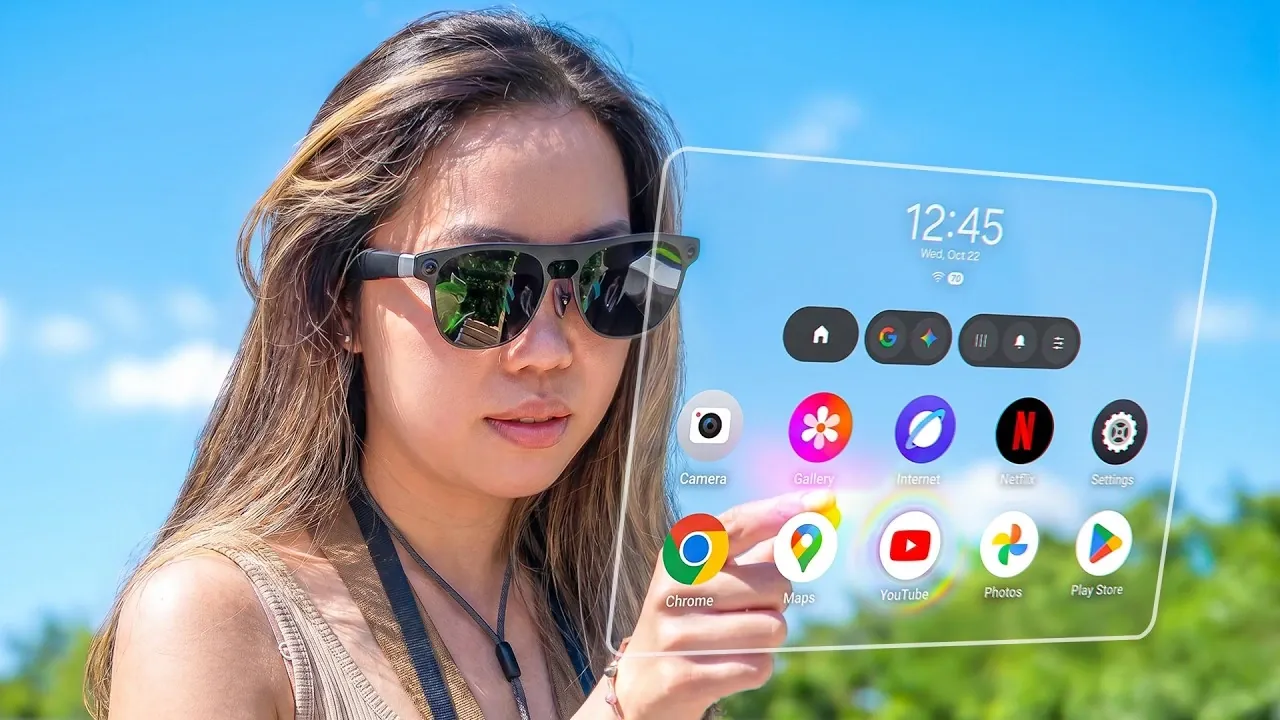
Project Aura represents a collaborative effort by XRO, Google and Qualcomm to create a lightweight XR headset that combines Augmented Reality (AR) and Virtual Reality (VR) into a single device. Weighing under 95 grams, the glasses prioritize portability while maintaining high performance, thanks to an external Snapdragon puck that handles processing. This puck, which can be clipped or worn, includes features like a trackpad for navigation and a fingerprint sensor for security. As highlighted by Cas and Chary XR, the device’s prism lenses and Sony micro OLED panels deliver sharp visuals, with adjustable tint modes making sure usability in various lighting conditions.
Learn how Project Aura’s wide 70° horizontal field of view enhances AR applications, creating a more immersive experience. Explore its multitasking capabilities, such as managing up to five floating windows and discover features like hand tracking and 2D-to-3D content conversion. You’ll also gain insight into its potential applications across creativity, education and entertainment, as well as its practical design considerations, including battery life and portability. This breakdown provides a clear look at what makes Project Aura a promising step forward in XR technology.
Design and Hardware: Balancing Comfort and Performance
TL;DR Key Takeaways :
- Project Aura combines AR and VR into a lightweight device under 95 grams, powered by a Snapdragon puck and running on the Android XR platform for seamless functionality and portability.
- The glasses feature prism lenses with Sony micro OLED panels, offering sharp visuals and adjustable tint modes for optimal performance in various lighting conditions.
- Key software features include hand tracking, Gemini AI for voice-based app control, spatial anchoring and 2D-to-3D content conversion, enhancing productivity and user interaction.
- Applications span creativity, education and entertainment, with tools like 3D fingerpainting, interactive educational models and compatibility with gaming devices like the Steam Deck.
- Challenges include the absence of eye tracking, potential heat management issues and uncertain pricing and release date, with a consumer launch expected in late 2026.
Project Aura’s design focuses on achieving a balance between comfort and high performance. The glasses rely on an external Snapdragon puck for processing, which reduces the weight of the wearable device itself. This puck is a multifunctional accessory, equipped with:
- A trackpad for intuitive navigation
- A fingerprint sensor to enhance security
- Multiple form factors, allowing it to be clipped, worn on a lanyard, or placed on a flat surface for convenience
The glasses feature prism lenses paired with Sony micro OLED panels, delivering sharp, high-resolution visuals. Adjustable tint modes ensure optimal performance in various lighting conditions, making the device adaptable to both indoor and outdoor environments. While prism lenses are bulkier than waveguides, they provide superior image clarity, making them particularly effective for AR and VR applications. This design approach prioritizes both functionality and user comfort, making sure that the glasses remain practical for extended use.
Field of View: Expanding the Visual Horizon
Project Aura offers a 70° horizontal field of view (FOV), providing users with a wide-screen experience that enhances AR applications. While this FOV does not fully immerse users in the way traditional VR headsets do, it represents a significant improvement over many existing AR glasses. The vertical FOV aligns with current AR standards, creating a balanced and natural viewing experience. This combination of horizontal and vertical FOV ensures that users can engage with digital content in a way that feels intuitive and immersive, making it suitable for both casual and professional use.

Explore further guides and articles from our vast library that you may find relevant to your interests in smart glasses.
- Google’s New AI Smart Glasses Are Leaving Meta Behind
- Move Over, Ray-Ban Meta: Samsung’s AI Galaxy Smart Glasses Are Finally Coming This Year
- Nothing Al Smart Glasses : Premium AR Features with Everyday Comfort
- Apple Glasses Leak: The Features That Could Kill Meta’s Ray-Bans
- Samsung Galaxy Smart Glasses: The Newest Addition to the Ecosystem Arrives in 2026
- Leak: Apple Testing Four Distinct Frame Styles for Upcoming 2027 Smart Glasses
- Forget Vision Pro: Apple Glass “Early Look” Set for 2026 (Leaked)
- Google’s Gemini Smart Glasses Make Meta Ray-Bans Look Outdated
- The Wait Is Almost Over: Apple’s Smart Glasses Just Hit a Major Production Milestone
- 5 Smart Glasses Tested: Why an $89 Pair Beats Ray-Ban Meta
Software and Functionality: A Platform for Seamless Interaction
Running on the Android XR platform, Project Aura supports a diverse range of applications, including those available on the Play Store and the Galaxy XR ecosystem. Its multitasking capabilities allow users to manage up to five floating windows simultaneously, enhancing productivity and allowing seamless interaction. Key features include:
- Hand Tracking: Enables precise navigation and interaction with virtual objects.
- Gemini AI: Facilitates voice-based app creation and control, streamlining user interaction.
- Advanced Display Modes: Includes spatial anchoring for fixed virtual objects and smooth follow for dynamic content, enhancing the overall user experience.
- 2D-to-3D Content Conversion: Transforms traditional media into immersive 3D experiences, broadening the scope of content consumption.
These features make Project Aura highly adaptable, catering to a wide range of users, from casual consumers to professionals seeking advanced tools for productivity and creativity.
Applications: Creativity, Education and Entertainment
The versatility of Project Aura extends across multiple domains, demonstrating its potential to transform how users interact with digital content. Key applications include:
- Creative Tools: A fingerpainting app allows users to create stable 3D drawings in AR, offering new possibilities for artists, designers and hobbyists.
- Education: The glasses can display interactive models, such as molecular structures or historical artifacts, making complex subjects more accessible and engaging for students and educators.
- Entertainment: Compatibility with external devices like the Steam Deck enables the glasses to function as video glasses for gaming or media consumption, enhancing leisure activities.
These applications highlight the device’s ability to enhance productivity, assist learning and provide immersive entertainment experiences, making it a versatile tool for various user needs.
Battery Life and Portability: Designed for Everyday Use
Project Aura is designed with practicality in mind, offering a battery life of 3-4 hours, which is sufficient for most tasks. For extended use, USB-C power pass-through allows the device to be charged while in operation, making sure uninterrupted functionality. A compact carrying case is included, providing storage for both the glasses and the Snapdragon puck, further enhancing portability. Future accessory integrations could expand the device’s capabilities, making it even more adaptable to diverse user requirements. This focus on portability and usability ensures that Project Aura can seamlessly integrate into daily life.
Limitations and Challenges: Room for Improvement
While Project Aura represents a significant advancement in XR technology, it is not without its challenges. Key areas for improvement include:
- Eye Tracking: The absence of this feature limits the potential for enhanced interaction and immersion.
- Heat Management: The long-term performance of the Snapdragon puck during extended use remains untested, raising concerns about overheating.
- Audio Performance: Although tuned by Bose, the audio quality has yet to be fully evaluated, leaving room for refinement.
- Uncertain Pricing and Release Date: While a developer program was launched in 2023, a consumer release is not anticipated until late 2026, leaving potential users in anticipation.
These limitations underscore the areas where further development and testing are needed to fully realize the potential of Project Aura.
A Promising Future for XR Technology
Project Aura stands as a testament to the progress being made in AR and VR technology. Its lightweight design, advanced tracking capabilities and versatile software platform make it a compelling tool for productivity, education and entertainment. While certain features require further refinement, the device’s innovative approach positions it as a significant step forward in the XR industry. As development continues, Project Aura has the potential to redefine how users interact with digital content, paving the way for a more immersive and integrated future.
Media Credit: Cas and Chary XR
Disclosure: Some of our articles include affiliate links. If you buy something through one of these links, Geeky Gadgets may earn an affiliate commission. Learn about our Disclosure Policy.
