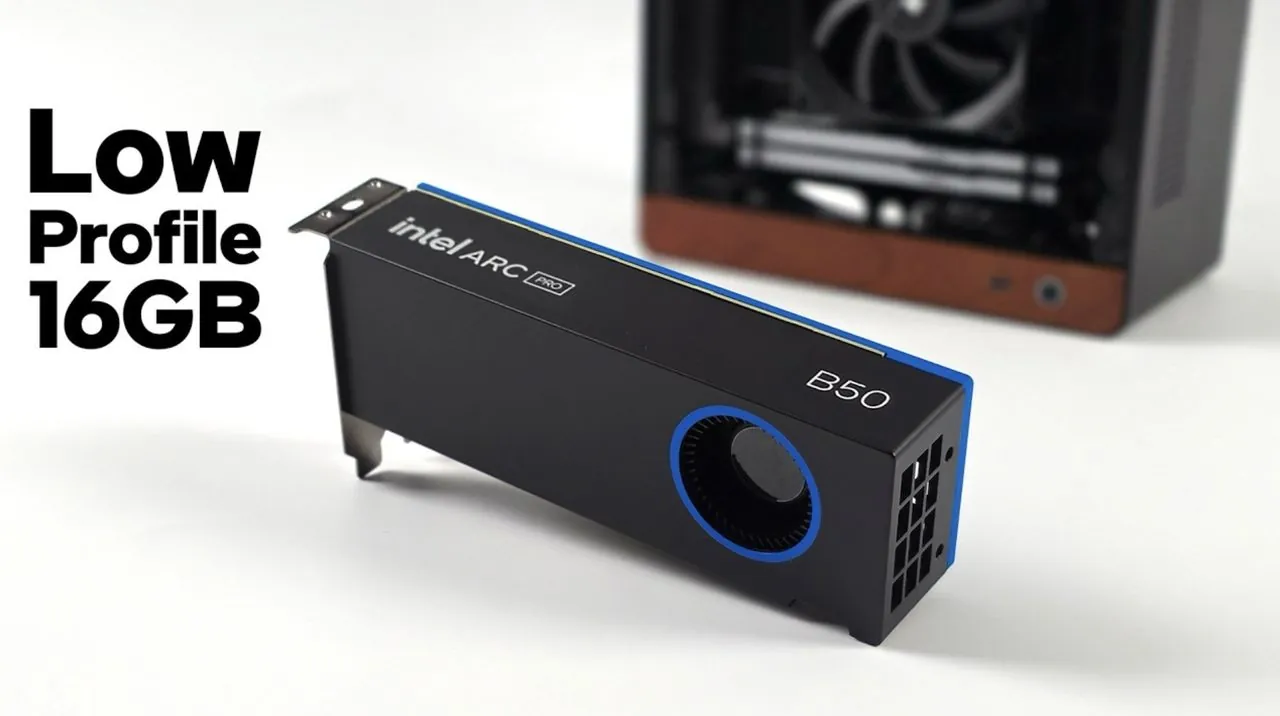
What if your next gaming rig didn’t need to dominate your desk, or your power bill? Enter the Intel Arc Pro B50 16GB, a low-profile GPU that’s quietly redefining what small form factor (SFF) builds can achieve. Designed with professionals in mind, this compact powerhouse features 16GB of GDDR6 VRAM and ECC memory for precision-driven tasks like AI workloads and content creation. But here’s the twist: beneath its workstation-first design lies a surprising gaming potential, making it a rare gem for those who want a sleek, space-saving system that doesn’t compromise versatility. Could this be the ultimate secret weapon for gamers and professionals alike?
In this overview, ETA Prime explores how the Arc Pro B50 balances power efficiency with performance, offering a unique dual appeal for SFF enthusiasts. From its blow-style cooling system that thrives in tight spaces to its ability to handle modern games with Intel’s XESS technology, this GPU challenges the notion that compact builds must sacrifice capability. But is it truly a jack-of-all-trades, or does its workstation DNA hold it back from gaming greatness? Let’s unpack the details and see if this low-profile GPU is the perfect fit for your next build, or if its limitations outweigh its promise.
Intel Arc Pro B50 Overview
TL;DR Key Takeaways :
- The Intel Arc Pro B50 is a low-profile workstation GPU with 16GB of GDDR6 VRAM, ECC memory support, and a power-efficient 70-watt design, ideal for professional workloads and small form factor (SFF) builds.
- Its compact, dual-slot design fits seamlessly into space-constrained setups, drawing power directly from the PCIe slot, making it suitable for minimalist or portable systems.
- Optimized for AI-driven applications, the GPU features 128 XMX engines and ECC memory, excelling in tasks like image generation, machine learning, and coding.
- While not a dedicated gaming GPU, it delivers playable performance in modern titles at 1080p and 1440p, using Intel’s XESS and Frame Generation technologies for enhanced visuals and frame rates.
- Its limitations include a restricted performance ceiling due to its 70-watt power design, lack of overclocking options, and drivers optimized for professional tasks, making it less suitable for high-end gaming.
Specifications: Balancing Power and Efficiency
The Arc Pro B50 is engineered with professional tasks in mind, yet its hardware hints at gaming potential. Its specifications reflect a balance between power and efficiency:
- 16GB of GDDR6 VRAM with ECC memory support for enhanced data reliability and error correction.
- 128-bit memory interface, 16 XE cores, 16 ray tracing units, and 128 XMX engines for AI and graphics workloads.
- 70-watt total board power, with typical consumption ranging between 50-55 watts during operation.
- Blower-style cooling system optimized for compact builds, making sure efficient heat dissipation in tight spaces.
These features emphasize reliability and efficiency, making the GPU well-suited for professional environments. At the same time, its hardware capabilities suggest it can handle light gaming tasks, offering versatility for users with diverse needs.
Compact Design for Small Form Factor Builds
The Arc Pro B50’s low-profile, dual-slot design is a standout feature for those working with space-constrained setups. It fits seamlessly into compact cases like the Jonsbo NV10, making it an excellent choice for SFF builds. Additionally, the GPU draws power directly from the PCIe slot, eliminating the need for external power connectors. This design simplifies installation and enhances its appeal for minimalist or portable systems. Whether you’re building a workstation for professional tasks or a compact gaming rig, the Arc Pro B50’s design ensures compatibility and ease of use.
Intel Arc Pro B50 16GB Low-Profile

Discover other guides from our vast content that could be of interest on Intel Arc.
- ASRock Intel Arc A380 low profile graphics card just $99
- Intel ARC B570 Review: Affordable Graphics Card for Gaming
- Intel ARC B580 Review: Best Budget GPU 1440p Gaming in 2025
- SPARKLE Embedded Intel Arc graphics cards for the Edge
- World’s first single slot low profile Intel ARC A380 GPU
- MSI Claw 8 AI Update to Intel ARC GPU Delivers Desktop Power
- Intel ARC A730M dedicated GPU mini PC gaming performance
- How Intel’s ARC 140T iGPU Handles Modern Games at 1080p
- Intel Core Ultra 7 258V vs AMD Ryzen Z1 Extreme iGPUs
- Dual-GPU Setup Guide: Affordable 1440p Gaming Performance
Workstation Features: Optimized for AI and Professional Tasks
The Arc Pro B50 excels in professional workloads, particularly in AI-driven applications. Its 128 XMX engines are optimized for tasks such as image generation, machine learning, and coding, as demonstrated in Intel’s AI Playground. The inclusion of ECC memory ensures data integrity, making it a reliable choice for professionals handling sensitive or complex computations. These features make the GPU a dependable tool for industries requiring precision and efficiency, such as content creation, data analysis, and AI development.
Gaming Performance: A Capable but Limited Contender
Although the Arc Pro B50 is not marketed as a gaming GPU, it delivers playable performance in many modern titles. Benchmarks such as Geekbench 6 and 3DMark place it below dedicated gaming GPUs like the RTX 4060. However, real-world tests at 1080p and 1440p demonstrate its ability to handle popular games, including:
- Cyberpunk 2077
- Marvel Rivals
- Doom: The Dark Ages
- Forza Horizon 5
The GPU uses Intel’s XESS (Xe Super Sampling) and Frame Generation technologies to enhance frame rates and visual quality in supported games. These features make it a viable option for casual gaming, particularly in SFF systems where space and power efficiency are critical. While it won’t rival high-end gaming GPUs, it offers a satisfactory gaming experience for users prioritizing compactness and versatility.
Limitations: Built for Workstations, Not Gaming
Despite its versatility, the Arc Pro B50 has clear limitations. Its 70-watt power design restricts its performance ceiling, and the lack of overclocking options further limits its gaming capabilities. Additionally, its drivers are optimized for professional applications, which may result in suboptimal gaming performance compared to GPUs specifically designed for gaming. These constraints highlight its primary focus as a workstation GPU, with gaming as a secondary consideration.
Exploring Optimization Opportunities
For advanced users, there may be opportunities to optimize the Arc Pro B50’s performance. Adjusting power limits or experimenting with driver settings could potentially unlock additional capabilities. However, these modifications come with risks, including potential instability or reduced lifespan of the hardware. Such tweaks are best suited for those with technical expertise and a willingness to accept the associated challenges. While these adjustments may not transform the GPU into a gaming powerhouse, they could provide incremental improvements for specific use cases.
A Niche GPU with Dual Appeal
The Intel Arc Pro B50 is a unique GPU that bridges the gap between workstation and gaming performance. Its compact design, power efficiency, and professional-grade features make it an excellent choice for SFF builds and AI workloads. While it doesn’t compete with dedicated gaming GPUs in raw performance, it offers playable gaming experiences in many titles, especially when using Intel’s XESS and Frame Generation technologies.
If you’re seeking a compact, power-efficient GPU with moderate gaming potential and strong professional capabilities, the Arc Pro B50 is worth considering. However, for users prioritizing high-end gaming, a dedicated gaming GPU may be a better fit. This GPU’s dual appeal lies in its ability to cater to professionals and casual gamers alike, making it a versatile option for those balancing diverse computing needs.
Media Credit: ETA PRIME
Disclosure: Some of our articles include affiliate links. If you buy something through one of these links, Geeky Gadgets may earn an affiliate commission. Learn about our Disclosure Policy.
