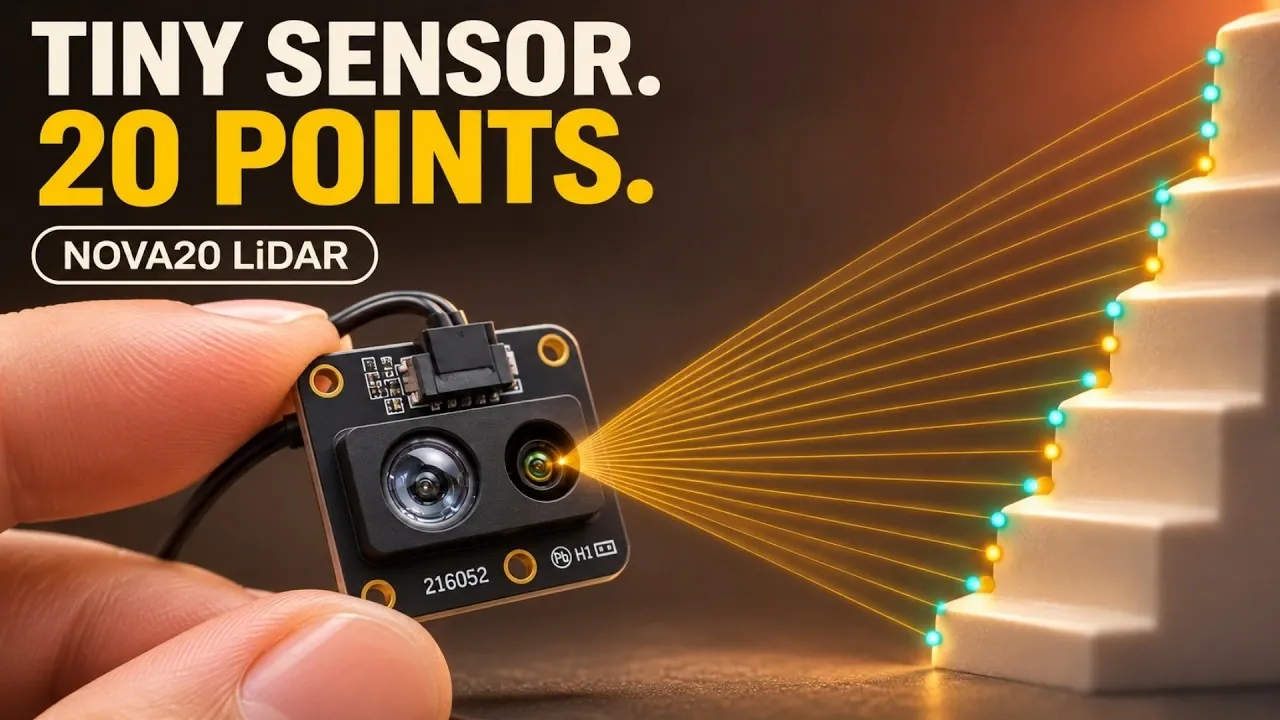
The Benewake NOVA20 uses 20 detection channels across a 40° field of view to measure distance in multiple directions without a rotating scanner. Paired with an ESP32, the sensor can feed an OLED readout and a Wi-Fi dashboard for real-time monitoring. Repeated outdoor tests reached 2 m, below the stated maximum of up to 3 m, according to How To Electronics.
Follow the wiring from the sensor’s UART connection and the OLED’s I2C pins to the ESP32, then examine how the firmware extracts and filters readings from nine-byte packets. Explore the dashboard’s radar and channel history, and see how its 3D-style view uses time as the third axis rather than depicting object height.
TL;DR Key Takeaways :
- The Benewake NOVA20 is a compact solid-state LiDAR sensor with 20 detection channels, a 40° field of view and a 10 Hz frame rate.
- Paired with an ESP32 and a 0.96-inch OLED, it provides a distance display and a Wi-Fi dashboard. The ESP32 filters invalid or unwanted readings from the sensor’s data packets.
- The dashboard shows a real-time 2D radar, channel history and a 3D-style view whose third axis represents measurement history over time, not object height.
- In a hand test, the displayed points tracked movement toward and away from the sensor, and distance readings changed immediately.
- Repeated outdoor tests reached a maximum detected distance of 2 m, below the sensor’s stated maximum of up to 3 m. Its specified range under challenging lighting and target conditions is 1 m.
NOVA20 Distance Monitor
The Benewake NOVA20 is a compact solid-state LiDAR sensor with 20 detection channels across a 40° field of view. Paired with an ESP32, it forms a distance-monitoring system with an OLED display and a Wi-Fi dashboard. The dashboard shows radar, measurement history and a 3D-style view.
In a hand test, the displayed points tracked movement toward and away from the sensor, and distance readings changed immediately. In repeated outdoor tests with the OLED display, the maximum detected distance was 2 m, below the sensor’s stated maximum capability of up to 3 m.
How the NOVA20 Measures Distance
Benewake supplied the NOVA20 for the project. The module comes in a small white box and has no camera, rotating motor or complex scanning mechanism. Two optical openings sit on the front: one sends infrared laser light, and the other receives the reflected light. The back has labeled connections, including UART pins, and gold-plated test points.
- 20 detection channels measure in different directions.
- 40° field of view spans the sensing channels.
- 10 Hz frame rate updates measurements 10 times per second.
- Laser: 95 nanometers.
- Power: 5V.
- Communication: high-speed UART.
The sensor sends a short pulse of invisible infrared light toward an object and measures how long the reflection takes to return. It calculates distance from that round-trip time and the speed of light.
Unlike a conventional rotating LiDAR, the NOVA20 uses distributed channels to measure in different directions. Comparing their readings can identify nearby obstacles and their approximate positions. The stated operating range is 1 m under challenging lighting and target conditions. Stated accuracy is approximately 3 cm at shorter distances and 5 cm between 30 and 50 cm.

Uncover more insights about ESP32 project ideas in previous articles we have written.
- 6 ESP32 Projects to Build Including an OLED Pulse Oximeter
- Build a 10.1-Inch Home Assistant Panel with the ESP32
- 10 ESP32 Desk Gadget Projects to Build from Adaptive Lamps to USB Meters
- How to Build a Custom AI Desk Buddy with a ESP32 S3
Building the ESP32 Monitor
The project combines the sensor with an ESP32 board and a 0.96-inch I2C OLED. You can use jumper wires on a breadboard or a PCB; the assembled example uses a custom board manufactured by JLCPCB. The project schematic connects the OLED to the ESP32’s I2C pins and the NOVA20 to its UART pins.
Each 9-byte packet from the NOVA20 contains distance, signal strength, temperature and channel identification. The ESP32 extracts the measurements and filters unwanted or invalid readings, producing cleaner, more stable distance data.
The code uses the ESP32’s built-in Wi-Fi and web server library, plus Adafruit GFX and SSD306 libraries and a custom font for the OLED. It includes Wi-Fi SSID and password settings alongside hardware and NOVA20 configuration. The dashboard page uses HTML, CSS and JavaScript.
For the upload, the ESP32 dev module and COM port were selected. A successful upload displays the board’s IP address, which you can use to open the dashboard in a browser on a smartphone or computer. The OLED shows distance in large characters; covering the sensor reveals its minimum distance or blind zone. The assembled board would be ready for testing once working firmware was uploaded.
Radar, 3D View and History
The dashboard’s 2D radar plots real-time measurements from all 20 channels across the sensor’s 40° vertical field of view. Each point represents one channel’s measured distance. The scan page also shows valid beams, nearest and average distance, scanning rate and a large distance readout.
The 3D-style visualization combines the current scan with previous measurements. Its third axis represents measurement history over time, not the actual height of objects. You can rotate the view by dragging, zoom by scrolling and inspect individual points by selecting them.
A separate history page plots color-coded readings from all 20 channels over successive samples. It also displays individual measurements for channels 0 through 19.
In the short-distance hand test, radar points moved toward the center as the hand approached and outward as it receded. Different channels detected different parts of the hand. The 3D points shifted correspondingly, and the colored surface changed shape. That view gave a better visual understanding of the moving hand across the sensing channels, while the history graph and individual readings updated as its distance changed.
On the history graph, distance decreased as the hand moved closer and increased as it moved farther away. All 20 individual channel readings updated continuously during the movement.
Outdoor Range and Project Uses
During outdoor testing, the OLED displayed the minimum distance, and the displayed value rose as the tester moved farther away. The repeated 2 m maximum result was below the NOVA20’s stated 3 m maximum capability; its specified range under challenging lighting and target conditions is 1 m.
The compact sensor and its 20 channels are useful for robotics, obstacle detection and automation. Other possible uses identified include fall prevention, presence sensing and foreign object detection. You can find the complete code and project details through the link in the description. Robotic obstacle avoidance is another possible use.
How To Electronics says the compact NOVA20 can be useful for robotics, obstacle detection and automation. In the hand test, its 20 channels tracked movement, while the dashboard’s 3D view plotted measurement history rather than object height. Repeated outdoor OLED tests reached 2 m, below the stated maximum of up to 3 m; the specified range under challenging lighting and target conditions is 1 m.
Media Credit: How To Electronics
Disclosure: Some of our articles include affiliate links. If you buy something through one of these links, Geeky Gadgets may earn an affiliate commission. Learn about our Disclosure Policy.
