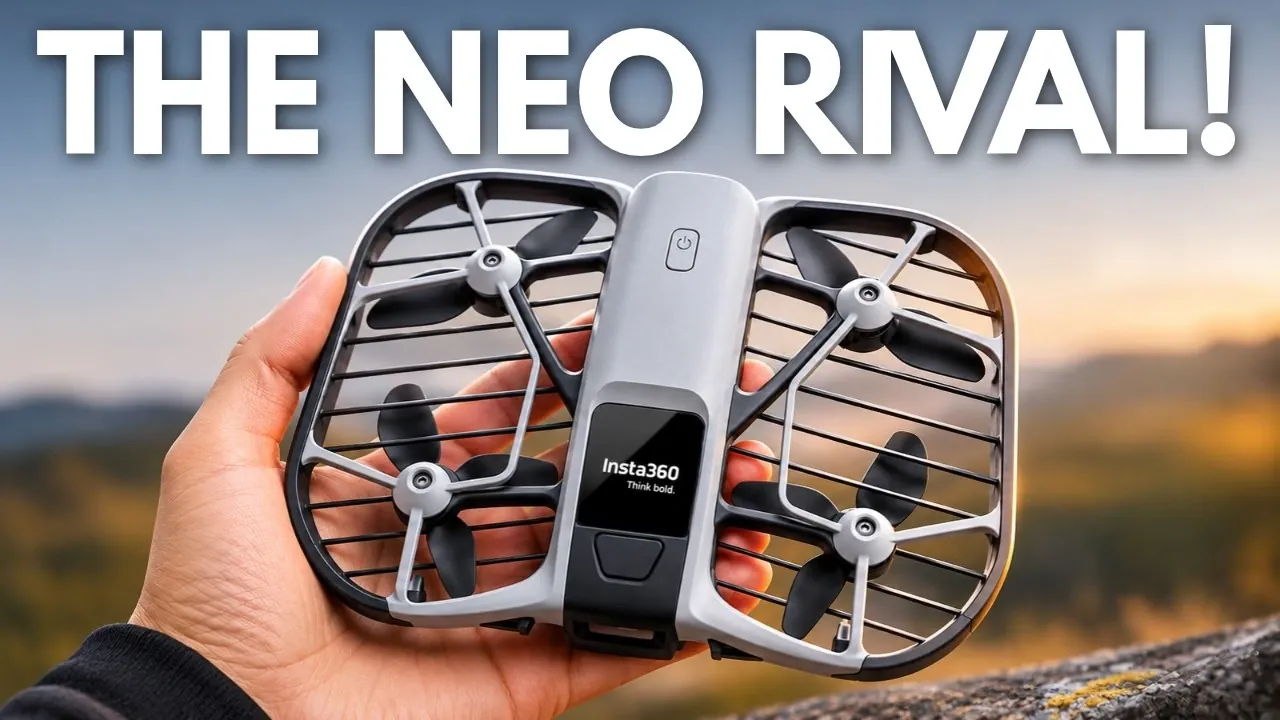
A leaked image of Insta360’s upcoming drone suggests the company is preparing to challenge DJI’s Neo series with a compact, user-friendly design. The drone features a protective integrated frame, fully enclosed propellers, and what appears to be a small built-in display on its body. While its exact capabilities remain unconfirmed, the design hints at a focus on autonomous flying and ease of use for casual creators, according to Tech Court.
Explore how Insta360’s expertise in stabilization and subject tracking could shape this drone’s performance, particularly in follow-me scenarios. Gain insight into potential accessory compatibility, such as wearable controllers, and how these could enhance the flying experience. Additionally, understand the challenges Insta360 may face in competing with DJI’s Neo series, from battery life to camera stabilization. The leaked design raises intriguing possibilities for a simplified yet capable flying camera.
Leaked Insta360 Drone Targets DJI Neo Series
TL;DR Key Takeaways :
- A leaked image of an upcoming Insta360 drone, shared by Igor Bogdanov, suggests a compact design with fully enclosed propellers and a possible built-in display, potentially targeting casual creators and close-range autonomous flying.
- The drone’s design emphasizes convenience, with features like a protective frame and potential palm-launch capability, but its ability to navigate obstacles autonomously in complex environments remains unverified.
- Insta360’s expertise in camera software, including stabilization and subject tracking, could enhance the drone’s appeal, though there is no confirmation of specific features like GPS-assisted tracking or compatibility with existing Insta360 accessories.
- The leaked image does not show a mechanical gimbal, raising the possibility of reliance on electronic stabilization, which could challenge Insta360 in competing with DJI’s Neo2, known for its two-axis gimbal and advanced video quality.
- While the Insta360 drone’s development stage is unclear, its potential entry into the market could push DJI to improve features like tracking reliability, battery life, and ease of use in its Neo series, particularly with the anticipated Neo3 upgrade.
A leaked image of an upcoming Insta360 drone, shared by Igor Bogdanov, reveals a design that may directly challenge DJI’s Neo series. The drone features a compact central body, fully enclosed propellers within an integrated frame, and what appears to be a built-in display. While many details remain unconfirmed, the design and Insta360’s focus on user-friendly features suggest it is aimed at casual creators and close-range autonomous flying.
Compact Design and Autonomous Focus
The leaked photograph shows a drone with an integrated frame designed to protect its propellers. The frame combines black outer sections with lighter internal supports, emphasizing close-range autonomous flying over long-distance photography. A visible power button and a black panel with Insta360’s “Think Bold” branding are located on the body.
This panel resembles a small integrated display, though its exact function, whether for battery status, flight modes, or tracking information, remains unverified. A button-like feature beneath the black panel is also visible, but its purpose is unclear.
The design suggests a focus on convenience, potentially allowing users to launch the drone from their palm, let it follow autonomously, and retrieve it without a traditional controller. This aligns with the growing demand for compact, easy-to-use flying cameras. However, while the protective frame may enhance safety, it does not guarantee effective autonomous navigation, particularly in obstacle-rich environments.

Become an expert in Insta360 and DJI drones with the help of our in-depth articles and helpful guides.
- The Drone That Changes Everything: Antigravity A1
- Rumoured DJI Neo 3 Drone Targets a September 2026 Launch
- DJI Neo 3 vs Neo 2: Leaks Show a 64% Battery Increase
- DJI Neo 3 64% Larger Battery, 193g and 16-Minute Flight Time
- Leaked DJI Neo 3 May Integrate Transceiver vs Neo 2 Module
Potential Features and Accessories
Insta360’s expertise in camera software and computational imaging could significantly enhance this drone’s appeal. The company has demonstrated strengths in subject tracking, stabilization, automatic reframing, and simplified editing through its action and 360 cameras. These capabilities could make the drone particularly appealing to casual creators prioritizing ease of use over advanced flight controls.
The drone might integrate with Insta360’s existing ecosystem of accessories. For example, the Antigravity A1 drone, another product from Insta360’s drone-related brand, supports controllers like a watch remote and a ring remote. The watch remote provides a live camera preview and GPS-assisted tracking, while the ring remote enables gesture-based control.
Although these accessories were designed for the Antigravity A1, their compatibility with the smaller Insta360 drone remains speculative. There is no confirmation that accessories announced for the Antigravity A1 will work with this drone.
GPS-assisted tracking, if included, could help the drone maintain awareness of a subject’s position even if visual contact is temporarily lost. However, this feature has not been confirmed. If Insta360 integrates such capabilities, it could improve the drone’s usability for casual users.
Stabilization and Camera Considerations
Stabilization will be a critical factor for this drone to compete with DJI’s Neo series. The leaked image does not clearly show a mechanical gimbal, raising the possibility that the drone could rely on electronic stabilization. For comparison, DJI’s Neo2 uses a two-axis mechanical gimbal, which significantly improves video quality during flight. Insta360‘s experience with electronic stabilization in its cameras may help mitigate this gap, but achieving stable footage on a flying platform remains a challenge.
The drone’s camera setup is another area of uncertainty. While Insta360 is known for its 360° cameras, this smaller drone seems to target a different audience. A conventional forward-facing camera might be more practical for a compact follow-me drone, simplifying the capture of usable footage without extensive post-production reframing. A forward-facing camera could therefore be a logical choice for this type of drone.
Competition with DJI Neo Series
DJI’s Neo2 has set a high standard in this category, offering features such as omnidirectional obstacle sensing, 4K 60 fps recording, and a two-axis gimbal, all within a lightweight 151 g design. However, its rated battery life of up to 19 minutes often decreases significantly in real-world conditions, particularly during tracking in windy environments or frequent speed adjustments. This limitation presents an opportunity for Insta360 to differentiate its product by focusing on longer usable flight times and reliable autonomous tracking.
Reports suggest that DJI’s upcoming Neo3 may weigh approximately 193 g, feature a redesigned body, and include a larger battery. Speculated improvements include enhanced camera capabilities and new controller options, though DJI has not officially confirmed these details. If accurate, the Neo3 could represent a significant upgrade, raising the stakes for Insta360’s entry into the market. However, there is no indication that the Insta360 drone and the DJI Neo3 will launch simultaneously.
While DJI continues to develop its next-generation Neo, the Neo2 remains a strong competitor in this category. The timing of the Insta360 drone leak adds intrigue to a potential showdown with the Neo3, though it is unclear how far along Insta360’s drone is in its development. It could be nearing production or still undergoing substantial changes.
Challenges and Opportunities
The Insta360 drone’s protective frame suggests an emphasis on safety, but it does not guarantee effective obstacle navigation. A drone relying primarily on camera and software for environmental awareness may face challenges in complex environments, such as narrow paths with trees or other obstacles. Dedicated obstacle sensors, if included, could address this issue, but no evidence of such sensors has been observed in the leaked image.
Insta360’s strength lies in creating user-friendly cameras, which could differentiate its drone from DJI’s offerings. A compact drone that reliably follows its subject, integrates with wearable controllers, and produces footage that is easy to edit could attract users who find traditional drones overly complex. Such a drone could appeal to casual users even if it lacks the most advanced specifications.
The leaked image indicates that Insta360’s drone is progressing, though its development stage remains uncertain. It could be nearing production or still subject to significant revisions. Regardless, competition from Insta360 is likely to push DJI to improve tracking reliability, battery life, video quality, and ease of use in its Neo series.
Tech Court sees Insta360’s strengths in simplicity, stabilization, and user-friendly design as key to differentiating its drone from DJI’s Neo series. A compact follow-me drone with reliable tracking, wearable controls, and easy editing could attract users who find traditional drones too complex. However, with no confirmed details on its camera setup, battery life, or release timeline, much about the product remains unclear. Tech Court believes focusing on a straightforward and accessible flying experience could be a more effective strategy than attempting to match DJI’s advanced flight features.
Media Credit: Tech Court
Disclosure: Some of our articles include affiliate links. If you buy something through one of these links, Geeky Gadgets may earn an affiliate commission. Learn about our Disclosure Policy.
