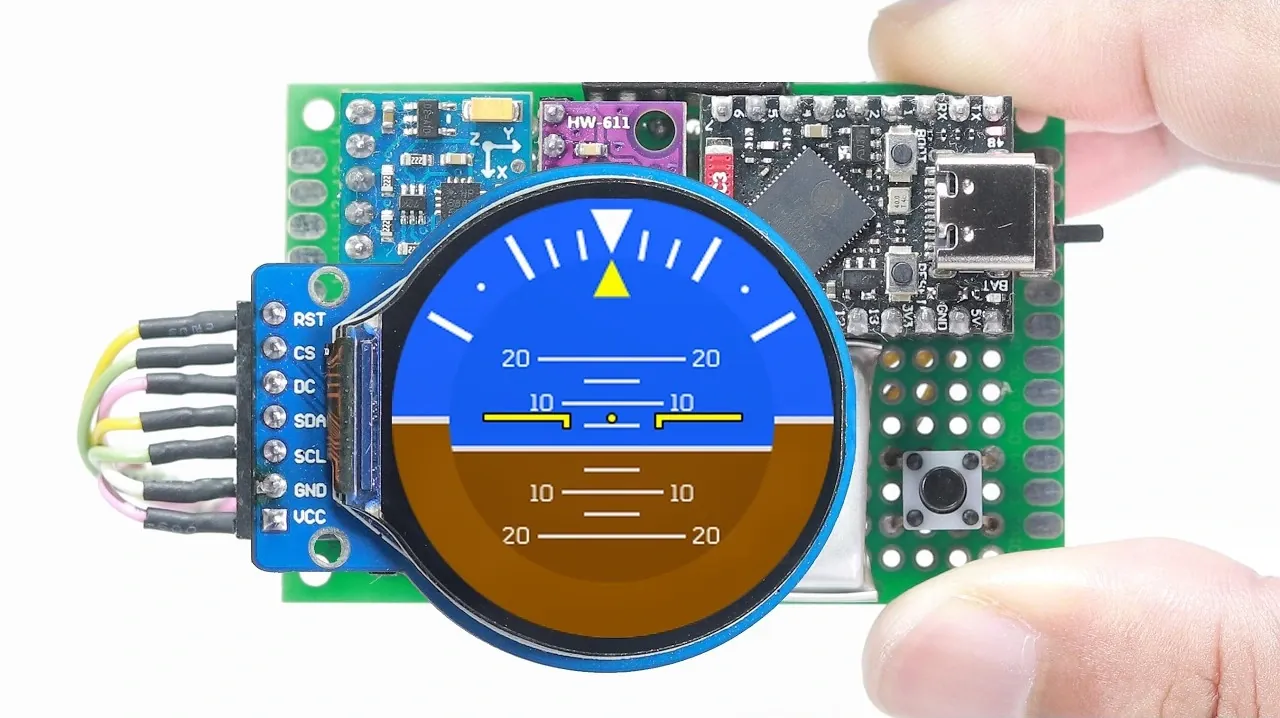
Creating an artificial horizon, heading indicator, and altimeter for an RC dashboard requires careful integration of hardware and software. This project, built around the compact and battery-capable ESP32 board, features a 240×240 pixel round display and multiple sensors communicating via I²C. The system delivers essential flight data, though challenges like gyro drift and tilt compensation remain unresolved, as detailed by LazyDays Creation.
Explore how this setup balances portability and functionality, from soldering the board’s pins to calibrating sensors for pitch, roll, and altitude. Gain insight into the use of SquareLine Studio for UI design and Arduino for code deployment, as well as the practical benefits of automated and manual calibration. This report highlights both the system’s current capabilities and the planned improvements aimed at enhancing its precision and reliability.
TL;DR Key Takeaways :
- The project uses an ESP32 board for its compact size and built-in battery charging capability, making it ideal for space-limited RC dashboard applications.
- A 240×240 pixel round display is integrated, offering clear visuals for artificial horizon, heading indicator, and altimeter data, though some refinements are still in progress.
- The system employs I²C communication for three sensors, with the altimeter using barometric pressure, the heading indicator featuring a moving card compass style, and the artificial horizon relying on pitch and roll data, but filtering algorithms are not yet implemented.
- Calibration is automated at startup, with manual recalibration available, though tilt compensation and advanced filtering for gyro drift and cornering forces are planned for future updates.
- The project demonstrates the potential of the ESP32 for FPV RC dashboards but currently faces challenges with accuracy and reliability due to the absence of tilt compensation and filtering algorithms.
Building an Artificial Horizon, Heading Indicator, and Altimeter with ESP32
A recent project has developed an artificial horizon, heading indicator, and altimeter for an FPV RC dashboard using the versatile ESP32 board. This compact setup integrates a round display and precise sensors to deliver essential flight data, though some refinements are still in progress. Below is a breakdown of the build and its current functionality.
Hardware and Display Choices
The system is built around the ESP32 board, chosen for its compact size and built-in battery charging capability. The board requires manual soldering of pins before use, but its small form factor makes it ideal for space-limited applications like RC dashboards. Testing confirmed its suitability for projects needing compact, battery-integrated boards.
A 240 by 240 pixel round screen serves as the display, using just seven pins for its controller. Its circular shape and high resolution are well-suited for round gauges, providing clear and functional visuals for flight data. This design improves the dashboard’s readability and usability.
Power is supplied by a small lithium battery, which powers both the circuit and the display. This lightweight solution supports the project’s focus on portability and integration.

Discover other guides from our vast content that could be of interest on ESP32.
- $5 ESP32-S3 Super Mini Packs Wi-Fi and Bluetooth
- The $4 ESP32 S3 Super Mini Packs a 240 MHz Dual-Core Chip
- How an $8 ESP32 S3 Microcontroller Runs a 28.9M Parameter Local LLM
- 5 ESP32 Projects Worth Building in 2026: Such as an Apple HomeKit Controller
- $4 ESP32 Module Brings Wi-Fi and Bluetooth to IoT Projects
- Replacing Security Cameras with Three $10 ESP32S3 Wi-Fi Boards
- ESP32-S3 Super Mini Costs $5 and Packs Wi-Fi and Bluetooth
- Gemini 4 Argon Writes ESP Mosaico Firmware to Control RGB LEDs
- ESP32-S3 Super Mini Brings 240 MHz Dual-Core Power For $4
- ESP32 S31 Devkit Hands-on: 320 MHz RISC-V Chip Adds Wi-Fi 6
Sensors and Communication
The system uses three sensors to provide artificial horizon, heading indicator, and altimeter functionalities. These sensors communicate via I²C, a protocol that allows multiple devices to share the same two data lines when connected in parallel. Testing demonstrated the practicality of I²C for multi-sensor setups.
The altimeter measures altitude through barometric pressure, while the heading indicator employs a moving card compass style. The artificial horizon uses pitch and roll data, though filtering algorithms to refine these measurements are not yet implemented.
Software and Calibration
The user interface was designed in SquareLine Studio, with the UI files exported for integration into the project. Code development and uploading were handled through Arduino, requiring specific libraries and board parameters. Once uploaded, the display becomes operational within minutes.
Sensor calibration is automated at startup, with a reset button available for manual recalibration. Calibration offsets are included for the compass, though tilt compensation has not been added. These calibration features are critical for accuracy and are planned for future updates.
Challenges and Future Updates
The project faces challenges despite its functionality. Gyro drift and cornering forces affect pitch and roll data due to the lack of filtering algorithms. Similarly, the compass’s accuracy is limited during tilted flight because tilt compensation has not been implemented. Updates to the source code are expected to address these issues, reflecting ongoing efforts to improve reliability and precision.
This project demonstrates the potential of the ESP32 board for creating compact, functional RC dashboard instruments. The current build integrates an artificial horizon, heading indicator, and altimeter, offering clear visuals and straightforward calibration. However, its performance is limited by the absence of filtering algorithms and tilt compensation, which are essential for accurate operation in dynamic conditions. The project provides a promising foundation for FPV enthusiasts, with its future success depending on planned updates to address these limitations.
Media Credit: LazyDays Creation
Disclosure: Some of our articles include affiliate links. If you buy something through one of these links, Geeky Gadgets may earn an affiliate commission. Learn about our Disclosure Policy.
