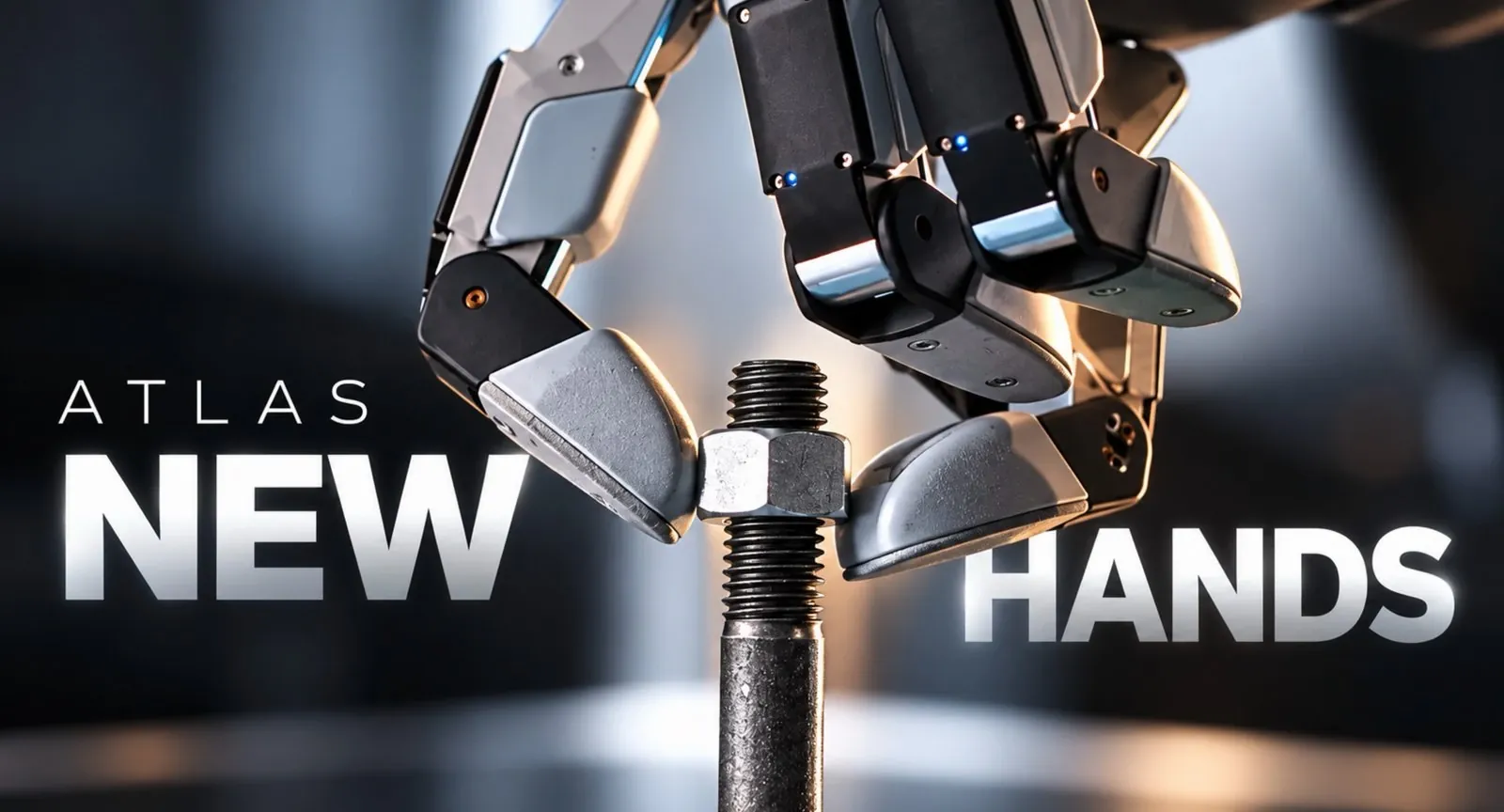
Boston Dynamics has unveiled the GR3 hand, a new addition to its Atlas robot designed to enhance dexterity and operational reliability. The GR3 hand features 13 degrees of freedom, nearly doubling the range of its predecessor, the GR2. Its design omits the pinky finger, focusing instead on strength and adaptability while maintaining a simplified structure. Advanced proprioception enables the hand to adjust its grip in real time, allowing it to handle delicate objects or perform intricate tasks with precision.
Explore how the GR3 hand incorporates various grasping methods, including pinch and tripodal grips, to accommodate diverse tasks. Gain insight into the role of simulation-based training in refining its capabilities while minimizing development costs. The overview also highlights durability-oriented elements, such as back-drivable joints, that support consistent performance in challenging environments.
Key Features of the GR3 Hand
- The GR3 hand by Boston Dynamics introduces 13 degrees of freedom, nearly doubling its predecessor’s capabilities, allowing intricate and human-like dexterity.
- Its advanced proprioception and integrated sensors allow real-time grip adjustments, making it ideal for handling delicate or irregularly shaped objects.
- Durability is enhanced through back-drivable joints and a streamlined design, making sure reliability in demanding environments and extended operational lifespan.
- Simulation and reinforcement learning enable efficient virtual training, reducing development time and expanding the hand’s adaptability for complex tasks.
- The GR3 hand is designed for diverse applications, including tool manipulation, precision operations and industrial automation, showcasing its fantastic potential in robotics.
The GR3 hand builds upon the foundation of its predecessor, the GR2, by incorporating a range of improvements that significantly enhance its capabilities:
- Expanded Degrees of Freedom: The GR3 features 13 degrees of freedom, nearly doubling the GR2’s 7, allowing more intricate and precise movements that closely mimic human dexterity.
- Optimized Structure: Slightly larger and stronger than a human hand, the GR3 omits the pinky finger to streamline its design while maintaining maximum functionality and versatility.
- Enhanced Durability: The simplified design minimizes potential failure points, making sure greater reliability and operational efficiency over extended periods of use.
This balance between advanced functionality and practical design makes the GR3 hand a scalable and adaptable solution for a wide range of robotic applications, from industrial automation to field operations.
Unmatched Dexterity and Adaptability
The GR3 hand is engineered to perform a diverse array of tasks that demand precision and adaptability. Its design supports multiple grasping techniques, allowing it to handle objects of varying shapes and sizes with ease. Key grasping methods include:
- Pinch Grasp: Ideal for manipulating small, delicate objects with precision and care.
- Tripodal Grasp: Perfect for securely gripping tools or irregularly shaped items.
A standout feature of the GR3 is its advanced proprioception, which allows it to sense force and motion dynamically. Integrated sensors enable the hand to adjust its grip in real time, making sure safe and precise interactions. This capability is particularly valuable for handling fragile items or performing delicate operations, bringing robots closer to achieving human-like functionality in complex tasks.

Here are more guides from our previous articles and guides related to Boston Dynamics that you may find helpful.
- Boston Dynamics Unveils Atlas : New Factory Ready Humanoid Robot at CES 2026
- Meet the New Atlas: Boston Dynamics’ Robot That Thinks for Itself
- Are Robotic Hands About to Outperform Humans? Boston Dynamics Thinks So
- Boston Dynamics Spot robot new tricks demonstrated
- The Real Reason Google Sold Boston Dynamics to SoftBank
- Boston Dynamics Sand Flea Robot Jumps 30 Feet In The Air (Video)
- Google DeepMind & Boston Dynamics Announce New Partnership to Bring AI to Humanoid Robots
Simulation and Learning: A Smarter Robotic Hand
The GR3 hand is fully simulatable, providing a robust platform for reinforcement learning and advanced training. Boston Dynamics has developed highly accurate virtual models of the hand’s kinematics, dynamics and contact interactions. These simulations allow researchers to train the GR3 in virtual environments before deploying it in real-world scenarios, significantly reducing development time and costs.
Reinforcement learning plays a pivotal role in enhancing the GR3’s performance. Through iterative trial-and-error processes, the hand continuously improves its efficiency and adaptability. This approach not only accelerates the refinement of its capabilities but also expands the potential applications of robotic systems, pushing the boundaries of what they can achieve in dynamic environments.
Engineered for Durability and Real-World Challenges
The GR3 hand is designed to excel in demanding environments, thanks to its robust construction and advanced engineering. Key durability features include:
- Back-Drivable Joints: These joints enhance impact resistance, reducing the risk of damage during high-force interactions and making sure reliable performance in challenging conditions.
- Streamlined Design: The simplified structure minimizes wear and tear, extending the hand’s operational lifespan and maintaining consistent performance over time.
These durability-focused innovations make the GR3 hand well-suited for a variety of applications, including industrial tasks that require both strength and precision, as well as field operations in unpredictable or harsh environments.
Iterative Development and Innovation
The development of the GR3 hand was guided by a meticulous, iterative process that combined advanced simulations, 3D-printed prototypes and hands-on experimentation. This approach enabled engineers to rapidly test and refine key features, such as dexterity, power efficiency and structural integrity.
By using 3D printing technology, Boston Dynamics accelerated the design and testing cycles, allowing for the exploration of innovative solutions and the optimization of the hand’s performance. Each iteration was carefully balanced to ensure that the final product was not only technologically advanced but also practical and manufacturable at scale.
Expanding Applications and Future Potential
The GR3 hand represents a significant milestone in robotic technology, unlocking new possibilities for Atlas and other robotic systems. Its enhanced capabilities make it an ideal tool for a wide range of tasks, including:
- Tool Manipulation: Performing complex operations with precision and control.
- Component Assembly: Streamlining manufacturing processes by handling intricate assembly tasks.
- Precision Operations: Excelling in tasks that require adaptability and fine motor skills.
By bridging the gap between virtual simulations and real-world performance, the GR3 hand paves the way for more advanced applications in robotics. Its combination of strength, precision and durability positions it as a fantastic tool for industries seeking to integrate robotic systems into their workflows.
As of October 2026, Boston Dynamics continues to push the boundaries of robotic innovation. The GR3 hand stands as a testament to the company’s commitment to advancing the field of robotics, offering a glimpse into a future where machines interact with their environments in increasingly complex and meaningful ways.
Media Credit: Boston Dynamics
Disclosure: Some of our articles include affiliate links. If you buy something through one of these links, Geeky Gadgets may earn an affiliate commission. Learn about our Disclosure Policy.
