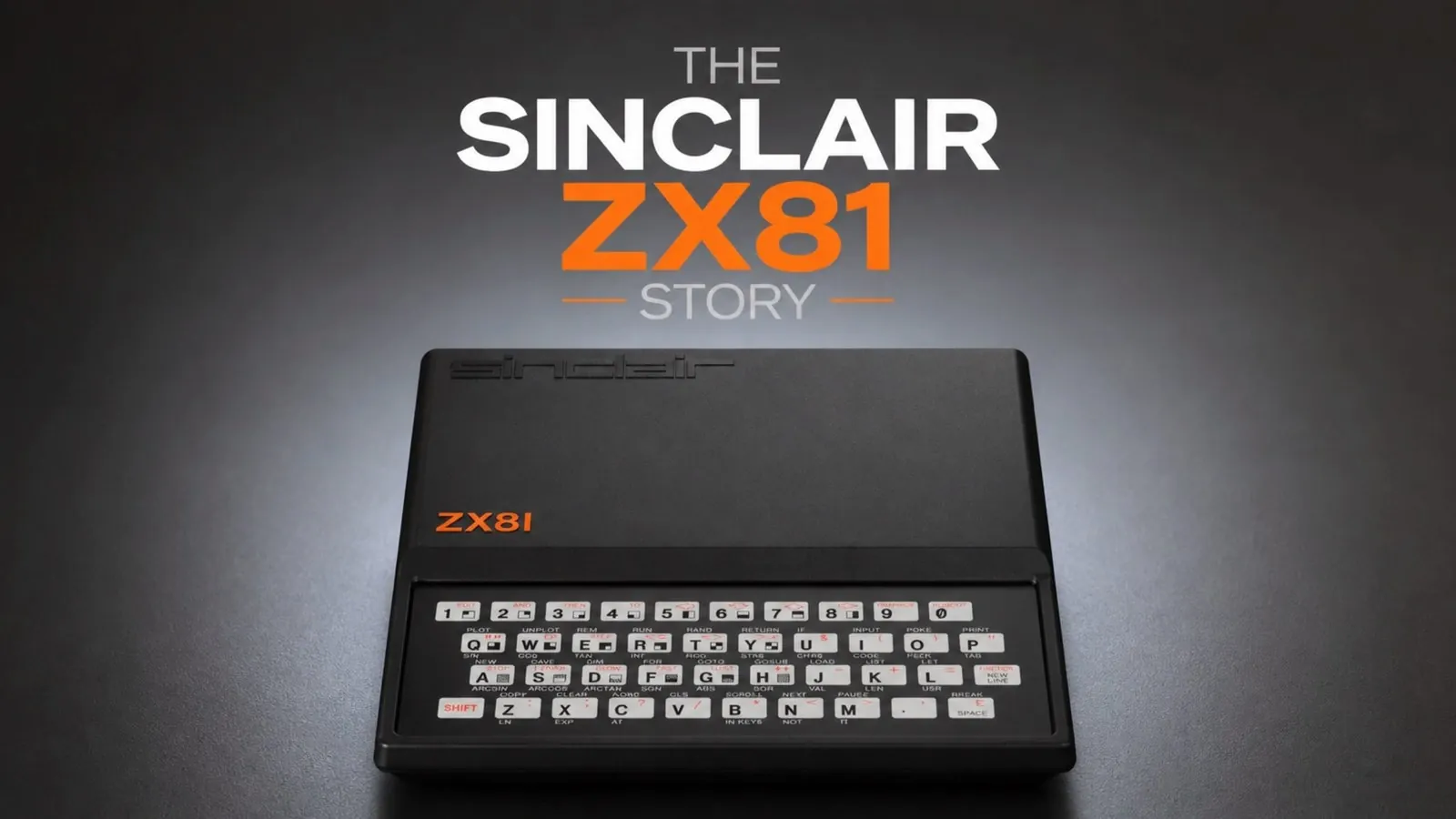
The Sinclair ZX81, launched in 1981, stands as a landmark in the history of home computing, offering an affordable gateway into personal technology. Created by Sinclair Research, this compact machine featured a Z80 processor, 1KB of RAM (expandable to 16KB), and a membrane keyboard, all packaged at a price point that made it accessible to beginners and hobbyists alike. Little Car’s exploration of the ZX81 highlights how its clever engineering, such as the use of the Uncommitted Logic Array (ULA) chip, allowed for reduced production costs while maintaining functionality. Despite its technical limitations, including low-resolution graphics and an unresponsive keyboard, the ZX81 became a cultural icon, selling over 1.5 million units and inspiring a generation of programmers.
Dive into this guide to uncover how the ZX81 balanced affordability with adaptability, fostering a culture of experimentation. You’ll gain insight into its modular design, which allowed users to expand its capabilities with peripherals like RAM packs and thermal printers. Discover the challenges faced by those assembling the DIY kits and how this hands-on approach shaped the early computing community. Finally, explore the ZX81’s broader impact, from its role in global markets to its influence on the development of its successor, the ZX Spectrum.
Innovative Design and Engineering
TL;DR Key Takeaways :
- The Sinclair ZX81, launched in 1981, transformed home computing by offering an affordable and accessible entry point, selling over 1.5 million units and becoming a cornerstone of early computing history.
- Its design featured a Z80 processor, 1KB of RAM (expandable to 16KB), a membrane keyboard and enhanced BASIC programming, balancing cost efficiency with functionality.
- Priced at £70 pre-assembled or £50 as a DIY kit, the ZX81 democratized computing, inspiring a generation of hobbyists and students despite challenges like assembly difficulties and technical limitations.
- Strategic global distribution, including partnerships with Timex in North America and WH Smith in the UK, helped the ZX81 achieve international success and widespread availability.
- The ZX81’s legacy includes inspiring its successor, the ZX Spectrum, fostering innovation through software and peripherals and serving as a fantastic option for the global spread of personal computing.
The Sinclair ZX81 was designed as the successor to the ZX80, addressing many of its predecessor’s limitations. Powered by a Z80 processor, it came equipped with 1KB of RAM, which could be expanded to 16KB and featured a membrane keyboard. The device also introduced an improved ROM that supported enhanced BASIC programming, allowing floating-point calculations and basic graphics. These features made the ZX81 a versatile tool for programming and simple computing tasks.
To achieve its affordability, Sinclair Research employed innovative engineering techniques. A key component was the Uncommitted Logic Array (ULA) chip, which significantly reduced the number of components required. This not only lowered production costs but also simplified the device’s design. Additionally, the modular nature of the ZX81 allowed users to expand its capabilities with peripherals, making it adaptable to individual needs. These design choices reflected a balance between cost efficiency and functionality, making sure the ZX81’s appeal to a broad audience.
Affordability and Accessibility
One of the ZX81’s most significant achievements was its price point. At just £70 for a pre-assembled unit or £50 as a DIY kit, it was one of the most affordable computers of its time. This pricing strategy was instrumental in targeting beginners, hobbyists and students, providing an accessible entry point into the world of computing and programming.
For those who opted for the DIY kit, assembling the ZX81 presented a challenge. The process required careful soldering and assembly, which proved difficult for many users and led to a high rate of returns. However, the low cost and the opportunity to learn through hands-on assembly outweighed these challenges for many, inspiring a generation of tech enthusiasts. By lowering the financial barrier to entry, the ZX81 democratized access to computing and fostered a culture of experimentation and innovation.

Explore further guides and articles from our vast library that you may find relevant to your interests in mini PCs.
- Testing Cyberpunk 2077 on a Low-Cost 32W AMD Mini PC
- Corsair AI Workstation 300 vs Apple M1 Ultra Benchmarks
- Ryzen 5 7430U Mini PC Review : Budget Performance Tested
- Budget SteamOS Mini PC for Living Room Gaming and Streaming
- GMKtec EVO T2 Mini PC Review: 1440p Gaming Performance Tested
- Broken Phone Transformed into a DeX-Powered 1440p Mini PC for Under $100
- Apple’s $299 Mac mini Neo: Everything We Know So Far
- PIX NII 4K Intel cube mini PC
- Khadas Mind Pro Mini PC Specs : Panther Lake, ARC B390, Ports & Benchmarks
- This 2-Liter SFF Mini PC is a 1440P Gaming Beast
Technical Limitations and Trade-Offs
While the ZX81 was new for its affordability and accessibility, it came with notable limitations that shaped its legacy. These included:
- No sound or color capabilities, restricting its multimedia potential
- Low-resolution graphics, which limited its appeal for advanced applications
- An unresponsive membrane keyboard, which frustrated users during extended use
- Performance issues caused by the Z80 processor handling video output in “SLOW” mode
These constraints were the result of deliberate trade-offs made to keep costs low. While they limited the ZX81’s functionality compared to more advanced systems, they were necessary to achieve its primary goal: making computing affordable and accessible to a wider audience.
Global Reach Through Strategic Distribution
The ZX81’s success was amplified by strategic manufacturing and distribution partnerships. In North America, Timex produced and marketed the computer as the Timex Sinclair 1000, adapting it for the local market. In the UK, an exclusive retail agreement with WH Smith ensured the ZX81’s widespread availability, making it a familiar presence in high-street stores.
Beyond the UK and North America, the ZX81 was exported to Europe, Australia, New Zealand and Japan. Its impact varied across regions, but it achieved its greatest success in the UK, where it became a symbol of affordable computing. These distribution strategies played a crucial role in establishing the ZX81 as a global phenomenon, extending its influence far beyond its home market.
Expanding Functionality with Software and Peripherals
Despite its hardware limitations, the ZX81 supported a range of innovative software that showcased its potential. Games like 3-D Monster Maze and Mazogs demonstrated the creativity of developers working within the system’s constraints. These titles captivated users and highlighted the ZX81’s ability to engage and entertain, even with limited resources.
The ZX81’s functionality could also be expanded through peripherals. RAM expansion packs increased memory capacity, allowing more complex programs and applications. A thermal printer allowed users to produce hard copies of their work, adding a practical dimension to the computer’s capabilities. However, these add-ons often came with drawbacks, such as reliability issues and additional costs, which tempered their appeal.
The Path to the ZX Spectrum
The ZX81’s success laid the foundation for its successor, the ZX Spectrum, which launched in 1982. The Spectrum featured enhanced capabilities, including color graphics and improved sound, broadening its appeal to a wider audience. Despite the arrival of more advanced competitors, the ZX81 remained on the market until 1984, continuing to serve as an entry-level computer for beginners.
The ZX81’s influence extended beyond its production years. It inspired numerous clones, particularly in South America and Asia, where local adaptations tailored its design to meet regional needs. These clones further solidified the ZX81’s global impact and underscored its role as a fantastic option for the spread of personal computing.
A Lasting Legacy in Computing History
The Sinclair ZX81 holds a unique place in the history of computing. By lowering the financial barrier to entry, it introduced millions of people to the possibilities of personal technology. Its affordability and accessibility fostered a culture of innovation, empowering individuals to experiment, learn and create.
Although quickly overshadowed by more advanced systems, the ZX81’s legacy endures as a symbol of the widespread access of technology. It not only popularized home computing but also enabled Clive Sinclair to fund other ambitious projects, such as electric vehicles and portable televisions. The ZX81 remains a cultural and historical milestone, celebrated for its role in making computing a reality for the masses.
Media Credit: Little Car
Disclosure: Some of our articles include affiliate links. If you buy something through one of these links, Geeky Gadgets may earn an affiliate commission. Learn about our Disclosure Policy.
