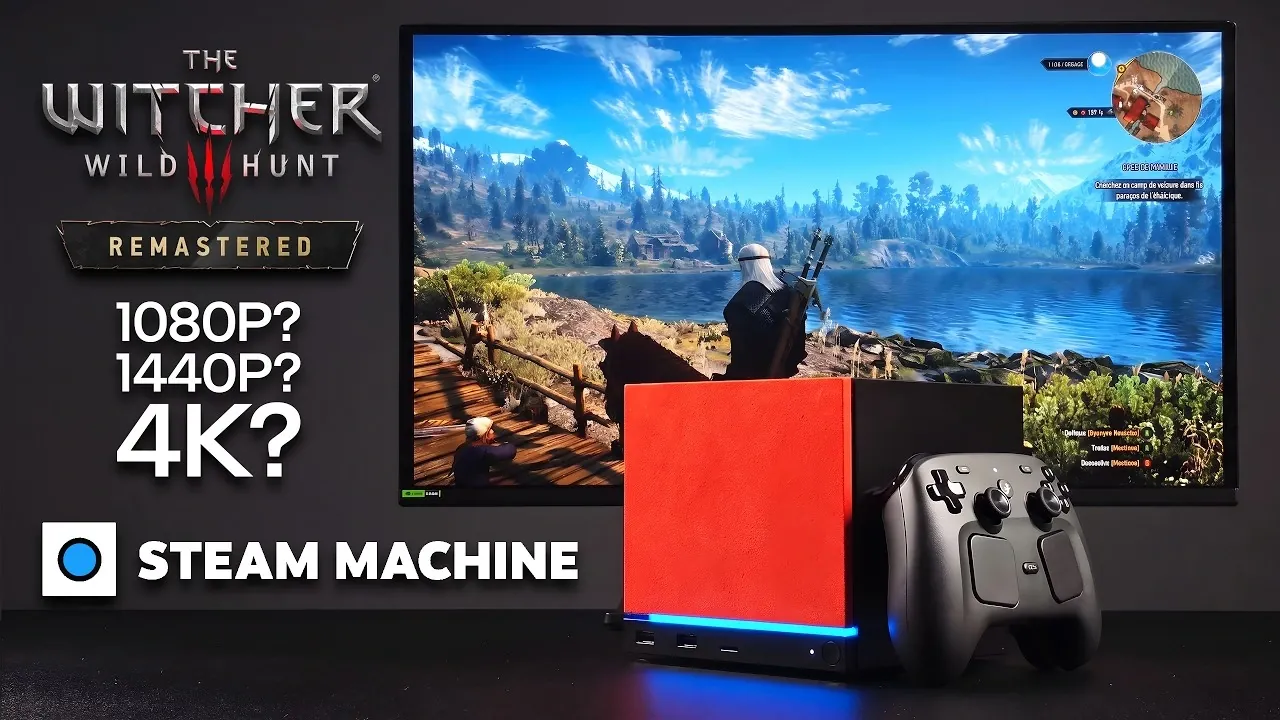
CD Projekt Red’s free remastered update for The Witcher 3: Wild Hunt introduces enhancements such as path tracing, upgraded textures and refined gameplay mechanics. These improvements elevate the visual and gameplay experience but also place greater demands on hardware. As ETA Prime highlights, the Steam Machine encounters significant performance issues with the remastered version. For instance, running the game at 1080p ultra settings without ray tracing results in inconsistent frame rates, while allowing ray tracing causes GPU instability, rendering the feature unusable.
Explore how the Steam Machine handles various settings and resolutions, including 1080p and 4K. Gain insight into the impact of FidelityFX Super Resolution (FSR) on performance, such as achieving over 70fps at 1080p ultra settings with FSR set to quality mode. Additionally, learn about the system’s challenges at higher resolutions and discover potential adjustments to improve playability on mid-range hardware.
What’s New in the Remastered Version?
TL;DR Key Takeaways :
- CD Projekt Red released a free remastered update for The Witcher 3: Wild Hunt, featuring advanced graphical and gameplay enhancements like path tracing, improved textures and refined animations.
- The update demands high-end hardware, with features like path tracing requiring GPUs such as the Nvidia RTX 5080 for optimal performance at 4K resolution and 60fps.
- Mid-range devices like the Steam Machine and Steam Deck struggle with the remastered version, particularly at higher resolutions and with ray tracing enabled, often resulting in performance bottlenecks.
- FidelityFX Super Resolution (FSR) and frame generation help improve performance on mid-range hardware, allowing smoother gameplay at 1080p or 1440p settings, but cannot fully compensate for hardware limitations.
- Future updates and optimizations may enhance performance on less powerful systems, but for now, the remastered version is best experienced on modern, high-performance hardware.
The remastered edition of The Witcher 3 has been carefully designed to use the capabilities of modern hardware, resulting in a substantial upgrade in both visuals and gameplay. Key features include:
- Path Tracing: This advanced lighting technique simulates realistic light behavior, creating highly immersive and lifelike environments. However, it requires high-end GPUs, such as the Nvidia RTX 5080, to achieve smooth performance at 4K resolution and 60fps.
- Enhanced Textures and Foliage: Textures have been significantly upgraded for sharper details, while foliage density and variety have been increased, making the game world feel more vibrant and alive.
- Improved Lighting: Enhanced global illumination and ambient occlusion provide more dynamic and realistic lighting effects, adding depth and atmosphere to every scene.
- Overhauled Animations: Character movements and combat animations have been refined, resulting in smoother and more natural interactions during gameplay.
- Revamped Skill System: Gameplay mechanics have been rebalanced, offering a more engaging and rewarding progression system for players.
These enhancements breathe new life into the game, offering a fresh experience for both returning players and newcomers. However, the increased hardware demands may pose challenges for older or less powerful systems, particularly the Steam Machine.
Can the Steam Machine Handle It?
The Steam Machine, equipped with an RDNA 3 GPU featuring 28 compute units and 8GB of VRAM, struggles to meet the demands of the remastered version. At 1080p ultra settings without ray tracing, frame rates frequently dip below 60fps, highlighting the hardware’s limitations. Allowing ray tracing is not a viable option, as it causes GPU crashes, rendering this feature inaccessible. Similar performance issues are observed on the Steam Deck, which shares comparable hardware constraints.
To address these challenges, FidelityFX Super Resolution (FSR) becomes an essential tool. When enabled, FSR allows the Steam Machine to achieve over 70fps at 1080p ultra settings with FSR set to quality mode. However, even with FSR, performance at higher resolutions remains a significant hurdle, limiting the device’s ability to fully showcase the remastered game’s potential.

Here is a selection of other guides from our extensive library of content you may find of interest on Steam Machine.
- Custom Mini-ITX Steam Machine Outperforms Valve’s by 81% for $200 Less
- High End Emulation on the Steam Machine Tested
- Compact Steam Machine Alternative : Built for 1440p Gaming
- Steam Machine Guide: How to Get Maximum Performance Out of the 6-Inch Cube
- Valve Hits 760,000 Yearly Steam Machine Sales Amid RAM Shortage
- Steam Machine Makes Couch Co-Op Feel Fresh Again : Proton, Lepton & FEX Support
- Steam Machine Exceeds Expectations: SteamOS, Solid Gaming Performance, Compact Design
- Upgrading Valve’s Steam Machine to 64GB RAM and 4TB Storage
- Steam Machine Hands on : New Console Struggles with Native 4K Gaming
- How to Upgrade Steam Machine SSD Storage with a 1TB Samsung 9100 Pro
Performance at 1440p and 4K
Testing at 1440p ultra settings reveals further performance bottlenecks. Without scaling, the Steam Machine averages just 33fps, resulting in inconsistent and choppy gameplay. Allowing FSR and frame generation improves performance, pushing frame rates above 60fps and delivering a smoother experience. However, the hardware struggles considerably at 4K ultra settings, achieving an average of only 14fps without scaling. Even with FSR and frame generation enabled, performance remains below 60fps, underscoring the Steam Machine’s limitations for high-resolution gaming.
These results highlight the challenges of running the remastered version on mid-range hardware. While FSR and frame generation offer some relief, they cannot fully compensate for the hardware’s inability to handle the game’s most demanding features, such as path tracing and 4K textures.
Hardware Limitations and Potential Optimizations
The Steam Machine’s RDNA 3 GPU, while capable for its time, is not designed to handle the intensive requirements of modern remastered titles at ultra settings and high resolutions. Valve’s initial claims of 4K 60fps performance with scaling have proven overly optimistic, as the hardware struggles to meet these benchmarks. Features like path tracing remain entirely out of reach for the Steam Machine and Steam Deck, requiring state-of-the-art GPUs like the RTX 5080 for smooth and consistent performance.
Future updates and optimizations from Valve could potentially improve performance on the Steam Machine and Steam Deck. Developers may also introduce additional performance modes or scaling options to make the game more accessible to players with mid-range hardware. For now, these devices are best suited for 1080p high or 1440p ultra settings with FSR and frame generation enabled, offering a balance between visual fidelity and performance.
The remastered version of The Witcher 3 demonstrates CD Projekt Red’s commitment to enhancing their flagship title for a modern audience. With features like path tracing, enhanced textures and refined animations, the update delivers a visually stunning and immersive experience. However, these advancements come with steep hardware requirements, making it a challenge for older or less powerful systems to keep up. For Steam Machine users, the optimal experience lies at 1080p high or 1440p ultra settings with FSR and frame generation enabled. While the hardware struggles with 4K gaming and ray tracing, future updates may help improve performance, making sure that more players can enjoy this remastered masterpiece.
Media Credit: ETA PRIME
Disclosure: Some of our articles include affiliate links. If you buy something through one of these links, Geeky Gadgets may earn an affiliate commission. Learn about our Disclosure Policy.
