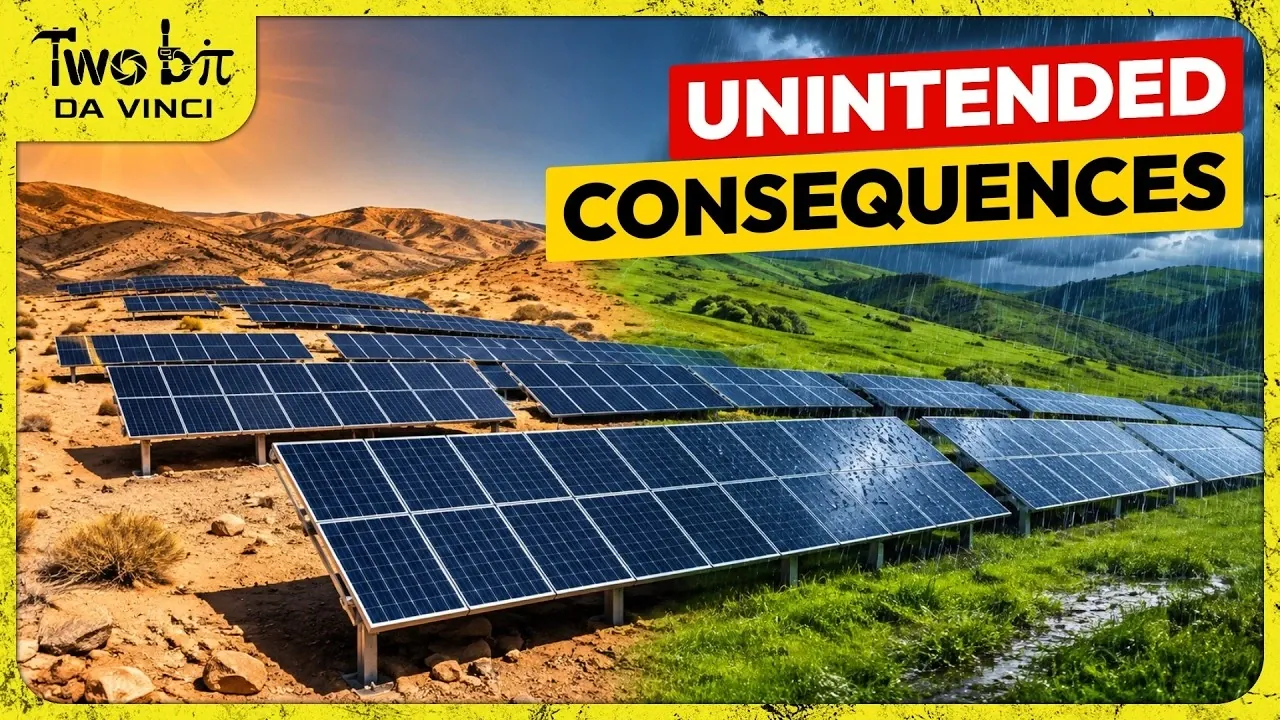
The UAE needs fresh water, and solar farms could potentially help bring rain to its desert. A weather model produced an average of 570,000 cubic metres of extra rain a day using two dark squares, each 20 kilometres across. The idea is that large, dark surfaces heat the air enough to help storms form, but the model used black-painted panels rather than working solar farms. Discover what makes the difference important, as well as how researchers plan to study the air around a real farm in Dubai, according to Two Bit da Vinci.
Solar Farms and Rain in the UAE Desert
TL;DR Key Takeaways :
- In a weather model, two dark squares 20 kilometres on each side produced an average of 570,000 cubic metres of extra rain daily.
- Squares 10 kilometres on each side produced no meaningful or statistically significant increase in modelled rainfall.
- A rough calculation found that a solar farm retains about 24 watts per square metre more heat than bare desert, versus 250 for the model’s black paint.
- A calculation found that solar electricity could produce about 10,000 times as much water through desalination as the modelled annual rain.
- Two Bit da Vinci found no measurements of extra rain or cloud from a real solar farm, while Dubai research will map air around one.
A weather model suggests that heating large areas of the UAE desert could increase rainfall. The researchers modelled dark-painted panels, which retain more heat than a solar farm that sends energy away as electricity.
In the UAE’s summer desert, sinking air and a layer of warmer air above it resist the upward movement needed to form storms. A sea breeze brings humid air inland from the Gulf and gives it some lift, but it does not always provide enough force to overcome that resistance, known as convective inhibition.
The UAE’s rain enhancement program funded Oliver Branch’s team at the University of Hohenheim in Germany to explore whether heating a large area of desert could add the lift needed. The researchers used a weather model detailed enough to simulate individual thunderstorms.
Large Dark Squares Produced Rain in the Model
Researchers placed two dark squares in the model, each 20 kilometres on a side, and replayed four summer days chosen partly because the air was already moderately unstable.
Across those runs, the squares produced an average of about 570,000 cubic metres of extra rain a day, enough to fill about 230 Olympic swimming pools. Much of the rain fell outside the squares, mainly downwind.
The paper claims that, with 10 such days a year, the extra rain could provide drinking water for 31,000 people, based on consumption of about 500 litres per person per day. Squares 10 kilometres on a side produced no meaningful or statistically significant increase in rain.
The smaller squares heated the air at roughly the same rate per square metre as the larger ones, but the air crossed them too quickly to gather enough heat. The result suggests that the size of a heated area matters as well as its temperature.

Here is a selection of other guides from our extensive library of content you may find of interest on energy.
- Google Partner Project Red Yields Only 40-60% of Target Power
- Proxima Fusion Plans the Alpha Stellarator for the Early 2030S
- China Stores 1,000 Megawatts in Massive 10-Hour CO2 Battery
- Fraunhofer Small Wind Turbines Top Conventional Output By 83%
- Google Project Suncatcher Uses Space Solar Panels for AI
Real Solar Panels Retain Less Heat
The model represented generic black-painted panels that reflected 5% of incoming sunlight and absorbed the rest. Desert solar panels were installed to generate electricity, not rain: a solar farm also absorbs sunlight, but sends some energy away as electricity rather than retaining it as heat.
A rough calculation for a UAE summer noon compared bare sand with a farm whose panels cover 40% of the ground. Both receive about 1,000 watts per square metre of sunlight, while the sand reflects around 30% and the panel glass about 7%.
On that basis, the farm absorbs about 92 watts per square metre more than the sand, close to the darkening observed at a UAE site in a 2024 satellite study. After electricity and wiring losses are accounted for, however, the farm retains only about 24 watts per square metre more heat than bare desert. That is roughly a tenth of the 250 watts retained by the model’s black paint.
Real farms do warm their surroundings a little. At a Tucson solar plant, night air was regularly 3-4°C warmer than over nearby natural desert.
Panel Height and Efficiency Affect the Heat
The way heat reaches the air may also matter. Solar panels typically sit about half a metre to just over a metre above the ground, where wind can carry heat sideways before it gathers. An airflow model at one North American solar farm showed the extra warmth had disappeared by about 5 to 18 metres above the ground.
Panel efficiency also affects how much sunlight becomes local heat: the more a panel turns into electricity, the less it leaves behind as warmth. Branch’s team suggests briefly stopping electricity delivery when conditions favour storms, so the panels convert more sunlight into heat. That would trade some electricity generation for a possible increase in heat available to the air.
Existing Solar Parks Compared With the Model
Only two solar parks with published areas reaching the model’s scale were identified, both in China: Talatan, at around 420 square kilometres, and another still being planned, at around 466 square kilometres. Both are inland, without a moisture-supplying sea breeze, while the largest farm identified near the Gulf was near Dubai, at 77 square kilometres.
Rain and Desalination Produce Different Returns
Reverse osmosis forces seawater through a membrane to produce fresh water, but produces about 1.4 cubic metres of brine per cubic metre of fresh water. Saudi Arabia, the UAE, Kuwait and Qatar produce over half the world’s desalination brine; rain leaves none.
A calculation scaling the UAE’s Al Dhafra solar plant up to the size of the model’s squares put annual output at 89 terawatt-hours, enough to desalinate 30 billion cubic metres of water a year. Against a few million cubic metres of modelled annual rain, that is about 10,000 times as much water.
Rain also has a cost to the farm itself. Ten extra cloudy days were estimated to cut output by 1-2%, worth $10-25 million in electricity, against rain valued at about $1 million.
A coastal farm would probably not take rain from elsewhere because its moisture comes from sea vapour. Inland, limited moisture could instead be redistributed, leaving another place drier.
Dubai Research Will Map Air Around a Farm
The UAE is funding work beside a real solar farm in Dubai to investigate the idea. Laser-based lidar instruments will map temperature, humidity and wind in three dimensions, from the Dubai Solar Park toward the coast and up to cloud level.
The distinction between a dark surface in a model and a working solar farm matters to the rain claim. Two Bit da Vinci notes that, as far as it could find, nobody has measured extra rain or cloud from a real solar farm. The channel’s conclusion is that a sufficiently large farm might make rain, but there is not much evidence for it.
We would treat the rain numbers as a thought experiment. The model used generic black surfaces, not real solar farms, and real farms behave differently. We would weigh the headline claim against that gap and look for measured results before believing it.
For water supplies, solar electricity offers another route besides rain: it can power desalination, though that leaves brine. For anyone following the UAE’s water future, it is worth watching what the Dubai research finds about the air around a working solar farm.
Media Credit: Two Bit da Vinci
Disclosure: Some of our articles include affiliate links. If you buy something through one of these links, Geeky Gadgets may earn an affiliate commission. Learn about our Disclosure Policy.
