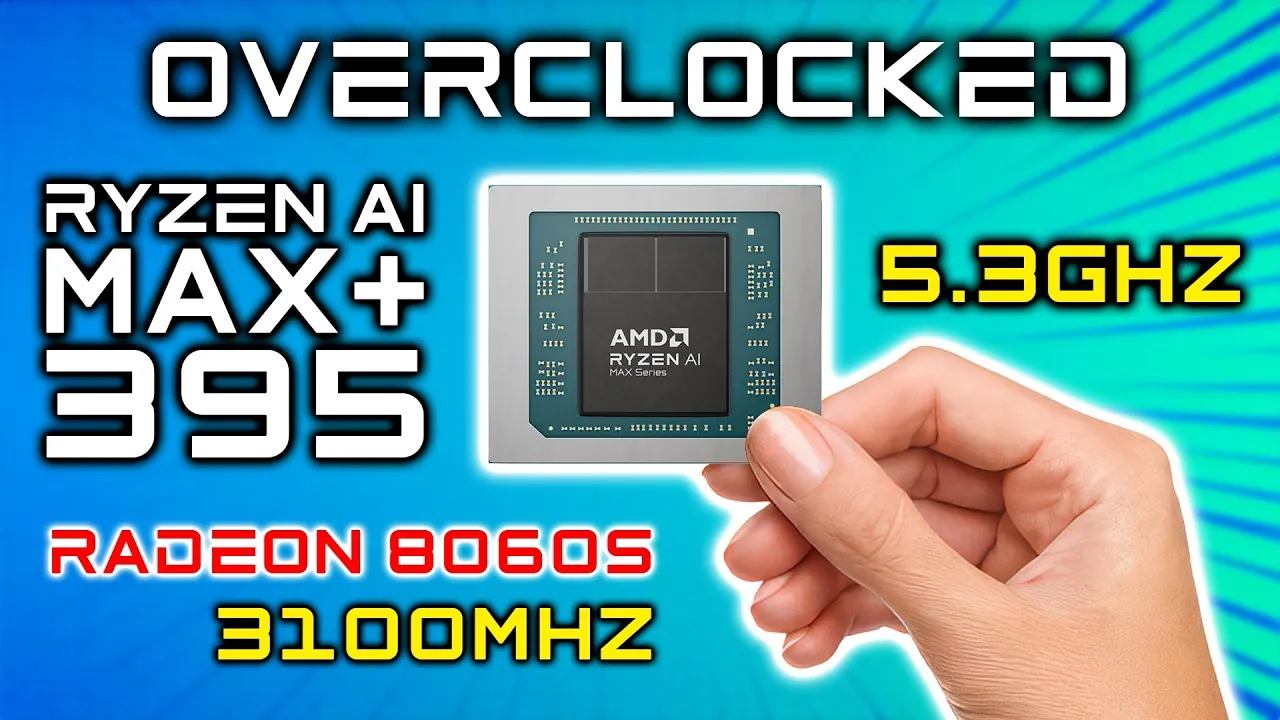
What happens when you take a processor already designed to push boundaries and push it even further? The AMD Ryzen AI Max Plus 395, with its 16 cores, 32 threads, and integrated Radeon 8060SIG iGPU, is no ordinary chip, it’s a powerhouse built for versatility. But in a world where performance enthusiasts are never satisfied with “good enough,” we decided to see just how far this processor could go. By cranking up its CPU and GPU clocks, tweaking its thermal design power (TDP), and fine-tuning every possible setting, we unlocked a level of performance that’s as thrilling as it is unexpected. The results? Let’s just say the combination of raw power and the compact Beink GTR9 mini PC delivered a ride that was nothing short of wild.
Below ETA Prime reveals the highs, lows, and surprises of overclocking the Ryzen AI Max Plus 395. You’ll discover how this compact setup managed to deliver desktop-level performance, the delicate balance between heat management and power, and whether the integrated Radeon 8060SIG iGPU can truly hold its own in demanding gaming and creative workloads. Along the way, we’ll share the benchmarks, real-world gaming tests, and the challenges of pushing hardware to its limits, all while staying within the constraints of a mini PC. If you’ve ever wondered what happens when innovative hardware meets the relentless pursuit of performance, this coverage is for you. Sometimes, the best stories are the ones where the limits are redefined.
Key Features of the Ryzen AI Max Plus 395
TL;DR Key Takeaways :
- The AMD Ryzen AI Max Plus 395, paired with the Beink GTR9 mini PC, offers a compact yet powerful platform with 16 cores, 32 threads, and an integrated Radeon 8060SIG iGPU, suitable for gaming, productivity, and creative workloads.
- Overclocking experiments increased CPU boost clocks to 5.3 GHz, GPU clock speeds to 3100 MHz, and TDP to 180 watts, achieving a balance between performance gains and thermal constraints.
- Performance benchmarks, including Geekbench 6, Cinebench R24, and 3DMark Time Spy, showed measurable improvements, highlighting the processor’s scalability under optimized conditions.
- Gaming tests demonstrated the integrated Radeon 8060SIG iGPU’s ability to handle demanding titles like Forza Horizon 5, Doom: The Dark Ages, and Cyberpunk 2077 at high settings with technologies like FidelityFX Super Resolution (FSR).
- Thermal management was critical due to increased heat output during overclocking, with the CPU peaking at 84.9°C, emphasizing the importance of effective cooling solutions in compact systems like the Beink GTR9 mini PC.
The Ryzen AI Max Plus 395 stands out as a high-performance processor tailored for demanding tasks. Its base clock of 5.1 GHz and integrated Radeon 8060SIG iGPU make it a versatile choice for users seeking a balance between CPU and GPU performance. When paired with the Beink GTR9 mini PC, the system provides advanced BIOS options, allowing users to fine-tune performance settings. This combination delivers desktop-level power in a small form factor, making it ideal for overclocking experiments.
What makes this processor particularly appealing is its ability to handle a wide range of applications, from gaming to content creation. The integrated Radeon 8060SIG iGPU offers respectable graphics performance, while the advanced BIOS features of the Beink GTR9 allow users to push the hardware further. This compact yet capable setup is a testament to how modern processors can deliver high performance without requiring a large footprint.
Overclocking Methodology
To explore the full potential of the Ryzen AI Max Plus 395, we focused on three critical areas of overclocking:
- CPU Boost Clocks: Increased from the default 5.1 GHz to 5.3 GHz, providing faster processing speeds for demanding tasks.
- GPU Clock Speeds: Raised to 3100 MHz, enhancing the performance of the integrated Radeon 8060SIG iGPU for gaming and graphical workloads.
- TDP Adjustment: Increased to 180 watts, allowing the processor to sustain higher performance levels under heavy loads.
These adjustments were achieved using a combination of advanced BIOS settings and third-party tuning software. Optimizing the fan curves was a crucial step to ensure thermal stability during the overclocking process. By carefully balancing performance gains with heat management, we achieved a stable configuration suitable for benchmarking and real-world applications.
Ryzen AI Max 395 Overclocking Demonstration

Check out more relevant guides from our extensive collection on AMD Ryzen AI that you might find useful.
- AMD Ryzen AI Max Plus 395 Overview : Powerful Handheld Gaming
- ASRock AI 350 SBC Review: AMD Ryzen AI 7 350 Performance
- What is the AMD Ryzen AI and why does it matter?
- AMD Ryzen Ai Max Plus 395 Mini PC : Specs, Performance
- Minisforum EliteMini AI370 AMD Ryzen AI 9 HX 370 Mini PC
- New Framework Laptop 16 : NVIDIA RTX 5070 & AMD Ryzen AI
- ASRock 4X4 BOX 7040 mini PC with AMD Ryzen AI
- AceMagic AMD Ryzen AI HX370 Mini PC: Compact Gaming Beast
- How to Build a Powerful Ryzen AI Max 395 Portable Gaming PC in
- AMD Ryzen 8000G next generation desktop processors
Performance Benchmarks and Observations
Overclocking the Ryzen AI Max Plus 395 resulted in measurable improvements across various benchmarks. These tests provided insights into how the processor scales under optimized conditions:
- Geekbench 6: Both single-core and multi-core scores showed noticeable improvements, reflecting enhanced efficiency and processing power.
- Cinebench R24: Rendering performance saw modest gains, showcasing the CPU’s ability to handle intensive creative workloads.
- 3DMark Time Spy: Incremental increases in total, CPU, and GPU scores highlighted the impact of overclocking on graphics performance.
While the performance gains were not dramatic, they demonstrated the processor’s ability to scale effectively when pushed beyond its stock settings. These results underscore the Ryzen AI Max Plus 395’s potential for users who require additional performance for specific tasks.
Gaming Performance and Real-World Applications
To evaluate the practical benefits of overclocking, we tested the system with several popular games. The results highlighted the capabilities of the integrated Radeon 8060SIG iGPU:
- Forza Horizon 5: Delivered smooth gameplay at 4K extreme settings, showcasing the iGPU’s ability to handle graphically demanding scenarios.
- Doom: The Dark Ages: Ran seamlessly at 1440p with FidelityFX Super Resolution (FSR) enabled, boosting frame rates while maintaining visual quality.
- Cyberpunk 2077: Achieved playable performance at 1440p with ray tracing ultra settings and FSR frame generation, demonstrating the system’s capability to handle innovative graphics technologies.
These gaming tests revealed that the Radeon 8060SIG iGPU, when paired with advanced upscaling technologies like FSR, can deliver a satisfying gaming experience even at higher resolutions. This makes the Ryzen AI Max Plus 395 a viable option for gamers who prioritize compact systems without sacrificing performance.
Thermal Management and Power Considerations
Overclocking inevitably increases power consumption and heat output, and the Ryzen AI Max Plus 395 was no exception. By raising the TDP to 180 watts, the processor maintained peak performance during heavy workloads. However, this came at the cost of higher temperatures, with the CPU peaking at 84.9°C during stress tests. Effective cooling solutions, such as high-performance thermal paste and optimized airflow, were essential to prevent thermal throttling and ensure system stability.
The compact design of the Beink GTR9 mini PC presented additional challenges in managing heat. Despite these limitations, the system performed reliably under sustained loads, demonstrating the importance of balancing performance with thermal efficiency.
Challenges and Future Testing Directions
While overclocking the Ryzen AI Max Plus 395 delivered measurable performance gains, the improvements were moderate due to the constraints of the Beink GTR9’s compact design. The limited thermal headroom and power delivery capabilities of the mini PC prevented more aggressive overclocking. Nonetheless, the processor’s stock performance remains impressive, particularly for an integrated graphics unit.
Looking ahead, further testing could explore alternative operating systems, such as Steam OS, to evaluate the system’s versatility. Additionally, subjecting the processor to more demanding scenarios, including 4K gaming and advanced productivity tasks, could provide deeper insights into its capabilities. These future experiments will help uncover the full potential of the Ryzen AI Max Plus 395 and its suitability for various use cases.
Media Credit: ETA PRIME
Disclosure: Some of our articles include affiliate links. If you buy something through one of these links, Geeky Gadgets may earn an affiliate commission. Learn about our Disclosure Policy.
