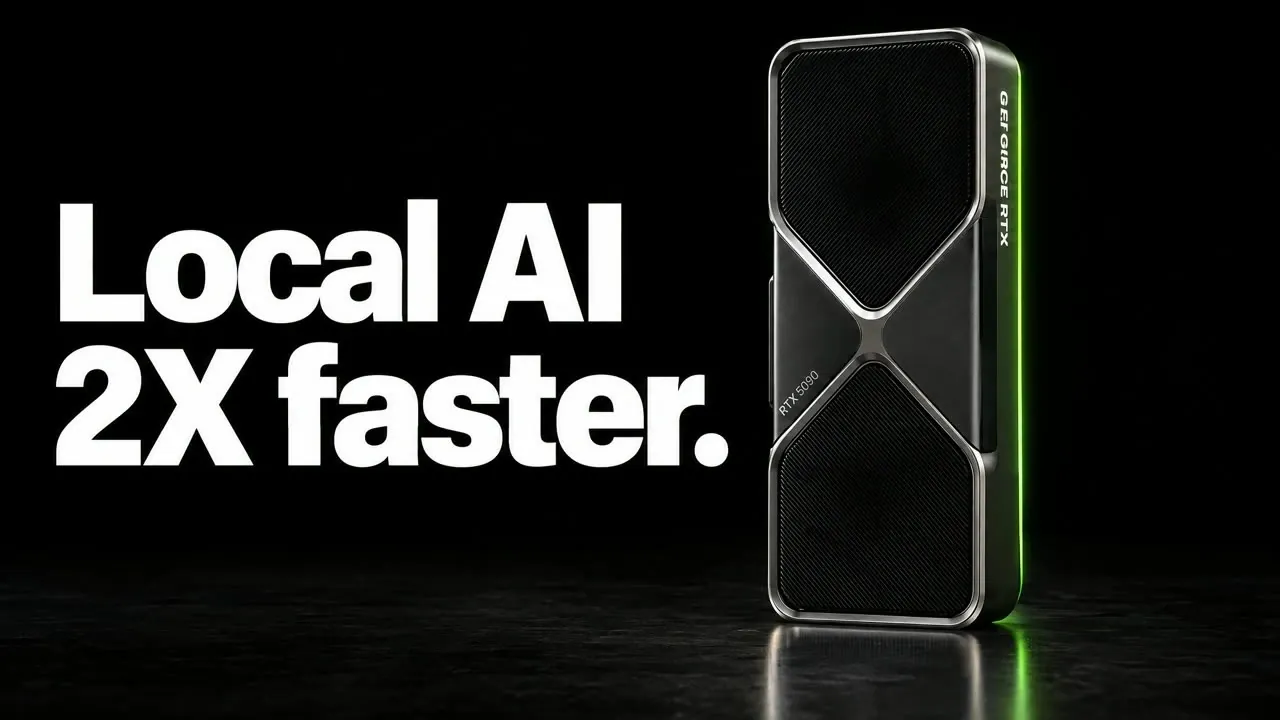
NVIDIA’s introduction of the NVFP4 format for its Blackwell GPUs offers a compact four-bit floating-point representation designed to optimize AI workloads. As highlighted by The Stack, this format aims to improve both computational performance and memory efficiency, potentially doubling processing speeds in certain scenarios. NVFP4 achieves this by compressing model weights and using shared multipliers to streamline calculations, making it particularly useful for users managing large-scale AI models. However, its benefits are contingent on hardware compatibility, as older GPUs lack the native support required for these performance gains.
In this breakdown, you’ll explore how NVFP4 impacts key areas like memory usage, accuracy trade-offs, and specific workload performance. Learn how to assess its real-world benefits by testing it on your tasks, comparing it against traditional formats like FP16 or FP32 and making sure your software stack is optimized for Blackwell GPUs. By understanding these factors, you can determine whether NVFP4 aligns with your needs and whether its advantages justify the investment in compatible hardware.
What is NVFP4 and Why Does It Matter?
TL;DR Key Takeaways :
- NVIDIA’s NVFP4 format introduces a compact four-bit floating-point representation, enhancing computational performance and memory efficiency for AI workloads, particularly on Blackwell GPUs.
- NVFP4 reduces memory consumption by compressing AI model weights, allowing larger models or longer input contexts without requiring hardware upgrades.
- Performance improvements with NVFP4 vary by task, with significant gains in prompt processing but more modest benefits in other areas like reply generation.
- While NVFP4 optimizes memory usage, it may introduce trade-offs in precision, making it less suitable for tasks requiring high accuracy, such as scientific research.
- Adopting NVFP4 requires Blackwell GPUs, compatible software and workload-specific testing to assess its real-world benefits and limitations.
NVFP4 is a specialized four-bit floating-point format engineered to store AI model weights more efficiently. By compressing data into this compact representation, NVFP4 reduces memory consumption while maintaining computational throughput. This is achieved through the use of shared multipliers for clusters of values, which help minimize rounding errors and streamline calculations. For users managing large-scale AI models, this innovation offers the potential to fit more data into limited VRAM, allowing longer input contexts or larger models without requiring hardware upgrades.
The importance of NVFP4 lies in its ability to address the growing demands of AI workloads. As models become increasingly complex, memory constraints often limit their scalability. NVFP4 provides a solution by optimizing memory usage without significantly compromising performance, making it a valuable tool for resource-intensive applications.
Who Can Use NVFP4?
To fully use NVFP4, you’ll need NVIDIA’s Blackwell GPUs, which are equipped with specialized Tensor Cores designed to handle this format natively. These Tensor Cores enable NVFP4 calculations to achieve the promised performance gains. However, older GPUs lack this native support, relying instead on fallback methods that are significantly less efficient.
Before adopting NVFP4, it’s essential to ensure your hardware is compatible and that your software stack is configured to support the format. This includes updating your runtime environment and verifying that your AI frameworks are optimized for NVFP4. Without these prerequisites, the potential benefits of NVFP4 may not be fully realized.

Take a look at other insightful guides from our broad collection that might capture your interest in NVIDIA GPUs.
- Valve Adds Initial NVIDIA GPU Driver Support to SteamOS
- Free SteamOS 3.9 Turns Your Mini PC Into a Steam Machine
- Apple’s Mac Studio Unified Memory Beats NVIDIA’s 32GB RTX 5090 Limit
- Valve Brings Official SteamOS Support to NVIDIA Desktop GPUs
- Build A Local Private AI Rig on a Budget : Learn Which GPUs Run AI Most Effectively
- NVIDIA RTX 5060 : Best Low-Profile Graphics Card for Gamers
- NVIDIA Rubin Platform Adds NVLink 6 at 3.6 TBps & HBM4 with 22 TBps Bandwidth
- Linux vs Windows 11 : Proton PC Gaming GPU Benchmarks on Bazzite
- SteamOS 3.9 Brings 4K Resolution at 120 FPS to AMD GPUs
- What We Know About Apple’s Highly Anticipated Foldable iPhone
Does NVFP4 Really Double AI Speed?
NVIDIA’s claim that NVFP4 can double AI processing speed requires careful examination. The actual performance improvements depend on the specific workload and use case. Here’s a breakdown of how NVFP4 impacts different tasks:
- Prompt processing tasks: NVFP4 delivers an average speed boost of 46% on Blackwell GPUs, making it particularly effective for initial data processing stages.
- Reply generation tasks: Gains are more modest, with performance improvements of around 1% in these scenarios.
- Overall throughput: Benchmarks indicate improvements ranging from 9% to 12% for certain workloads.
The most significant gains are observed in tasks that involve heavy computation during the initial processing stages. For other types of workloads, the performance boost may be less pronounced. It’s important to test NVFP4 on your specific tasks to determine whether the claimed speed improvements align with your expectations.
How Does NVFP4 Optimize Memory Usage?
One of the standout features of NVFP4 is its ability to reduce VRAM usage. By compressing model weights into a four-bit format, NVFP4 allows users to fit larger models or longer input sequences into the same memory footprint. This is particularly beneficial for applications that require extensive computational resources, such as natural language processing or large-scale image recognition.
However, the actual memory savings depend on several factors, including runtime configurations and the specific characteristics of your workload. For example, models with highly variable weight distributions may not compress as efficiently as those with more uniform data. To fully understand the memory optimization benefits of NVFP4, it’s crucial to test it with your specific models and configurations.
What About Accuracy?
While NVFP4 offers significant efficiency gains, these come with potential trade-offs in precision. The format’s reliance on shared multipliers and reduced bit depth can introduce approximations, which may affect the accuracy of certain computations. Early testing suggests that traditional formats like FP16 or FP32 may retain higher accuracy in scenarios that demand precise calculations, such as scientific research or sensitive AI applications.
For tasks where accuracy is critical, it’s essential to evaluate whether NVFP4 meets your quality standards. This may involve running comparative tests between NVFP4 and other formats to assess the impact on your specific use cases. In some instances, the trade-offs in precision may outweigh the benefits of improved performance and memory efficiency.
How to Decide If NVFP4 is Right for You
Adopting NVFP4 requires careful consideration of your hardware, software and workload requirements. Follow these steps to determine whether NVFP4 is the right choice for your needs:
- Test NVFP4 on your workloads: Measure its impact on speed, accuracy and memory usage to understand its real-world benefits.
- Ensure compatibility: Verify that your runtime software and AI frameworks are optimized for NVFP4 and Blackwell GPUs.
- Compare with traditional formats: Evaluate NVFP4’s performance against FP16 or FP32 to assess trade-offs in precision and efficiency.
It’s important to note that NVFP4 is not a one-size-fits-all solution. If your current setup performs reliably on existing hardware, the benefits of switching to NVFP4 may not justify the associated costs. Carefully weigh the potential advantages against the limitations to make an informed decision.
Limitations to Keep in Mind
While NVFP4 offers promising advantages, it’s not without its limitations. Here are some key factors to consider:
- Hardware dependency: Performance gains are tied to Blackwell GPUs, leaving users with older hardware unable to fully benefit from NVFP4.
- Benchmark variability: Published benchmarks often lack detailed context, making it challenging to predict NVFP4’s impact on specific tasks.
- Cost considerations: Upgrading to Blackwell GPUs solely for NVFP4 may not be cost-effective unless your workloads demand its unique capabilities.
These limitations underscore the importance of evaluating NVFP4 within the context of your specific needs and resources. While it offers significant potential, its benefits are not universally applicable.
Is NVFP4 Worth It?
NVIDIA’s NVFP4 format represents a noteworthy advancement in AI workload optimization, particularly for users equipped with Blackwell GPUs. Its ability to reduce memory usage and improve processing speeds makes it an attractive option for certain tasks. However, its effectiveness depends heavily on hardware compatibility, software configuration and the precision requirements of your workloads.
Before adopting NVFP4, it’s essential to thoroughly test its impact on your AI models. By doing so, you can ensure that it aligns with your performance and accuracy goals, allowing you to make the most of this innovative format.
Media Credit: The Stack
Disclosure: Some of our articles include affiliate links. If you buy something through one of these links, Geeky Gadgets may earn an affiliate commission. Learn about our Disclosure Policy.
